Analysis of Major Travel Agencies' Summer Season Booking Rates
Preference for Relatively Long-Distance Trips During Vacation and Holiday Seasons
Japan-Bound Overseas Travelers Rank First Overall
Recovered to 80% of Pre-COVID-19 Levels Compared to Same Period
With the endemic phase (periodic outbreaks of infectious diseases) leading to a rapid increase in overseas travelers and the unprecedented depreciation of the Japanese yen (Yen devaluation) occurring simultaneously, the rate of visits by our citizens to Japan has reached pre-COVID-19 levels. Preference was initially high for relatively nearby regions such as Osaka and Kyushu, but as the vacation and summer holiday season approaches, demand is increasing for relatively distant places like Hokkaido.
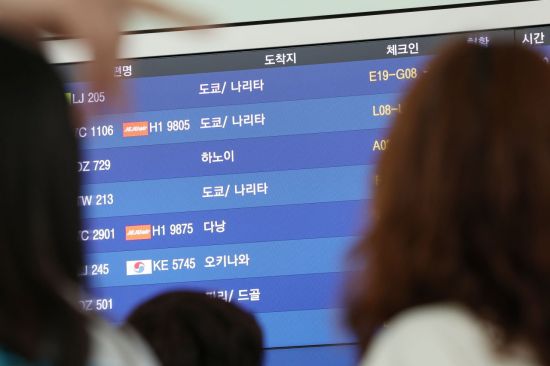 On the morning of the 22nd, information about a flight to Japan was displayed on the electronic board at Incheon International Airport Terminal 1. [Image source=Yonhap News]
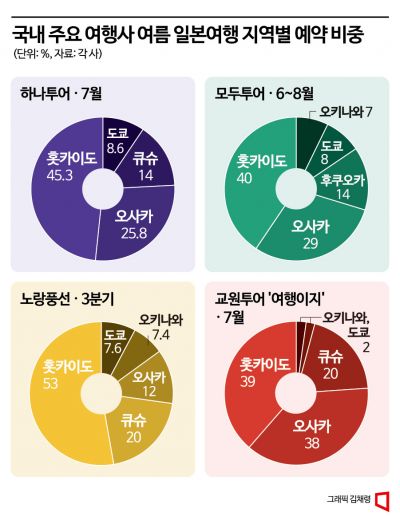
According to the travel industry on the 22nd, among Hana Tour's Japan travel bookings in July, the proportion of travelers visiting Hokkaido ranked first at 45.3%. This was followed by Osaka (25.8%), Kyushu (14%), and Tokyo (8.6%). Previously, in May and June, Osaka and Kyushu held the first and second places in regional booking shares for Japan travel. A Hana Tour representative explained, "From May to June, there were many short holidays of about three days, including Children's Day, Buddha's Birthday, and Memorial Day, which led to high demand for short-distance trips, making Osaka and Kyushu popular. Hokkaido is the farthest region from our country among Japanese areas and is considered a must-visit destination among travelers, so bookings concentrate during the summer peak season for 4-5 day trips." To meet this demand, charter flights are also operated.
Modetour also saw Osaka as the top destination in May with 36% of bookings, but from June to August, Hokkaido recorded the highest booking rate at 40%. A Modetour representative said, "With the easing of entry restrictions and positive factors such as the yen depreciation, the popularity of travel to Japan continues to increase. Hokkaido's average daytime high temperature in midsummer does not exceed 27 degrees Celsius, making it relatively cool, and it offers many attractive tourist spots not only in Sapporo city but also in the surrounding areas, making it the most popular destination in Japan during the summer peak season."
For Norang Balloon, Kyushu was the most popular region in Japan during May and June with 30%, but in the third quarter, which includes the summer vacation season, Hokkaido's booking rate reached 53%, ranking first. According to monthly booking rates from Kyowon Tour's Travel Easy, Osaka had the highest preference at over 40% in May and June, but Hokkaido led in July with 39%. Demand for Hokkaido products from Travel Easy has been rapidly increasing as the weather gets warmer, rising from 12% in May to 19% in June and 39% in July. Interpark Triple also saw the highest proportion of issued air tickets to Osaka at 12% in May, but ranking changes are expected with the summer vacation season.
As of this day, the value of the Japanese yen against the Korean won is in the low 910 won range, marking the lowest level in eight years since June 2015 (lowest 100 yen = 880 won). Consequently, demand for yen, considering travel to Japan and foreign exchange gains, is also surging. Last month, the 'yen sell amount' at the four major banks (KB Kookmin, Shinhan, Hana, Woori) was 30.167 billion yen (approximately 273.2 billion won), an increase of 7.328 billion yen compared to April (22.839 billion yen). This is the scale of currency exchange where banks receive Korean won and provide yen according to customer demand, which is 4.8 times the amount during the same period last year (6.285 billion yen).
Since the endemic phase, South Korea is the country with the highest number of overseas travelers visiting Japan worldwide. According to the Japan National Tourism Organization (JNTO), the number of Koreans visiting Japan from January to May this year was 2,583,400, nearly twice that of Taiwan (1,381,600), ranking first. This represents an approximately 102-fold increase compared to the same period last year and has recovered to about 80% of the 3,250,791 visitors during the same period in 2019 before the COVID-19 outbreak.
A travel industry official predicted, "With the continuous expansion of flight routes and the yen depreciation allowing relatively lower costs for travel and shopping, the number of visitors to Japan is expected to continue increasing."
© The Asia Business Daily(www.asiae.co.kr). All rights reserved.


















