Democratic Party Holds Forum on Equal Pay for Equal Work with Two Major Labor Unions
The opposition party has expressed its intention to participate in discussions on the legislation of 'Equal Pay for Equal Work of Equal Value,' which the ruling party has announced it will pursue. While major labor unions have raised questions about the ruling party's intentions, they have also expressed a principle willingness to participate in the discussions.
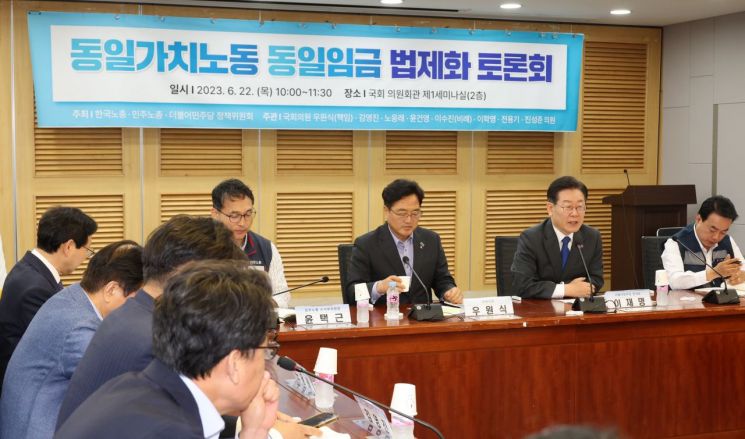
At the 'Equal Pay for Equal Work of Equal Value Legislation Forum' held at the National Assembly on the 22nd, Woo Won-sik, a member of the Democratic Party of Korea who chaired the forum, said at the conclusion, "This time, let's make an effort to make good use of the opportunity created by the ruling party to reach a conclusion with substantial progress." This indicated his willingness to bring the Labor Standards Act proposed by Kim Hyung-dong of the People Power Party, which includes 'Equal Pay for Equal Work of Equal Value,' to the discussion table.
The Labor Standards Act, which Kim introduced as the main sponsor on the 31st of last month, adds employment type to the list of prohibited discrimination grounds alongside nationality, religion, and social status. It also includes provisions guaranteeing equal pay for equal work of equal value among workers with different employment types within the same business. This is the first time a conservative party has proposed the principle of equal pay for equal work of equal value.
The academic community also expressed skepticism about the ruling party's intentions but stated that participating in the discussions would not be detrimental.
Professor Kwon Oh-sung of Sungshin Women's University, who presented at the forum, said, "Kim's bill prohibits discrimination based on employment type and further guarantees the principle of 'equal pay for equal work of equal value' regarding wage discrimination based on employment type, so as a scholar, I find it difficult to oppose it."
Professor Kwon added, "Under the current Labor Standards Act framework, Kim's legislation alone does not allow employers to unilaterally change the wage system from seniority-based to job-based pay." He evaluated that "contrary to some labor groups' concerns, Kim's bill is unlikely to have any concrete impact on wage system reforms." However, he explained, "Kim's bill has limitations in effectively addressing the core issues of the 'dual labor market structure,' such as the gap in working conditions between primary and subcontracted workers and disparities based on company size."
Yoo Jung-yeop, head of policy at the Federation of Korean Trade Unions (FKTU), who participated as a discussant, said, "Given the 69-hour workweek advocated under the guise of labor reform, the job performance-centered wage system reform, and demands for union accounting books under the banner of the rule of law, I was very skeptical about Kim's bill on equal pay for equal work of equal value." However, he added, "Regardless of the intent, the bill represents a significant advancement."
Yoo expressed hope that "this bill will serve as an opportunity to discuss ways to legally establish the principle of equal pay for equal work of equal value to practically improve the dual labor market structure and discrimination between regular and non-regular workers in Korea." However, he also mentioned, "For the principle of equal pay for equal work of equal value to function effectively beyond legal enactment at the workplace, an institutional foundation must be established to actively facilitate labor-management agreements, if not sectoral collective bargaining, otherwise it will be difficult to operate in practice."
Jeong Kyung-eun, a research fellow at the Democratic Labor Research Institute of the Korean Confederation of Trade Unions (KCTU), who also participated as a discussant, noted that the two major labor unions have either withdrawn from or not participated in the Presidential Economic, Social, and Labor Council. Referring to the social dialogue body established under the National Assembly during the past public servant pension reform that achieved results, she suggested, "If it is only for the bill, it might be necessary to create a one-point social dialogue body under the National Assembly."
However, both labor unions and political circles also raised questions about the ruling party's intentions and expressed concerns.
Lee Jae-myung, leader of the Democratic Party, who gave a congratulatory speech at the forum, said, "It is irrational, unjust, detrimental to social integration, and a cause of conflict and division that non-regular workers are treated differently for unreasonable reasons despite doing the same work and producing the same results at the same workplace." He added, "In the long run, to boost labor motivation, common sense must be restored so that equal pay is given for equal work of equal value." However, Lee also said, "Fortunately, the government and ruling party are making such claims, but some suspect that their true intention is to lower standards." He added, "I hope that is not the case."
Kim Dong-myung, chairman of the Federation of Korean Trade Unions, in a written congratulatory message, said, "I suspect the bill is intended to divide workers and incite anti-union sentiment to push through the government's current wage system reform, rather than being a genuine bill." He also expressed hope that "various discussions will proceed on the proper legislative approach to the principle of equal pay for equal work."
Ang Kyung-soo, chairman of the Korean Confederation of Trade Unions, in a written congratulatory message, said, "Having fought for over 20 years to abolish non-regular employment and discrimination as the top priority, KCTU is struggling to decide whether to welcome Kim's amendment or dismiss it as another misleading show." However, he also expressed sincere hope that "the amendment will resolve the reality where workers in the same workplace are discriminated against because they are non-regular workers, especially women and migrant workers who receive much lower wages despite doing the same work."
© The Asia Business Daily(www.asiae.co.kr). All rights reserved.

















