Ministry of Science and ICT to Announce Next Year's Calendar Highlights on the 22nd
68 Public Holidays, 5 Long Weekends, etc.
Next year, February will have one more day than this year, making a total of 366 days in the year.
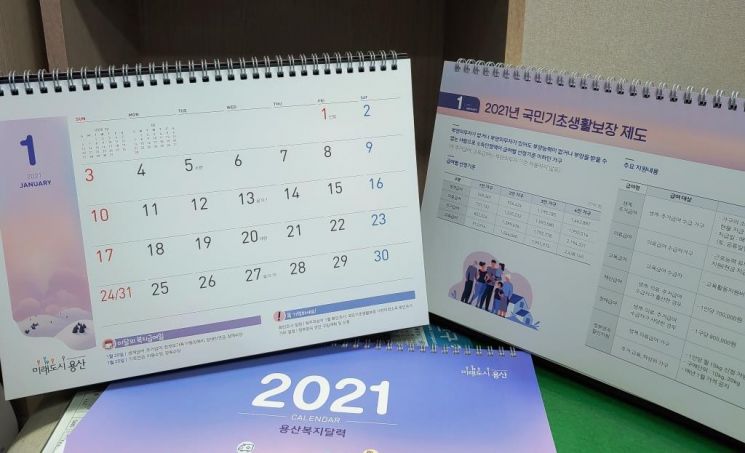
The Ministry of Science and ICT announced the 2024 calendar essentials, which serve as the basis for producing South Korea's calendar for the year 2024 (Dangi 4357).
The annual cycle based on celestial movements (tropical year) is approximately 365.2422 days. The solar calendar we use (Gregorian calendar) basically includes a leap year every four years. At the same time, if the year of the Common Era is divisible by 100, it is a common year, but if it is also divisible by 400, it is a leap year. As a result, there are a total of 97 leap years in 400 years. The length of a year in this calendar system is 365.2425 days.
The total number of public holidays marked in red on the 2024 calendar is 68 days. This includes 52 Sundays and 18 public holidays such as National Foundation Day and Lunar New Year, totaling 70 days, but since Lunar New Year (February 11) and Children's Day (May 5) fall on Sundays, the total is reduced. The 22nd general election held on April 10 is also included.
For institutions implementing a five-day workweek, the total number of holidays is 119 days. Adding 52 Saturdays to the 68 public holidays results in 120 days off, but excluding one day where a public holiday overlaps with Saturday (the second day of Lunar New Year holiday on February 10), the actual total number of holidays is 119 days. This is 2 days more than this year (117 days). Based on the five-day workweek, there are a total of 5 extended holidays lasting three days or more: December 30, 2023 to January 1, 2024 (Saturday, Sunday, and January 1, 3 days), February 9 to 12 (Lunar New Year holiday and substitute holiday, 4 days), March 1 to 3 (Independence Movement Day and weekend, 3 days), May 4 to 6 (Children's Day substitute holiday and weekend, 3 days), and September 14 to 18 (Chuseok holiday and Sunday, 5 days).
The major traditional holidays are Lunar New Year (Lunar January 1) on February 10 (Saturday), Jeongwol Daeboreum (Lunar January 15) on February 24 (Saturday), Dano (Lunar May 5) on June 10 (Monday), Chilseok (Lunar July 7) on August 10 (Saturday), and Chuseok (Lunar August 15) on September 17 (Tuesday). Additionally, Hansik is on April 5 (Friday), Chobok on July 15 (Monday), Jungbok on July 25 (Thursday), and Malbok on August 14 (Wednesday).
Following last year, this year's calendar essentials also include local public holidays. Local public holidays are designated by local governments to commemorate historical events that occurred in their regions according to the "Regulations on Local Public Holidays," and are days when local government offices are specially closed.
The local public holidays included in the calendar essentials are Jeju Special Self-Governing Province's April 3rd Incident Memorial Day (April 3), Gwangju Metropolitan City's May 18 Democratic Uprising Memorial Day (May 18), and Jeollabuk-do Jeongeup City's Donghak Peasant Revolution Memorial Day (May 11).
For more details, information can be found starting from the 23rd in the Official Gazette and on the websites of the Ministry of Science and ICT and the Korea Astronomy and Space Science Institute's Astronomy and Space Knowledge Information portal.
© The Asia Business Daily(www.asiae.co.kr). All rights reserved.
![Clutching a Stolen Dior Bag, Saying "I Hate Being Poor but Real"... The Grotesque Con of a "Human Knockoff" [Slate]](https://cwcontent.asiae.co.kr/asiaresize/183/2026021902243444107_1771435474.jpg)
















