Most Notices Attempted to Sell at 2 to 3 Times the Price
"Selling 30kg of 2010 Shinan solar salt for 1.5 million KRW."
The shock in the salt market stirred by the controversy over the discharge of contaminated water from the Fukushima nuclear power plant in Japan has spread to secondhand trading sites. As it has become difficult to find salt not only in offline marts but also in online shopping malls, consumers have started looking for salt on secondhand trading platforms as well.
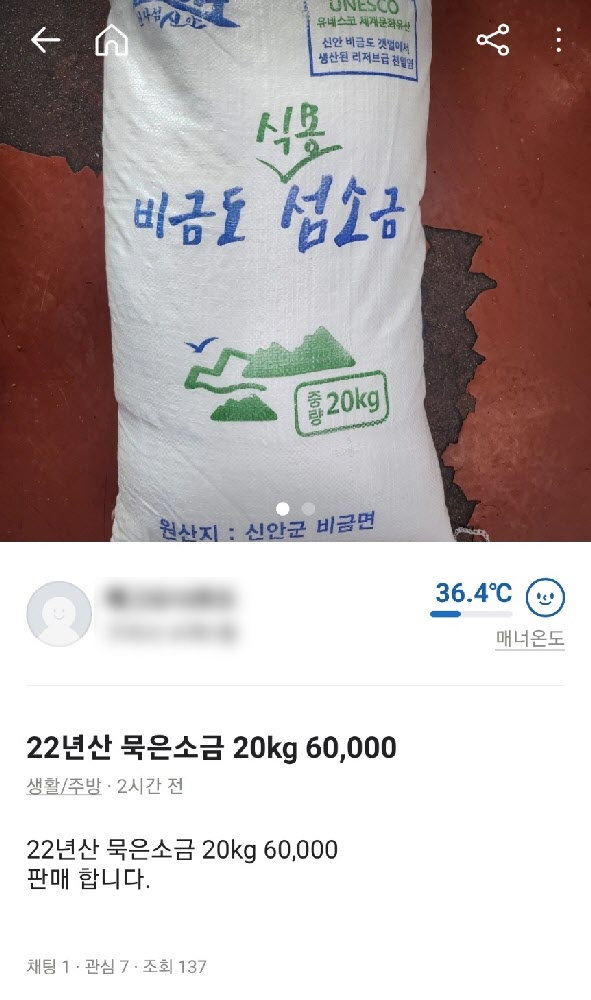 Screenshot of a salt transaction post uploaded on the 20th on a Korean secondhand trading application (app).
On the 20th, a post appeared on a secondhand trading site stating that "30kg of 2010 Shinan solar salt is for sale." The seller emphasized that it was "13-year-old salt from before the Fukushima nuclear power plant explosion," setting the price at a whopping 1.5 million KRW.
Another seller sparked competition by offering 20kg of 8-year-old Shinan solar salt on a first-come, first-served basis. This seller stated, "100,000 KRW each," which is nearly three times the official price, and added, "If you buy more than 10, I will give you a slight discount" as a 'favor.'
Posts selling large 20kg bags for around 60,000 to 80,000 KRW can be found without difficulty. This is about twice the 30,000 KRW price for 20kg of 2021 salt announced by the Jeonnam Shinan County Fisheries Cooperative direct store on the 8th. The price of salt currently produced has also surged about 65% compared to the average year.
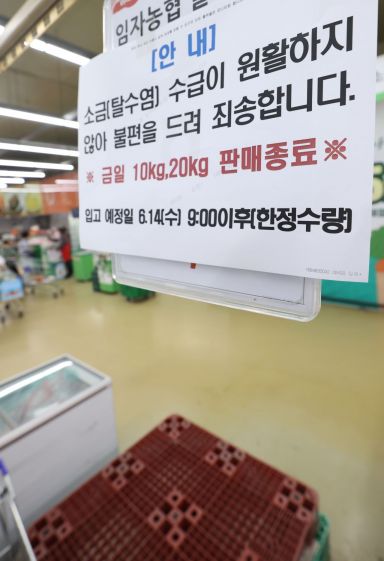
The surge in salt demand due to the Fukushima contaminated water issue is one reason, but production has also decreased. Due to adverse weather and other unfavorable conditions, domestic salt supply has decreased, causing salt prices to rise sharply.
The Ministry of Oceans and Fisheries stated that the salt production volume temporarily decreased over the past two months due to weather conditions, but there will be no supply problems once production recovers in June and July.
Experts explained that since water completely evaporates into the air during the solar salt production process, it is not affected by the radioactive isotope tritium, so solar salt remains safe even after the Japanese government’s discharge of contaminated water.
Professor Jeong Yong-hoon of KAIST: "No Problem with Japan’s Contaminated Water Discharge"
Meanwhile, on the 20th, Professor Jeong Yong-hoon of the Department of Nuclear and Quantum Engineering at KAIST commented on the long-term effects of the Fukushima nuclear power plant contaminated water discharge, saying, "To make a mountain out of a molehill, you have to gather as many molehills as a mountain. Molehills remain molehills no matter how much you gather."
Professor Jeong made this statement during a lecture at the People Power Party’s parliamentary meeting held at the National Assembly that morning, asserting, "Even after the contaminated water is discharged and a long time passes, it does not cause significant impact."
He elaborated, "If you go just a few kilometers from Fukushima, the water is diluted, and tritium is detected at 1 Bq (becquerel) per liter. If you measure water from the Han River immediately, it also shows 1 Bq per liter. So if you test the urine of Seoul citizens, that level of tritium appears." He continued, "China also discharges contaminated water with about 50 times the tritium concentration of Fukushima’s contaminated water. Our country does it too," emphasizing, "There is actually no effect from this, and when you consider the total amount, it is negligible."
Regarding the recent salt shortage caused by concerns over contaminated water discharge, he said, "Tritium does not remain in salt," adding, "Tritium is water, and it evaporates together when water evaporates."
© The Asia Business Daily(www.asiae.co.kr). All rights reserved.


















