Ministry of Education to Announce Measures to Enhance Public Education Competitiveness on 21st
Introduction of High School Credit System... Relative Evaluation for 1st Year High School Maintained
Retention of Foreign Language and Autonomous Private High Schools, Promotion of Autonomous Public High School 2.0
Designation of 3rd Grade Elementary and 1st Grade Middle School as 'Responsible Education Grades' for Achievement Assessment
Starting from the 2025 academic year, when current 2nd-year middle school students enter high school, the 'High School Credit System,' which allows students to choose the subjects they want to take, will be fully implemented. However, the full implementation of the achievement evaluation system (absolute evaluation) for common subjects (mainly 1st-year high school subjects) will not be introduced.
On the 21st, the Ministry of Education held a briefing at the Government Seoul Office and announced the 'Plan to Enhance the Competitiveness of Public Education,' which includes these details.
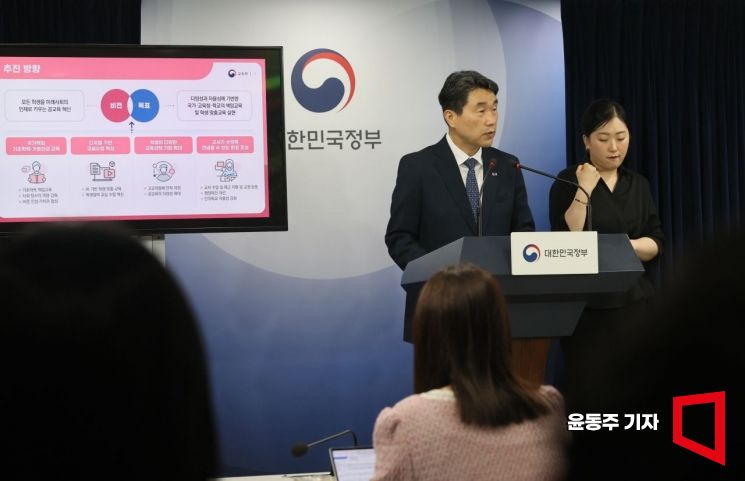 Education Minister Lee Ju-ho is briefing on measures to enhance the competitiveness of public education at the Government Seoul Office in Jongno-gu, Seoul, on the 21st. Photo by Dongju Yoon doso7@
High School Credit System to be Introduced as Scheduled in 2025
The High School Credit System, which had disagreements regarding the full implementation timeline, will be implemented as scheduled from 2025. However, the previously discussed full achievement evaluation system for 1st-year common subjects will not be implemented.
Currently, for high school grades, 1st-year students undergo both achievement evaluation (A·B·C·D·E) and 9-level relative evaluation for college admissions, while 2nd and 3rd-year students only undergo achievement evaluation. In other words, 1st-year students are evaluated relatively, and 2nd and 3rd-year students are evaluated absolutely.
Lee Ju-ho, Deputy Prime Minister for Social Affairs and Minister of Education, expressed his intention to convert all subject evaluations to a 5-level absolute achievement evaluation system following the introduction of the High School Credit System shortly after taking office in December last year, but this plan was ultimately abandoned.
The Deputy Prime Minister said, "There were strong opinions about the heavy burden on the field, so we deliberated until the very end," and added, "We decided to focus on strengthening schools' achievement evaluation capabilities and make efforts in that direction."
Under the High School Credit System, if students fail to meet 40% academic achievement or two-thirds attendance for a subject, it will be marked as 'incomplete.' Universities will introduce an 'I' grade, equivalent to an 'F' or failing grade.
Students must complete 192 credits over three years to graduate. To prevent students from failing to graduate due to insufficient credits, preventive and supplementary guidance and alternative credit acquisition systems will be established. Specific details will be announced separately in February next year.
The Ministry of Education plans to enhance the reliability of achievement evaluations by establishing a three-step inspection system involving schools, education offices, and external inspection teams, and by setting up and operating an evaluation management center.
Considering the large variation in subjects offered by school and region, the current four public online schools will be expanded to 17 by 2025, and joint education courses will be increased. Additionally, regional High School Credit System support centers will be established to strengthen cooperation among high schools, universities, and companies.
Along with this, participatory classes such as project-based learning will be increased, and essay and descriptive evaluations will be strengthened instead of multiple-choice questions.
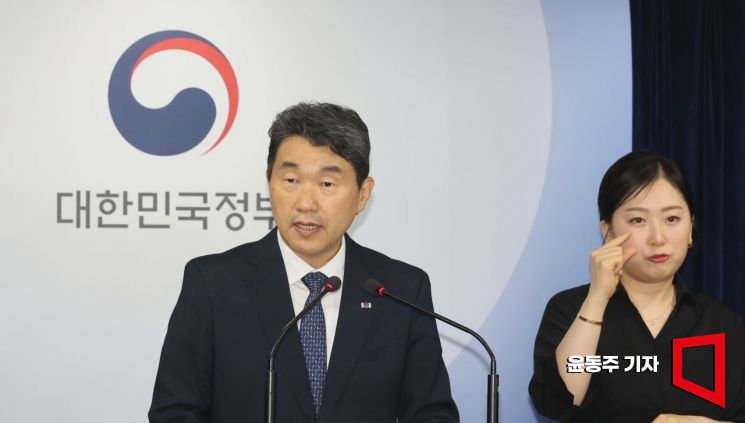 Education Minister Lee Ju-ho is briefing on measures to enhance the competitiveness of public education at the Government Seoul Office in Jongno-gu, Seoul, on the 21st. Photo by Dongju Yoon doso7@
Maintaining Autonomous Private High Schools and Foreign Language High Schools, Introducing 'Autonomous Public High School 2.0'
The Ministry of Education has decided to maintain autonomous private high schools (jasago), foreign language high schools (oego), and international high schools, which were previously planned to be converted into general high schools, and will revise related enforcement ordinances by the end of this year.
However, if existing foreign language and international high schools wish, they will be converted into 'International Foreign Language High Schools' to allow the operation of a two-school system curriculum.
To prevent these schools from monopolizing outstanding students, the current 'late selection' system will be maintained alongside general high schools, and autonomous private high schools recruiting nationwide will be required to select at least 20% of their quota from local talents. Additionally, half of the unfilled spots in the social integration admission track will be allowed to be filled through the general admission track.
Furthermore, a five-year cycle 'performance evaluation' will be introduced, and schools with poor results will have their quotas reduced.
Separately, the Ministry of Education will promote 'Autonomous Public High School 2.0,' allowing metropolitan and provincial education offices to autonomously operate schools according to regional and school conditions.
In the education community, there are opposing views: supporters argue that such a system will enhance public education competitiveness and revive prestigious local high schools, thereby slowing down regional extinction, while opponents warn that it will deepen school hierarchy.
Separately, the Ministry of Education plans to reform overall teacher policies, including the personnel system, to encourage voluntary teaching innovation among teachers.
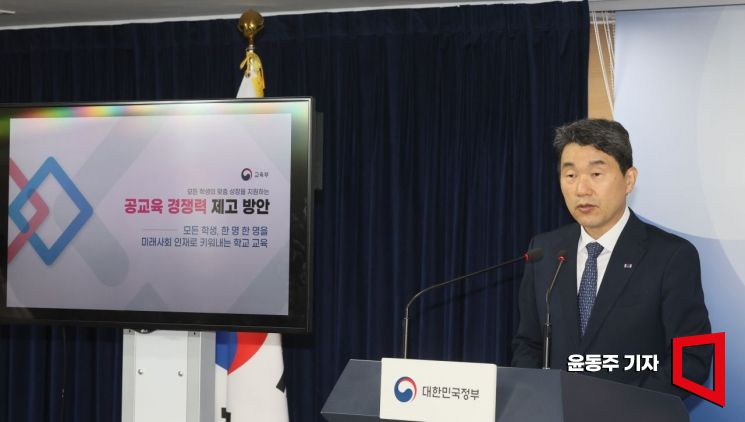 Education Minister Lee Ju-ho is briefing on measures to enhance the competitiveness of public education at the Government Seoul Office in Jongno-gu, Seoul, on the 21st. Photo by Dongju Yoon doso7@
Designating 3rd Grade Elementary and 1st Grade Middle School as 'Responsible Education Grades'... Expanding Learning Support Targets
3rd-grade elementary students, who begin formal subject study, and 1st-grade middle school students, who start secondary education, will be designated as 'Responsible Education Grades' to provide learning support.
To diagnose achievement levels at the beginning of the school year, education offices will be encouraged to allow all 3rd-grade elementary and 1st-grade middle school students to participate in customized academic achievement assessments, and participation will be reflected in the education office evaluations.
The customized academic achievement assessment is a diagnostic test (Korean, Math, English, Social Studies, Science) conducted by class upon application, but since it is voluntary, the national average participation rate is only 12.2% based on student numbers, with significant regional disparities.
Based on diagnostic results, the target group for focused learning support will be expanded from the current 'students below basic academic skills' to 'middle and lower-tier students' by 2025. This is expected to increase the support target from about 5% to up to 30% of all students.
Starting in 2024, a 'Learning Leap Seasonal Semester' will be introduced to provide supplementary basic academic learning during vacations, and for 1st-grade middle school students, career and aptitude diagnosis and career exploration will be strengthened, considering the purpose of the free semester system.
Additionally, from the second half of this year, students' adaptation to school life and peer relationships will be measured through social-emotional indicators, and the 'Student Social-Emotional Support Act' will be enacted. Character education and arts and physical activities will also be strengthened.
© The Asia Business Daily(www.asiae.co.kr). All rights reserved.
![Clutching a Stolen Dior Bag, Saying "I Hate Being Poor but Real"... The Grotesque Con of a "Human Knockoff" [Slate]](https://cwcontent.asiae.co.kr/asiaresize/183/2026021902243444107_1771435474.jpg)


















