A study has found that muscle quality is more important than muscle quantity in preventing the progression of liver fibrosis in patients with non-alcoholic fatty liver disease (NAFLD).
The Korea Disease Control and Prevention Agency's National Institute of Health announced on the 21st that this research was recently published in an international academic journal through the project "Establishment of a Non-Alcoholic Fatty Liver Disease Patient Cohort for the Prevention and Management of Cardiovascular and Cerebrovascular Diseases" (Principal Investigator: Professor Kim Won, Seoul National University).
According to the 2021 clinical guidelines for non-alcoholic fatty liver disease published by the Korean Association for the Study of the Liver, the prevalence of NAFLD in the Korean population is approximately 20-30%, with an incidence rate of about 450,000 cases per 1,000 population annually, resulting in significant economic and social losses. It has long been known that sarcopenia or low skeletal muscle mass increases the risk of developing NAFLD, but evidence regarding the impact of muscle quality on the progression of liver fibrosis in NAFLD patients has been unclear.
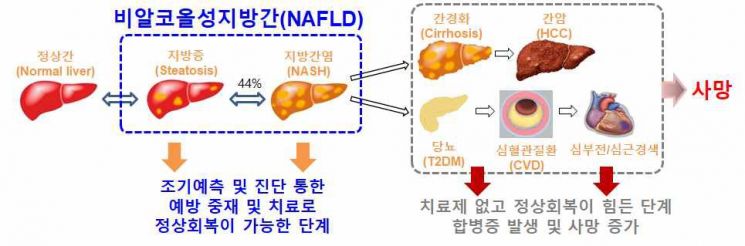
Accordingly, the research team conducted a follow-up study on 292 NAFLD patients diagnosed through liver biopsy (Boramae Hospital Fatty Liver Disease Cohort, Seoul) by dividing them into four groups (quartiles) based on muscle quality assessed via abdominal CT scans. The progression of liver fibrosis was then tracked. The results showed that the patient group with the highest amount of unhealthy muscle mass (LAMA) (top 25%) had a 2.8 times higher risk of liver fibrosis progression compared to the group with the lowest muscle mass (bottom 25%). In contrast, healthy muscle mass with minimal fat infiltration (NAMA) and total muscle mass (TAMA) did not show a significant difference in the risk of liver fibrosis progression.
The researchers explained, "By using a 'muscle quality map' of NAFLD patients, we confirmed that the risk of liver fibrosis progression significantly increased in the group with a high amount of unhealthy muscle mass." They added, "This study directly confirmed that muscle quality is a very important factor in determining the progression of liver fibrosis in NAFLD patients diagnosed through liver biopsy."
The National Institute of Health emphasized, "To reduce the risk of progression to liver fibrosis, which is a major cause of cirrhosis and cardiovascular disease in NAFLD patients, it is essential to reduce the amount of unhealthy muscle mass characterized by fat accumulation in the muscles." They stressed, "For this purpose, improving and practicing healthy lifestyle habits, including dietary control combined with aerobic and resistance exercises, is crucial."
The study results were recently published online in the international academic journal Alimentary Pharmacology & Therapeutics (Impact Factor 9.524).
© The Asia Business Daily(www.asiae.co.kr). All rights reserved.












