"Democratic Party Seems to Favor Increasing Seats More"
Kim Ki-hyun, leader of the People Power Party, proposed a "reduction of 30 National Assembly members" during a parliamentary negotiation group speech. In response, Cho Hae-jin, a People Power Party lawmaker and chair of the National Assembly's Special Committee on Electoral Reform, argued that the number of proportional representation seats should be reduced or eliminated to decrease the total number of seats.
On the 21st, Cho said on KBS's "Choi Kyung-young's Strong Current Affairs," "If the semi-proportional representation system is maintained as it is or expanded, there is a possibility that the number of proportional seats will need to be increased. However, if it is concluded that the proportional system is no longer necessary, there is a way to reduce the number of proportional seats."
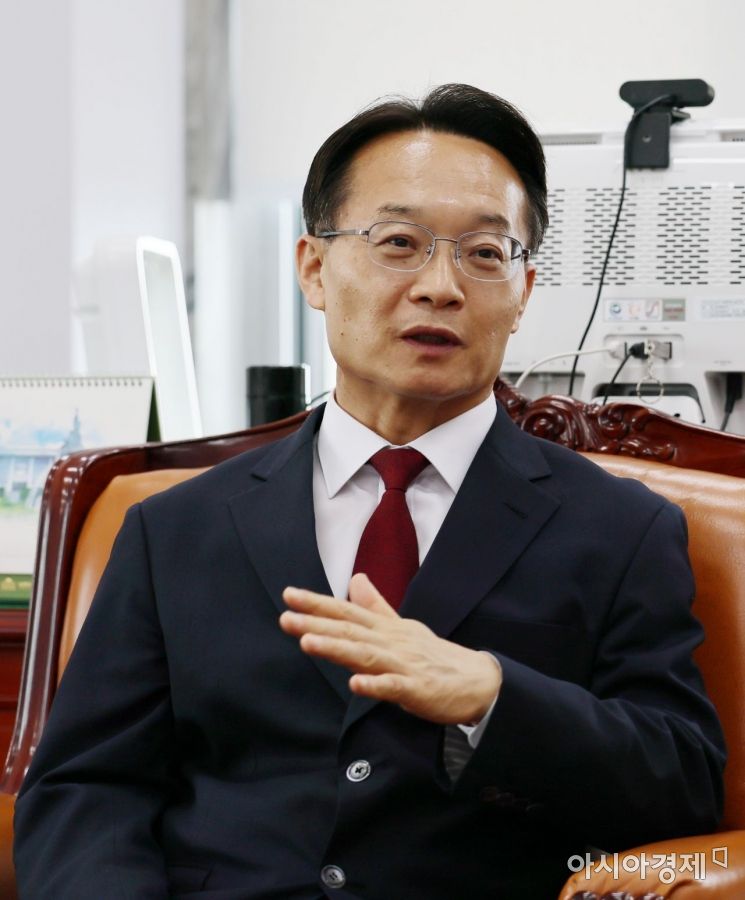
When the host pointed out that a recent public opinion survey conducted by the Special Committee on Electoral Reform in collaboration with KBS showed low support for expanding proportional representation, Cho responded, "The 500 participants in the deliberation process agreed on the importance of vote equivalence and proportionality to prevent abuse, and many opinions were adjusted and changed during the deliberation. However, the problem is that the decision is not made by the 500 participants but by the 50 million citizens, so the awareness of the 50 million people is also important."
Cho's reference to the "awareness of 50 million citizens" seems to reflect the high unfavorable views toward proportional representation among the general public, unlike the deliberation survey. According to a public perception survey released by the Korea Institute of Public Administration in April, 82% of citizens opposed expanding proportional representation.
Regarding how to discuss the reduction of 30 assembly members with the Democratic Party, Cho said, "Legally, the time has already passed, but overall, if the ruling and opposition parties form a consensus body by September or October, that would be a significant development. The bigger problem is not the timing but the current atmosphere, which is not conducive to reforming the election law through bipartisan agreement."
He added, "The Democratic Party still does not have a party stance on this issue, similar to our party. However, during the last plenary committee discussion, it seemed that more Democratic members favored increasing the number of seats. For proper discussion, the Democratic Party must first establish a party stance."
Cho said, "If the Democratic Party decides to increase the number of seats and our party decides to reduce them, then we need to have dialogue and communication based on those stances and persuade the public. We must convince the public of the necessity to reduce seats, and if the Democratic Party's stance is to increase seats, they must persuade the public accordingly. Then, we can adjust the final opinion."
The People Power Party is likely to adopt the reduction of 30 assembly members as a party stance. Cho stated, "There has been no formal party resolution procedure. The adoption of a party stance is under the jurisdiction of the floor leader, not the party leader. Considering the significant public support for this agenda and the fact that many lawmakers sympathize with it in informal discussions, if the floor leader convenes a party meeting to discuss it, it is highly likely to be adopted as a party stance."
© The Asia Business Daily(www.asiae.co.kr). All rights reserved.
![Clutching a Stolen Dior Bag, Saying "I Hate Being Poor but Real"... The Grotesque Con of a "Human Knockoff" [Slate]](https://cwcontent.asiae.co.kr/asiaresize/183/2026021902243444107_1771435474.jpg)
















