Last Year, Government Pushed Sale of Total 292 Cases of Property Tax Payment Securities... Average of Over 4 Failed Bids
Even High-Quality Property Tax Payment Securities Promoted at Investment Briefings Have Not Found Buyers for a Year
The government is facing difficulties in disposing of securities received as payment in kind for inheritance tax. Approximately 300 cases of such securities that the government attempted to sell last year were all auctioned off unsuccessfully at least four times, and even securities from companies promoted through investor briefings have yet to find buyers. If these securities are not converted into cash, the government may fail to collect taxes properly, resulting in losses to the national treasury. Consequently, there are opinions that more precise evaluation criteria for inheritance obligors should be introduced.
According to the Ministry of Economy and Finance and Korea Asset Management Corporation (KAMCO) on the 21st, the government attempted to sell a total of 292 cases of securities received as payment in kind through KAMCO last year, but on average, they were auctioned off unsuccessfully more than four times. This indicates that most of the securities paid in stocks and bonds instead of cash are facing difficulties in being converted into cash. Most of the auctioned-off company securities are shares of small unlisted companies, making it difficult to clearly evaluate their value externally, and it is interpreted that external investors find it hard to make investment decisions due to limited knowledge of the companies' internal situations.
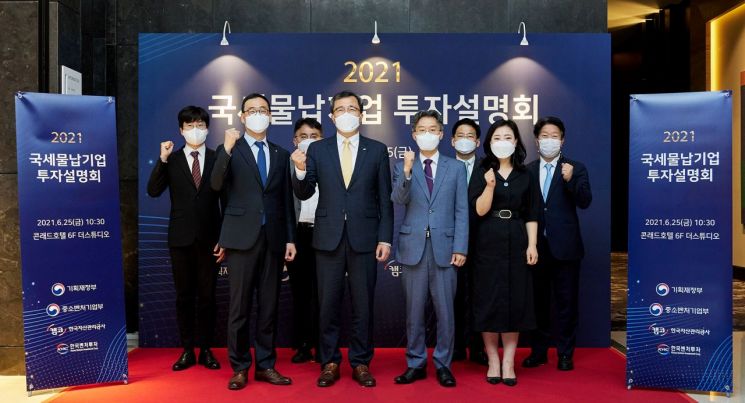
To facilitate the smooth sale of securities received as payment in kind, the government even held investor briefings, but these efforts had little effect. In June of last year, the Ministry of Economy and Finance and KAMCO directly introduced five major high-quality companies that had paid in securities and promoted these companies. The companies promoted by the government at that time were TKG Taekwang, a shoe manufacturer; Hutech Industry, a massage chair company; Jeong Food, the manufacturer of the soy milk brand "Vegemil"; Kiyoung Pharmaceutical, which distributes contrast agents; and Daepyeong, which operates warehouses at Gwangyang Port in Jeonnam. Although these companies were introduced as high-quality securities payers, even after a year, these securities have still not found buyers.
Payment in kind refers to transferring assets other than cash to the government and having the value of those assets recognized as tax payment. This system allows payment with real estate, government bonds, securities, etc., instead of cash, considering the practical circumstances of inheritance obligors who find it difficult to pay inheritance tax in cash. According to the Ministry of Economy and Finance, under the National Property Act, the National Tax Service entrusts KAMCO with the management and disposal of securities received as payment in kind. The smooth conversion of these securities into cash is essential to prevent losses to the national treasury. However, according to KAMCO, from the implementation of the inheritance tax payment-in-kind system in 1997 until August 2021, the actual recovery rate of unlisted stocks received as payment in kind was about 67.7%. Although the total amount of securities received was 1.4983 trillion KRW, the actual proceeds from sales amounted to only 1.0142 trillion KRW.
For these reasons, the government has reduced the scope of payment in kind and strengthened the requirements several times through tax law revisions since 2016. It has been mandated that payment in kind with inherited unlisted stocks is only allowed if it is proven that cash payment is difficult. To qualify for payment in kind, conditions such as the inheritance tax amount exceeding 20 million KRW and the value of assets eligible for payment in kind exceeding 50% of the total inherited assets must be met. Additionally, listed stocks with disposal restrictions and domestic real estate must be paid in kind first, and unlisted stocks can only be used if these are insufficient.
Among experts, there is an opinion that the criteria for judging the difficulty of cash payment need to be strengthened. In Japan, the possibility of cash payment is specifically assessed by deducting three months' living expenses and one month's operating funds for the taxpayer's ongoing business from the total amount of cash and deposits held by the taxpayer. Lee Sang-yeop, former research fellow at the Korea Institute of Public Finance, said, "There has been a need to establish more concrete criteria for judging cases where it is difficult to pay taxes in cash to prevent losses to the national treasury." However, he added, "Paradoxically, the fact that it is difficult to find buyers even when the government promotes these securities indicates that cash conversion is challenging from the perspective of general taxpayers as well, so there should also be consideration as to whether the inheritance tax itself is excessive."
© The Asia Business Daily(www.asiae.co.kr). All rights reserved.
![Clutching a Stolen Dior Bag, Saying "I Hate Being Poor but Real"... The Grotesque Con of a "Human Knockoff" [Slate]](https://cwcontent.asiae.co.kr/asiaresize/183/2026021902243444107_1771435474.jpg)
















