20 Hyundai Motor CEO Investor Day
"Electrification transition, leveraging past innovation experience to walk 'Hyundai Motor's own path'"
Development of 2nd generation electric vehicle dedicated platform by 2025
Expansion of domestic and overseas electric vehicle dedicated production lines
Securing battery development capabilities and supply stabilization
Hyundai Motor Company has raised its global electric vehicle (EV) sales target to 2 million units by 2030. This figure is 130,000 units higher than the target announced last year. To achieve this, Hyundai has also presented concrete strategies for electrification transition, including the introduction of the Integrated Modular Architecture (IMA), conversion of factories to EV production, and enhancement of battery capabilities.
On the 20th, Hyundai held the '2023 CEO Investor Day' at the Conrad Hotel in Yeouido, Seoul, targeting investors and analysts. Hyundai not only raised its global EV sales targets but also announced a large-scale investment plan averaging 11 trillion KRW annually over the next decade.
The event featured presentations by CEO Jang Jae-hoon, Executive Vice President Seo Kang-hyun, Vice President Kim Heung-soo of the Global Strategy Office (GSO), and Executive Director Kim Chang-hwan of the Battery Development Center. CEO Jang emphasized, "Hyundai has proactively responded to electrification and future technologies more than any other global company," adding, "We will continue to maintain our top-tier leadership in electrification."
At the event, Hyundai declared plans to sell 330,000 EVs this year, 940,000 units by 2026, and 2 million units globally by 2030. Compared to last year's targets, the 2026 goal increased by 100,000 units and the 2030 goal by 130,000 units. If these targets are met, the proportion of EV sales for Hyundai and Genesis is expected to rise from about 8% this year to 18% in 2026 and 34% in 2030. Notably, the EV share in key regions (the United States, Europe, and Korea) is expected to exceed half of total sales by 2030.
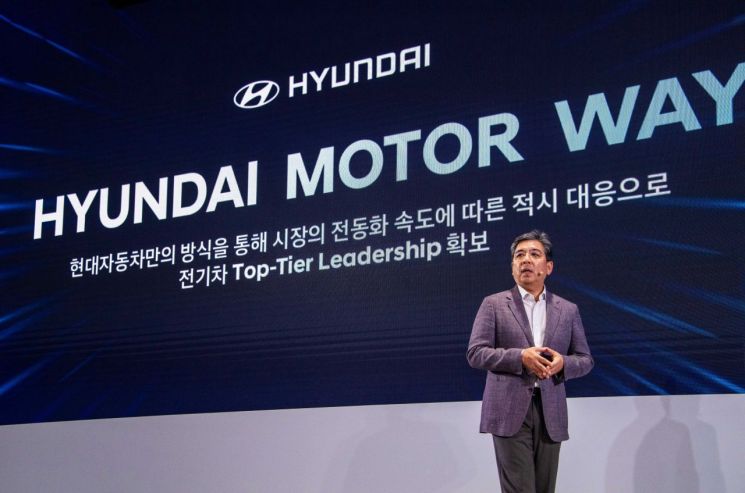 Jang Jae-hoon, CEO of Hyundai Motor Company, is giving a presentation at the '2023 CEO Investor Day' on the 20th.
 [Photo by Hyundai Motor Company]
◆ Development of 2nd Generation Dedicated EV Platform=First, Hyundai plans to complete the development system for the Integrated Modular Architecture by 2025. Following the launch of the dedicated EV platform 'E-GMP' in 2020, Hyundai aims to develop a 2nd generation dedicated EV platform.
Hyundai will maximize cost reduction effects by introducing the new Integrated Modular Architecture. Currently, parts sharing is only possible among models using the same platform. For example, the Ioniq 5, which uses a dedicated EV platform, and the Kona EV, which is based on a modified internal combustion engine platform, cannot share modules. Under the new architecture, 13 core strategic modules?including the motor, battery, inverter, electrical/electronic components, and autonomous driving systems?will be shared.
While the existing platform has about 23 common parts developed in advance, the new architecture will feature 86 module system combinations that can be used regardless of vehicle class. Hyundai plans to develop and launch four Hyundai and five Genesis passenger EV models on the 2nd generation dedicated EV platform between 2025 and 2030.
◆ Expansion of Dedicated EV Production Lines=Hyundai is pursuing a 'two-track strategy' by converting existing internal combustion engine factories into EV-dedicated lines while simultaneously constructing new EV-dedicated plants. Hyundai has already invested between 50 billion and 100 billion KRW in its Ulsan and Asan plants to convert production lines to EV manufacturing within a month. Beyond Korea, Hyundai is also converting internal combustion engine production lines to electrified lines at overseas plants in the United States, Czech Republic, and India.
New EV-dedicated plant construction is also underway. The first EV-dedicated plant in the United States, Georgia HMGMA (Hyundai Motor Group Meta Plant America), aims to start mass production in the second half of 2024, while the Ulsan EV-dedicated plant targets mass production in 2025. Additionally, the Singapore Global Innovation Center (HMGICS), which employs smart manufacturing technologies, will further maximize production efficiency.
Through these efforts, Hyundai plans to actively increase the proportion of EV production. In the United States, the EV production share, currently only 0.7% this year, is planned to rise to 75% by 2030, while Europe aims to expand to 54% by 2030. In Korea, EV production is expected to reach 36% by 2030.
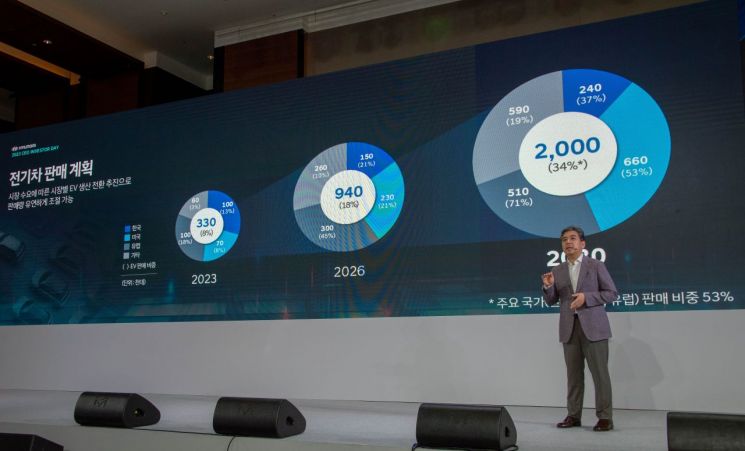 Jang Jae-hoon, CEO of Hyundai Motor Company, is giving a presentation at the '2023 CEO Investor Day' on the 20th.
 [Photo by Hyundai Motor Company]
◆ Securing Battery Development Capabilities and Supply Stability=Hyundai also announced plans to strengthen battery development capabilities and stabilize material supply, which are critical components for EVs. Hyundai has established dedicated functional organizations responsible for battery systems, cell design, battery safety reliability and performance development, and next-generation battery research. Over the next decade, Hyundai will invest 9.5 trillion KRW to improve battery performance, develop next-generation battery technologies, and build infrastructure.
To secure battery capabilities, Hyundai will increase external collaborations. For stable battery supply, joint ventures (JVs) and joint development projects are underway with major battery companies such as SK On and LG Energy Solution. For next-generation battery development, Hyundai is conducting joint research and equity investments with startups. Collaborations with U.S. companies like Solid Power focus on securing solid-state battery components and process technologies, while joint development of lithium-metal batteries is ongoing with SolidEnergy Systems (SES).
To realize this 'Hyundai Motor Way,' Hyundai plans to invest 109.4 trillion KRW over 10 years from 2023 to 2032. This includes 47.4 trillion KRW for R&D, 47.1 trillion KRW for capital expenditures (CAPEX), and 14.9 trillion KRW for strategic investments. Particularly, more than 12 trillion KRW will be invested in 2024 and 2025, when electrification investments are concentrated. Executive Vice President Seo emphasized, "Hyundai will continue to evolve into a sustainable and trusted company through a virtuous cycle structure of investment strategy, profit generation, and shareholder returns, including future technology investments."
© The Asia Business Daily(www.asiae.co.kr). All rights reserved.
![User Who Sold Erroneously Deposited Bitcoins to Repay Debt and Fund Entertainment... What Did the Supreme Court Decide in 2021? [Legal Issue Check]](https://cwcontent.asiae.co.kr/asiaresize/183/2026020910431234020_1770601391.png)