One of the solutions to the worsening population issues such as low birthrate and aging is to change the perception of 'non-marital childbirth.'
On the 20th, Professor Kim Young-chul of the Department of Economics at Sogang University stated at a seminar titled "Non-Marital Childbirth as Population Policy," hosted by the Korea Future Population Research Institute (Hanmiyeon) at the POSCO Center in Gangnam-gu, Seoul, that "The decisive difference between Korea and major OECD countries is that the non-marital population does not lead to the formation of non-marital families."
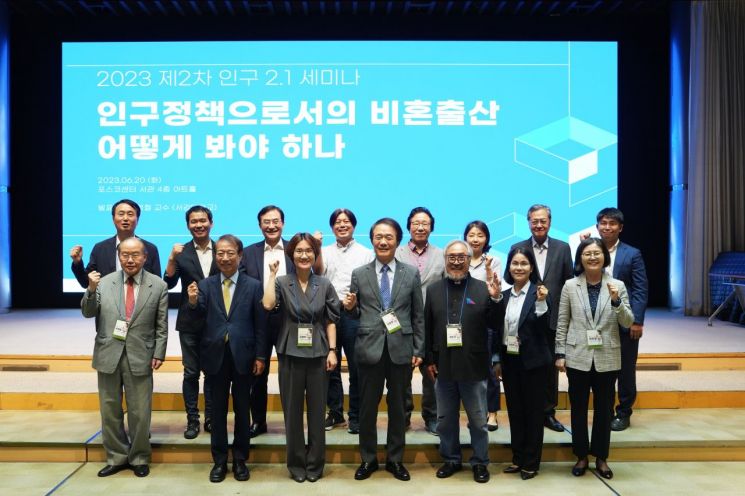 At the seminar on childbirth without marriage held on the 20th, hosted by the Korea Future Population Research Institute, attendees including Jeong Un-chan, Chairman of the Korea Future Population Research Institute (second from the left in the front row), Kim Young-mi, Vice Chairman of the Low Birthrate and Aging Society Committee (third from the left in the front row), and Kim Jong-hoon, Chairman of HanmiGlobal (fourth from the left in the front row), are taking a commemorative photo.
 [Photo by Korea Future Population Research Institute]
As of 2021, Korea's non-marital childbirth rate is only 2.9%. This means that giving birth without marriage is not common in our society. Conversely, as of 2020, the average non-marital childbirth rate among OECD member countries reached 41.9%, establishing it as a common family form in major countries. Professor David Coleman, a world-renowned demographer who visited Korea last month, mentioned the need to change perceptions of non-marital childbirth as a measure against Korea's low birthrate.
In this regard, Professor Kim proposed a policy called the "Co-parent Family Registration System (tentative name)" to activate non-marital childbirth. The idea is to legally recognize cohabitants who have children as parents, even if they are not married. For example, key points include ▲applying family welfare services such as registering cohabitants as dependents under the National Health Insurance ▲recognizing cohabitants as legal spouses when signing surgical consent forms at hospitals ▲a separate property system allowing each to manage and dispose of their own assets ▲choosing the child's surname with parental agreement ▲and no kinship formation with the cohabitant's family.
Following this, under the chairmanship of Lee In-sil, director of Hanmiyeon, a panel discussion with Professor Song Heon-jae of the Department of Economics at the University of Seoul, Research Fellow Byun Soo-jung of the Korea Institute for Health and Social Affairs, Professor Eun Ki-soo of the Graduate School of International Studies at Seoul National University, and Professor Jung Jae-hoon of the Department of Social Welfare at Seoul Women's University presented various measures to support low birthrate policies. Professor Song said, "When the support target for low birthrate policies shifts from parents to children," adding, "If the state focuses on creating an environment where children can live without worry, the marital status of parents will not be very important in policy design." Professor Jung pointed out, "The meaning of family is not absolute, and family is a moving unit of life," and stated, "It will be difficult to expect a rebound in birthrate unless the social stigma on the life choices of individuals is changed."
Hanmiyeon organized this seminar to discuss the need for changing perceptions of non-marital childbirth and the social support system. In his welcoming remarks, Kim Jong-hoon, chairman of Hanmiyeon, emphasized, "Our society needs to more actively accept non-marital childbirth," and "The government must update laws and systems related to families to fit the times." After this seminar, Hanmiyeon plans to hold seminars and forums in the second half of the year on various issues such as ▲cases of corporate participation in population policies by country and government policies ▲women's economic activities and population changes ▲decline in the working-age population, and propose policies related to population issues.
© The Asia Business Daily(www.asiae.co.kr). All rights reserved.
![User Who Sold Erroneously Deposited Bitcoins to Repay Debt and Fund Entertainment... What Did the Supreme Court Decide in 2021? [Legal Issue Check]](https://cwcontent.asiae.co.kr/asiaresize/183/2026020910431234020_1770601391.png)















