May Seoul Officetel Transactions Down 69% Year-on-Year
Impact of Apartment Regulation Easing and Exclusion from Special Bogeumjari Loan
17 Trillion Won in Deposit Maturing Within One Year... Concerns Over Reverse Jeonse Crisis
The volume of apartment transactions in Seoul has exceeded 3,000 units for two consecutive months, but officetel transactions have shrunk to one-third, showing a stark contrast. Officetel transactions in May decreased by about 69% compared to the same period last year. This is attributed to the focus of regulatory easing on apartments, which has lowered the investment attractiveness of officetels, and their exclusion from loan benefits such as the ‘Special Home Loan’.
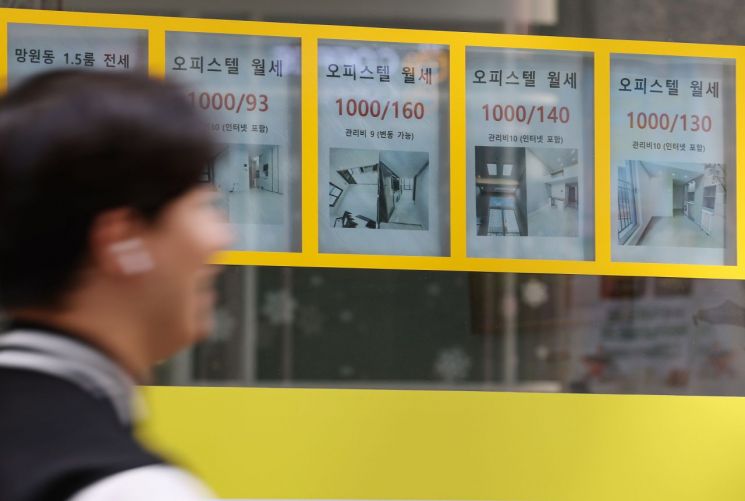
According to the Seoul Real Estate Information Plaza on the 21st, officetel transactions in Seoul in May this year were 594 units, down 68.74% from 1,900 units in May last year. This is less than one-third of last year’s transaction volume. The transaction volume of Seoul officetels has been continuously decreasing, recording 920 units in February, 673 units in March, and 608 units in April this year. In contrast, Seoul apartment transactions increased to 2,459 units in February and 2,983 units in March, and continued an upward trend by exceeding 3,000 units for two consecutive months in April and May.
As demand fails to recover, officetel sale prices are also falling. According to the Korea Real Estate Board, the sale price index of Seoul officetels in May recorded 101.11, down 0.13% from the previous month, continuing a decline for nine consecutive months.
The officetel market’s struggle is largely due to the easing of apartment regulations. During the real estate boom, demand concentrated on residential officetels, which were free from government apartment regulations, but with the significant easing of real estate regulations earlier this year, there is no longer a reason to choose officetels as substitutes for apartments. Various regulations such as resale restrictions have been lifted, and with recent interest rates remaining steady, the investment appeal of officetels has diminished.
Another reason cited is that officetels are excluded from the Special Home Loan, which allows loans of up to 500 million KRW for ‘housing’ priced under 900 million KRW regardless of income. Unlike apartments, which saw strong buying demand after the launch of the Special Home Loan, officetels, which are not classified as ‘housing’ under the Housing Act, remain excluded from support, maintaining a high loan barrier.
Unlike apartments, officetels have a relatively high jeonse rate (the ratio of jeonse deposit to sale price), making them vulnerable to jeonse fraud and reverse jeonse risks, further freezing the officetel market. According to the real estate platform Zigbang, the total jeonse deposit amount for officetels nationwide, with contracts expiring from the second half of this year to the first half of next year, reaches 17.56 trillion KRW. As the two-year maturity of jeonse contracts signed since the second half of 2021, when jeonse prices peaked, approaches, concerns over reverse jeonse are expected to expand further.
Ko Jun-seok, CEO of J-Edu Investment Advisory, said, “Officetels gained popularity as alternative investments to apartments during the real estate boom, but now demand inevitably shifts to apartments due to government regulatory easing and the implementation of the Special Home Loan.” He added, “Since concerns over deposit non-return due to recent jeonse fraud and reverse jeonse issues are more pronounced in officetels, it is expected to take a long time for sales transactions to recover.”
© The Asia Business Daily(www.asiae.co.kr). All rights reserved.

















