Safety Evaluation Research Institute, Development of Biomaterials
Research Team of Professor Lee Haesik at KAIST and Professor Shin Mikyung at Sungkyunkwan University
Domestic researchers have developed a biomaterial that can reduce the time and number of vascular surgeries.
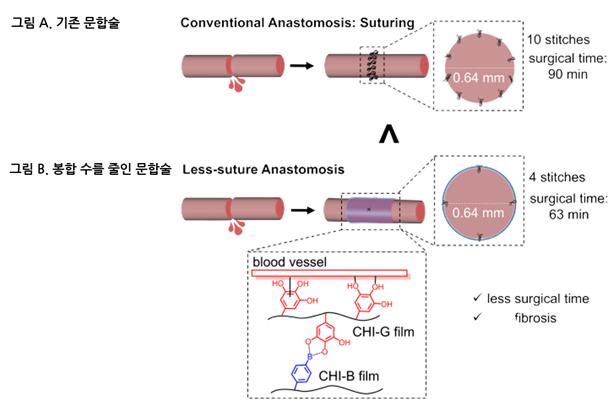 A schematic diagram of a study comparing the number of sutures and operation time in a blood coagulation disorder model according to vascular anastomosis.
 In Figure A, for the conventional anastomosis, a vascular anastomosis with a diameter of 0.64 mm took 90 minutes with 10 sutures. In Figure B, when CHI-G film and CHI-B film were applied to the anastomosis site, a vascular anastomosis with the same diameter of 0.64 mm took 63 minutes with 4 sutures.
Source of image: Provided by the Safety Evaluation Research Institute
The Korea Institute of Toxicology (KIT) announced on the 20th that a research team led by Professor Lee Haesik from the Department of Chemistry at the Korea Advanced Institute of Science and Technology (KAIST) and Professor Shin Mikyung from Sungkyunkwan University developed a biomaterial that can drastically reduce the number of sutures in vascular anastomosis (surgery connecting blood vessels), thereby shortening surgery time while enabling stable vascular anastomosis.
The chitosan-gallol film developed by the research team is flexible and adhesive, allowing it to naturally wrap around blood vessels. Its transparent material offers the advantage of directly observing bleeding or blood flow in the surgical vessel with the naked eye. Additionally, it has hemostatic functions, enabling it to be primarily attached to the anastomosis site to wrap the vessel. The team also developed a chitosan-boric acid film that is wet-fused with the first-attached chitosan-gallol film to enhance the overall film strength. This ensures that the film remains sufficiently attached until the blood vessel regenerates, maximizing the efficacy of the biomaterial.
Using the film developed by the research team, in animal models (rats) with blood coagulation disorders such as hemophilia and thrombocytopenia, where internal proteins that interfere with blood clotting are reduced or absent, the anastomosis surgery that previously required 10 sutures was reduced to 4 to 5 sutures with the multifunctional film, cutting the number of sutures in half and reducing surgery time by 30%. Analysis of vascular tissue in animal experiments showed improvements in postoperative patency rates (the probability that the vessel does not become blocked again) and the degree of vascular wall thickening (which causes blockage) compared to conventional anastomosis.
Kim Kiseok, head of the Next-Generation Drug Evaluation Research Group, stated, “The multifunctional biomaterial film developed through this research can be applied especially in surgeries that need to be performed quickly in emergency situations, making it effectively usable for critical patients,” adding, “We plan to expand research to apply it to highly elastic and curved tissues such as the heart, skin, and nerves.”
© The Asia Business Daily(www.asiae.co.kr). All rights reserved.
![User Who Sold Erroneously Deposited Bitcoins to Repay Debt and Fund Entertainment... What Did the Supreme Court Decide in 2021? [Legal Issue Check]](https://cwcontent.asiae.co.kr/asiaresize/183/2026020910431234020_1770601391.png)















