Endangered Animals and Forest Ecosystem Restoration Project
Doosan Corporation is taking steps to support biodiversity conservation as part of its ESG management activities.
Doosan Corporation announced on the 20th that it signed a Memorandum of Understanding (MOU) with the Korea National Park Service for an 'Ecosystem Restoration Project' at Doosan Tower in Jung-gu, Seoul.
Under this agreement, Doosan Corporation will support ▲the restoration project for the endangered Asiatic black bear ▲the ecosystem restoration project for island forests in marine national parks to expand carbon sinks, providing 260 million KRW in project funds. Both parties agreed to discover and collaborate on various activities to conserve biodiversity.
The Asiatic black bear restoration project involves conducting location tracking, ecological research, and dietary habit studies on 85 first-class endangered Asiatic black bears, aiming to create and monitor the Jirisan ecosystem. This project began in 2004 to restore the Jirisan ecosystem and establish an environment where humans and wildlife coexist.
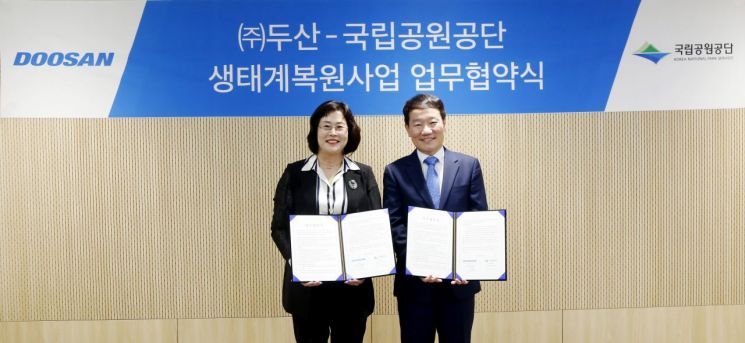 After the signing ceremony for the 'Ecosystem Restoration Project,' Park Young-ho, Vice President of Doosan Corporation (right), is taking a commemorative photo with Son Young-im, Director of Resource Conservation at the Korea National Park Service.
 [Photo by Doosan Corporation]
The ecosystem restoration project for island forests in marine national parks is designed to restore the ecosystem and expand carbon sinks by restoring the terrain and vegetation and protecting the soil on Bulgundo Island in Wando-gun, Jeollanam-do.
A Doosan Corporation official stated, “From an ESG perspective, biodiversity conservation is important for a sustainable environment and also contributes to creating social and economic value,” adding, “Going forward, Doosan Corporation plans to develop various sustainable ESG activities that employees can participate in together.”
© The Asia Business Daily(www.asiae.co.kr). All rights reserved.

















