Uncopyable Blockchain-Based System
Comprehensive Traceability Management for Plastic Waste Recycling Process
SK Geocentric announced on the 20th that it has introduced Korea's first plastic recycling material traceability platform utilizing 'blockchain.' By leveraging the tamper-proof characteristics of blockchain, customers can use plastic recycled materials with confidence and expand their scope of use.
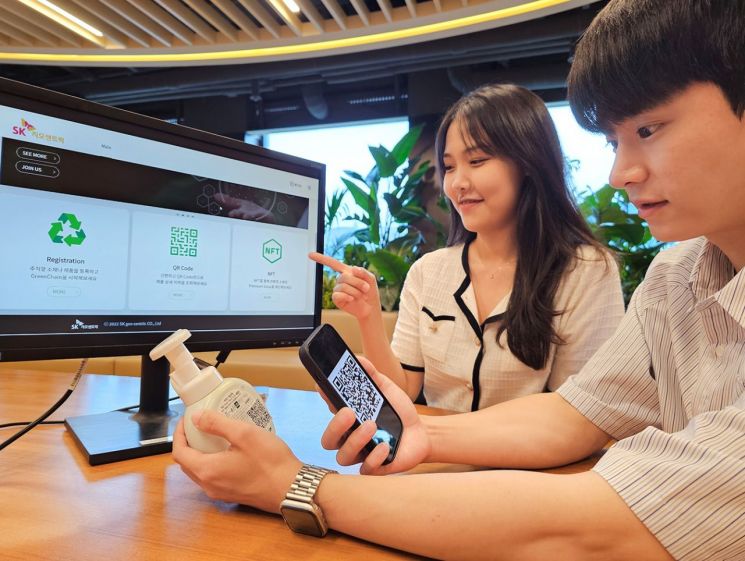 SK Geocentric members are accessing the blockchain-based plastic recycling material traceability platform via QR code to check plastic material information. Photo by SK Geocentric
The plastic recycling material traceability platform recently established by SK Geocentric stores and manages all processes from the collection of waste plastic to its recycling into new products using blockchain technology. Blockchain is a 'distributed data storage technology' that simultaneously replicates and stores data-containing 'blocks' across multiple computers. These blocks are then linked like a 'chain' to cross-verify their authenticity. Since unauthorized tampering is impossible, it is used as a means to enhance trust in fields such as virtual currency and financial authentication.
Plastic recycling is gaining attention as an alternative to solving environmental pollution problems. However, some doubts remain regarding the origin and safety of collected waste plastics. Finished product manufacturers want to verify the suitability of the components in recycled material parts produced through recycling. SK Geocentric recognized these concerns from customers and consumers while promoting its plastic recycling business and introduced the traceability platform to alleviate these worries.
The traceability platform records every step from securing waste plastics, recycling them into materials, to producing the final products. Intermediate producers and consumers can scan the QR code attached to the product with their smartphones to check the entire plastic recycling history. The traceability information includes the type and source of the waste plastic used as raw material, as well as the proportion of each material utilized in making the new product. Detailed information such as the quality grade of the material required by intermediate producers is also included, reducing certification procedures and costs related to the suitability of recycled materials.
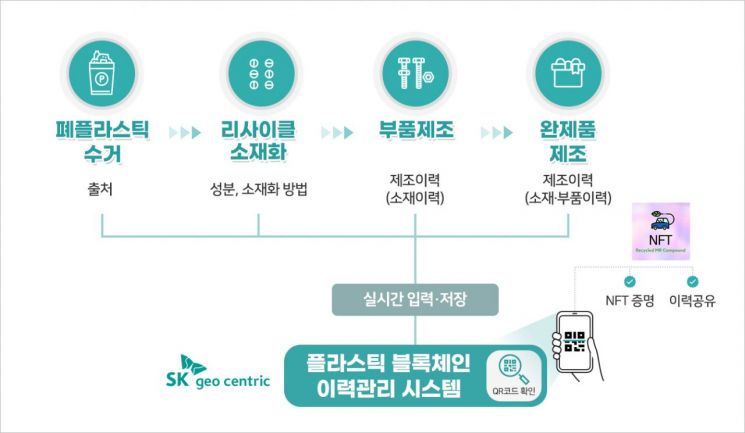
The traceability information accessible by scanning the QR code is certified as a Non-Fungible Token (NFT) to verify authenticity and can be shared via email with stakeholders such as material purchasers. This opens a path to objectively prove that products are made from recycled waste plastic materials to customers.
SK Geocentric expects that systematic traceability management will enhance trust in the plastic recycling process and help expand the related industry. This is because it can activate a market for high-quality waste plastics that are safe for humans and suitable for recycling. Furthermore, by understanding real-time demand and quality status of materials in the plastic recycling market, efficient resource allocation in the industry will also become possible.
With the world’s first comprehensive plastic recycling complex, Ulsan ARC (Advanced Recycle Cluster), scheduled to begin construction in the second half of this year and start full operation, the scale of plastic recycled materials distributed in the market will increase, and the number of stakeholders seeking material traceability is also expected to grow.
Na Kyung-soo, President of SK Geocentric, said, "The traceability management platform was established from the awareness that trust among stakeholders in the market is essential for the expansion of plastic recycling. We will systematically and continuously develop related systems so that customers can trust and use safer and higher-quality plastic recycled materials."
© The Asia Business Daily(www.asiae.co.kr). All rights reserved.
![User Who Sold Erroneously Deposited Bitcoins to Repay Debt and Fund Entertainment... What Did the Supreme Court Decide in 2021? [Legal Issue Check]](https://cwcontent.asiae.co.kr/asiaresize/183/2026020910431234020_1770601391.png)
















