The Ministry of Health and Welfare is set to announce the '2nd National Health Insurance Comprehensive Plan' (2024?2028) in the second half of this year, amid expert recommendations that mild illnesses should be selectively covered while coverage for severe and essential medical care should be strengthened. As medical expenses are expected to increase due to population aging, the intention is to boldly allocate funds where necessary and reduce spending where possible.
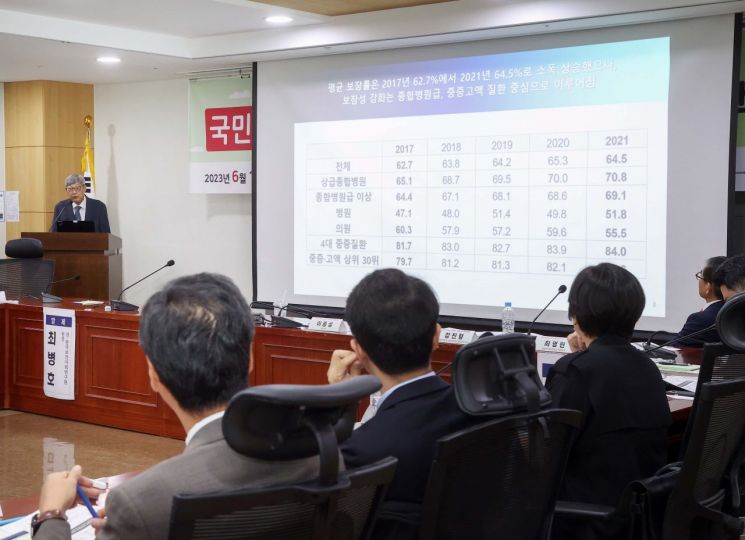
Choi Byung-ho, former president of the Korea Institute for Health and Social Affairs, stated at a policy forum on health insurance reform held at the National Assembly on the 19th, “The first National Health Insurance Comprehensive Plan, known as ‘Mooncare,’ established during the previous administration, aimed to achieve a coverage rate of 70% with a budget of 40 trillion won, but as of 2021, it only reached 64.5%. Moreover, the expansion of coverage was limited to high-cost diagnostics such as selective treatment fees at tertiary hospitals, superior hospital rooms, and MRI.”
Former President Choi emphasized, “In this comprehensive plan, the coverage for severe and essential medical care, which aligns with the fundamental purpose of health insurance, must be strengthened. Gradual 100% coverage should be pursued for the top 10 severe diseases.”
This aligns with the direction of health insurance reform desired by the public. The Future Health Network, a think tank in the health and medical field, disclosed a survey conducted by Gallup Korea in April targeting 5,039 people nationwide aged 19 to 65. 85% of respondents (21% strongly agree, 64% agree) agreed that essential medical coverage should be expanded more for severe diseases than for mild diseases. 73% of respondents chose severe diseases as the priority for coverage, which is more than four times higher than the 17% who chose frequent mild diseases.
Respondents explained, “Because patients and their families face economic difficulties in the case of severe diseases,” and “Because it directly relates to the lives of the people or threatens their quality of life.” They also believed that, assuming a health insurance budget of 10 million won, 6,615,000 won should be allocated to severe diseases and 3,385,000 won to mild diseases.
Professor Kang Jin-hyung of the Department of Oncology at Catholic University Medical School explained, “This survey is the first and largest of its kind targeting health insurance subscribers,” adding, “It was conducted with the intention that the public’s will be actively reflected in health insurance reform.” In response, a Ministry of Health and Welfare official stated, “This is an issue under multifaceted review to ensure the sustainability of the health insurance system.”
The government is attempting to improve the current fee-for-service system through this comprehensive health insurance plan. The fee-for-service system calculates medical fees for each medical act, which increases medical institution revenue as more services are provided to patients, leading to over-treatment and widening medical disparities between regions.
Experts also argue that a ‘pre-application and post-evaluation’ system for innovative treatments covered by health insurance should be introduced for severe patients. This is because even if new drugs are developed, it takes more than two years on average for them to be listed on Korea’s health insurance coverage, causing some patients to give up treatment.
A separate medical safety net fund for patients with severe and rare diseases and vulnerable groups is under study. Part of the fund’s resources will be covered through national subsidies to health insurance. However, the financial authorities stated, “It is necessary to carefully examine whether resource management can be conducted efficiently and whether there are tangible benefits.”
© The Asia Business Daily(www.asiae.co.kr). All rights reserved.

















