Last Year Saw 170,000 Gatherings... Increased Need for Dialogue Police
Experts Say "Qualification Requirements Must Be Strengthened and Education Systematized"
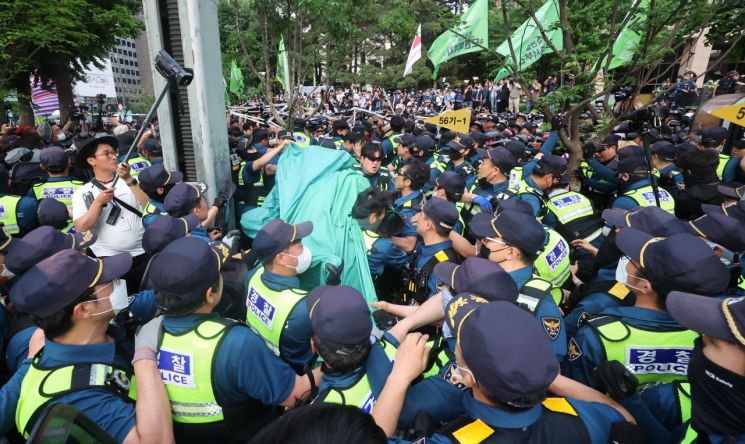
On the 16th and 17th of last month, when the 1-night 2-day overnight protest was held around Gwanghwamun in Seoul, dialogue police officers wearing yellow fluorescent vests moved among the protesters. Dialogue police are responsible for conveying complaints from nearby residents to the protest organizers or communicating the protesters' demands to the police or government. They also handle tasks such as guiding protesters to restrooms, which often becomes an issue during large-scale rallies. However, the most important mission of the dialogue police is to create a peaceful atmosphere through active communication with the participants. In other words, they prevent physical clashes through dialogue. One dialogue police officer said, "I must diligently convey safety precautions to the participants," adding, "I always remain on high alert in case physical confrontations occur."
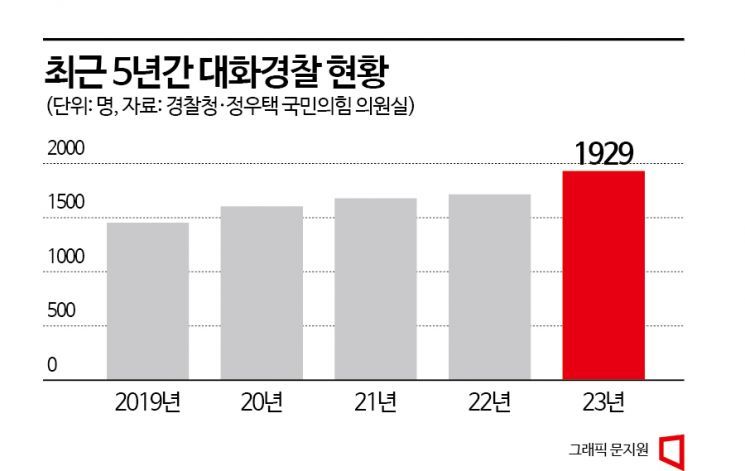
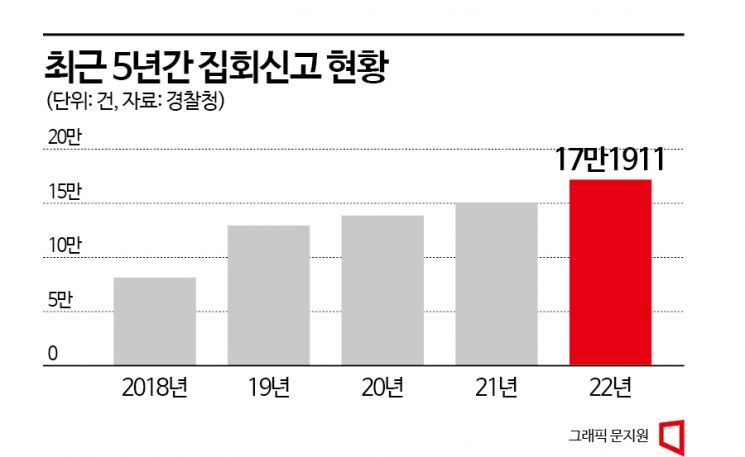
Recently, as the number of protest notifications has increased since COVID-19, the need for dialogue police who mediate conflicts on-site has grown even more. Currently, nearly 2,000 dialogue police officers are engaged in such activities. On the other hand, there are criticisms that active on-site mediation is still insufficient. In the political arena, there are calls to increase education and training for dialogue police to strengthen their practical professional capabilities.
Nearly 2,000 Dialogue Police... "Conflict Mediators"
According to data on the 'Status of Dialogue Police in the Last 5 Years' submitted by the National Police Agency to Jeong Woo-taek, a member of the National Assembly's Public Administration and Security Committee from the People Power Party, the number of dialogue police this year reached 1,929, a 12.5% increase from last year (1,714). Dialogue police were introduced in 2018, starting with 1,453 officers and increasing in number every year.
Dialogue police play a role in ensuring peaceful assemblies and demonstrations by communicating with participants. Their duties include ▲ mediating dialogue with opposing parties ▲ notifying illegal acts after legal interpretation ▲ handling civil complaints such as restroom guidance. A National Police Agency official stated, "Dialogue police work through communication and cooperation to protect human rights, ensure safety, and maintain public order." According to the police, dialogue police are generally assigned from the intelligence division or are officers with experience in intelligence work.
Assemblyman Jeong said, "Education and training must be strengthened so that dialogue police can demonstrate their professional capabilities effectively," adding, "It is also important for the National Police Agency to establish a direction to protect innocent citizens from harm caused by violent protests that violate laws and order."
Successful Case of 'Vehicle Protest Abrupt Cancellation'... Yet Response Limitations Remain
There have been cases where dialogue police successfully mediated conflicts at protest sites. On March 1, a vehicle protest heading to Yongsan regarding the toll issue on Yeongjong-Incheon Bridge was abruptly canceled due to the mediation by dialogue police. At that time, protesters changed the location and held the protest without using vehicles.
Sergeant Noh Young-seok of the Incheon Jungbu Police Station, who was in charge of dialogue police duties at the time, said, "We arranged a dialogue meeting where Ministry of Land officials and protest representatives met directly," adding, "We informed them that forcibly holding a protest with vehicles could be considered obstruction of business." Sergeant Noh added, "In the past, we mainly met with the executive committee on-site, but recently, we often meet and persuade working-level staff or participants directly and mediate opinions."
However, there are still difficulties in on-site mediation. A police officer from the intelligence division at a frontline Seoul police station said, "Since the overall policy for protest response is set by the command, there are many times when I feel the role of dialogue police is limited," adding, "Because I perform dialogue police duties alongside my existing intelligence work, there is an additional workload burden."
Experts say that while operating dialogue police efficiently, education should also be increased. In fact, specialization of dialogue police and strengthening crowd psychology response capabilities are only conducted twice a year.
Professor Lee Geon-su of the Department of Police Science at Baekseok University advised, "Dialogue police should prevent illegal protests through sufficient dialogue and minimize physical clashes during the process of protests turning violent," adding, "To enhance the capabilities of dialogue police, qualification requirements should be strengthened and regular education should be systematically conducted."
© The Asia Business Daily(www.asiae.co.kr). All rights reserved.



















