Assembly reports to police, road occupancy permits to local governments
Hong "Requests authoritative interpretation"... Police "Legal review"
At the queer festival held in Daegu, controversy arose as the Daegu city government and the police clashed over the road occupancy permit, leading to a conflict between authorities. Although the festival ended on the 17th, Daegu Mayor Hong Jun-pyo demanded disciplinary action against the Daegu Police Chief, and the police have begun legal reviews in response. The Daegu Queer Culture Festival Organizing Committee (Organizing Committee) also announced plans to file complaints and lawsuits against the administrative authorities that interfered with the assembly, indicating that the aftermath is expected to continue.
The main point of contention is the road occupancy permit. While the assembly must be reported to the police, the road occupancy permit application must be submitted to the local government. The two sides are at odds over whether an additional road occupancy permit from the local government is required when installing facilities such as stages on the road for the assembly.
Mayor Hong Jun-pyo of Daegu holds the position that the assembly report and the road occupancy permit are separate. Article 12 of the Enforcement Decree of the Assembly and Demonstration Act (Jipsibeop) explicitly designates restricted areas for demonstrations in major cities, and since Dongseong-ro, where the assembly was held, falls under this category, the Organizing Committee should have separately applied for the road occupancy permit.
Additionally, according to Article 74 of the Road Traffic Act, if swift measures are necessary to secure traffic and safety, the road management authority can take necessary actions without going through procedures. This article was cited as the basis when Mayor Hong appeared at the festival site with about 500 officials from Daegu City and Jung-gu, stating that they would "prevent illegal road occupation."
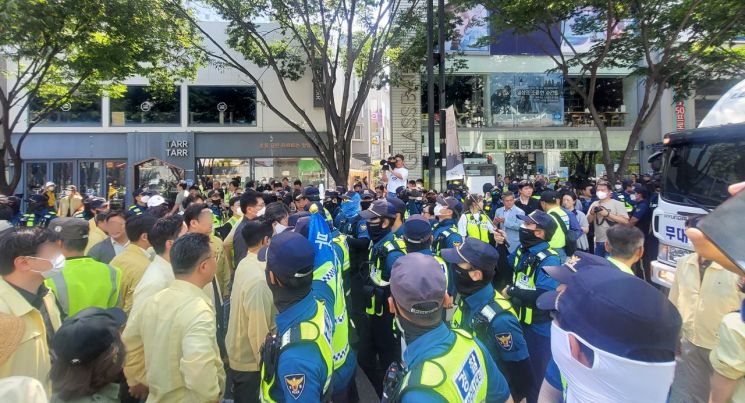 On the morning of the 17th, police officers managing traffic to allow the stage vehicle of the Queer Culture Festival near Banwoldang Station in Jung-gu, Daegu, and Daegu city officials trying to block it are confronting each other. [Image source=Yonhap News]
On the other hand, the Daegu police believe that assemblies reported through proper procedures are recognized as legitimate even without obtaining a road occupancy permit. This is because all citizens have the freedom of assembly (Article 21 of the Constitution), and lawful assemblies and demonstrations must be guaranteed to the maximum extent possible (Article 1 of the Assembly and Demonstration Act).
Furthermore, the police's position is that even if a road occupancy permit was not obtained, administrative enforcement is illegal unless there is a clear threat to public peace and order that justifies forcibly dispersing the assembly, as confirmed by court precedents.
Although the festival ended after just one day on the 17th, the repercussions continue. On the 19th, Mayor Hong warned, "I will hold those responsible accountable to the end, even to establish standards for lawful official duties," and announced plans to request an authoritative interpretation from the Ministry of Government Legislation. The Daegu police also began legal reviews in response.
Meanwhile, the Organizing Committee also announced plans to file complaints and lawsuits. Bae Jin-kyo, the head of the Organizing Committee, told Yonhap News Agency on the same day, "The administrative authorities violated the Assembly and Demonstration Act and there were issues with the administrative enforcement procedures. Administrative enforcement should begin with guidance, but they blocked (the installation of the stage, etc.) from the start," adding, "We will file complaints and lawsuits against the administrative authorities that interfered with the festival as early as next week during the weekdays."
© The Asia Business Daily(www.asiae.co.kr). All rights reserved.

















