The government has launched an inter-ministerial consultative body to address low birth rates and aging population, encompassing changes in demographic structure.
On the 19th, the Presidential Committee on Low Fertility and Aging Society announced the launch of the 'Population Policy Planning Group,' an inter-ministerial consultative body under its jurisdiction, and held a kickoff meeting. The planning group will be jointly led by the First Vice Minister of Strategy and Finance, who has actively responded to demographic changes through the committee serving as the control tower for low fertility and aging society policies and the dedicated Population Crisis Response Task Force (TF), and the First Vice Minister of Health and Welfare, the secretariat ministry of the committee.
The scope of the planning group’s population policy will be expanded from mitigating low birth rates and responding to an aging society to encompassing responses to demographic changes. This reflects consideration of the impact of population decline and demographic changes caused by deepening low birth rates and aging on society as a whole.
First, the planning group’s work will be divided into the 'Low Fertility and Aging Society Policy Subcommittee,' led by the Ministry of Health and Welfare, and the 'Demographic Change Response Policy Subcommittee,' led by the Ministry of Strategy and Finance. The Low Fertility and Aging Society Policy Subcommittee will enhance the quality of care and education and strengthen family-friendly housing services to mitigate low birth rates. To respond to a super-aged society, it will also identify and discuss issues related to medical and care linkage, age-friendly housing, and technology.
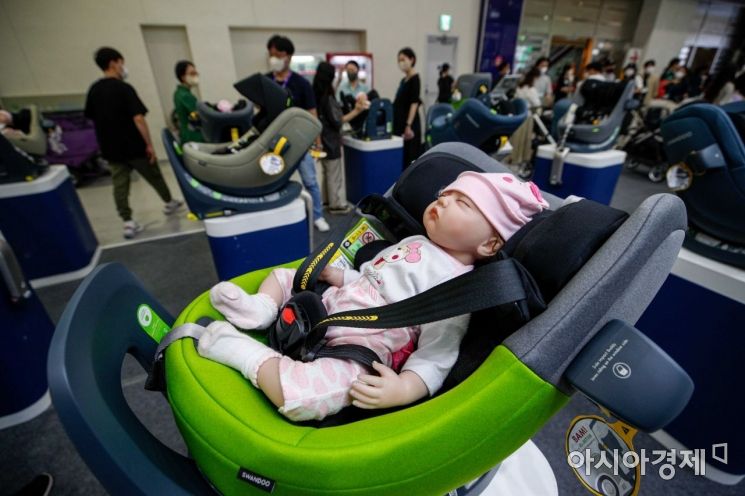 On the 15th, expectant parents attending the '42nd BEBE Baby Fair' held at COEX in Gangnam-gu, Seoul, are looking at childcare products. Photo by Jinhyung Kang aymsdream@
The Demographic Change Response Policy Subcommittee plans to review redesigning national systems, including corporate support projects, to be more child-rearing friendly. This subcommittee will devise measures to expand the economically active population, such as improving the productivity of elderly workers and increasing the introduction of skilled foreign workers. It will also develop systematic responses to regional extinction and the decline in school-age population and military service resources.
The planning group will establish a total of 11 working groups under the subcommittees, in addition to a general working group, to promote discussions on key agendas and identify tasks. Depending on the characteristics of each working group, research institutions and experts will be included to enhance the expertise of discussions.
At the meeting, the 'Population Policy Planning Group Composition and Operation Plan,' operational plans for each subcommittee, and important discussion topics for each working group were presented and discussed. Going forward, key policy tasks will be identified through discussions by working groups and subcommittee meetings, and the results will be announced at the Presidential Committee on Low Fertility and Aging Society and other venues.
Kim Young-mi, Vice Chair of the Committee, said, "Through the Population Policy Planning Group, we plan to discuss mid- to long-term plans for the next 10 years, which is the golden time for addressing Korea’s population issues," and urged, "I ask all ministries to actively engage with a sense of mission and pride in designing the future of the Republic of Korea."
© The Asia Business Daily(www.asiae.co.kr). All rights reserved.

















