Background of Cheonan Ship Sinking Incident... Hardliner Kim Young-chul Returns to Party
Possesses Various Practical Experiences Including North Korea-US Summit Coordination
"Utilized as a Hardline Signal... Possible Deployment in US Negotiations"
Kim Yong-chol, a former secretary for inter-Korean affairs of the Workers' Party and a 'hardliner toward South Korea' accused of being behind the Cheonan sinking incident, has returned to the position of advisor at the United Front Department. Amid U.S. Secretary of State Antony Blinken's visit to China, which has opened the door for dialogue between the U.S. and China, attention is focused on whether North Korea will continue to send 'hardline signals.'
On the 19th, the Korean Central News Agency reported on the Party plenary meeting, stating, "Comrade Kim Yong-chol has been newly elected as a candidate member of the Political Bureau of the Party Central Committee." Kim Yong-chol is a representative 'hardliner toward South Korea,' and his return as a 'candidate member of the Political Bureau,' a political rank necessary for a senior official, is seen as a step toward resuming duties related to South Korea. The Rodong Sinmun specified Kim Yong-chol's title as 'advisor to the United Front Department' on the same day.
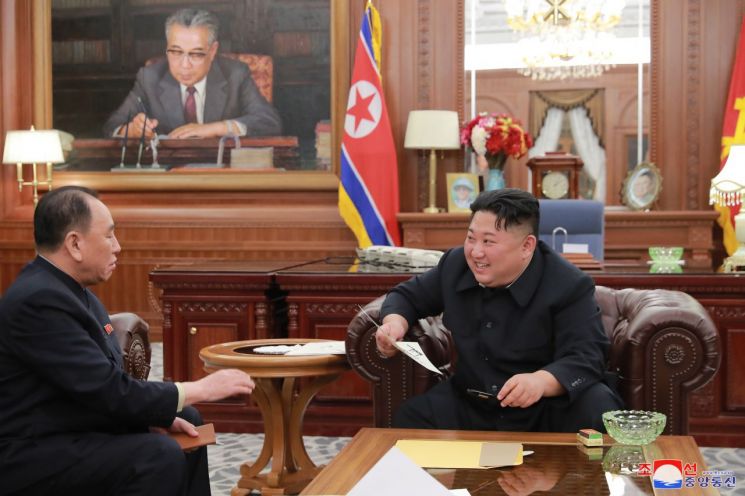 In January 2019, Kim Jong-un, Chairman of the State Affairs Commission of North Korea, met with the North Korea-U.S. high-level talks delegation led by Vice Chairman Kim Yong-chol at the Workers' Party Central Committee building to receive a report on the results of their visit to Washington.
Previously, Kim Yong-chol was effectively demoted to head of the United Front Department when the position of secretary for inter-Korean affairs was abolished at the 2021 Party Congress. Later, at the Party plenary meeting in June last year, he handed over the position of head of the United Front Department to his junior, Ri Son-gwon, and in September of the same year, he was dismissed from the Standing Committee, becoming a 'private citizen.' Until the inter-Korean and U.S.-North Korea talks continued in 2018, he was on the rise, but after the Hanoi U.S.-North Korea summit ended empty-handed in 2019, his influence declined.
However, given his extensive practical experience, he remains an important card for North Korea. Since 1990, he has participated as a representative in high-level inter-Korean talks and served as the North Korean head in the 2006-2007 inter-Korean general-level military talks. He was the chief North Korean representative at the 2000 inter-Korean summit and is known to have led the 'December 1 Measures' in November 2008, which included restrictions on South Korean land access. He was also involved in coordinating the 2018-2019 U.S.-North Korea summits.
From our perspective, he is remembered as the figure behind the 'Cheonan sinking.' When the Cheonan attack occurred in March 2010, during his tenure as director of the Reconnaissance General Bureau, the government pointed to the Reconnaissance General Bureau as the culprit, and the U.S. placed Kim Yong-chol under North Korea sanctions. Later, in April 2018, during a visit to Pyongyang by a South Korean art troupe, Kim introduced himself to South Korean reporters as "the person accused in the South of being the main culprit of the Cheonan sinking," causing controversy.
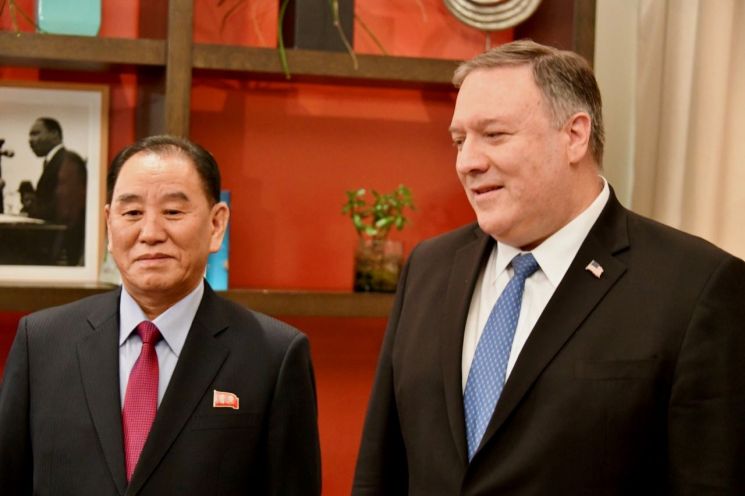 In January 2019, Kim Yong-chol, Vice Chairman of the Workers' Party of Korea and Head of the United Front Department (left), and Mike Pompeo, U.S. Secretary of State, stood side by side.
Several experts emphasize that Kim Yong-chol's return should not be interpreted solely as a 'hardline message toward South Korea and the U.S.' but rather as a 'strategic choice' by North Korea to prepare for future situations. Given his experience directly dealing with former U.S. President Donald Trump and Secretary of State Mike Pompeo in 2018-2019, there is analysis that he could be utilized in negotiations with the U.S.
Park Won-gon, a professor of North Korean studies at Ewha Womans University, evaluated, "Kim Yong-chol is a figure who expresses the most hardline stance on inter-Korean and U.S. issues and is likely to be used when issuing hardline messages." He added, "Kim Yong-chol was considered a 'persona non grata' in the U.S. ahead of the U.S.-North Korea summit, to the extent that the U.S. requested a personnel change due to stalled talks. From North Korea's perspective, such a figure is rather necessary when dealing with the U.S."
Im Eul-chul, a professor at the Institute for Far Eastern Studies at Kyungnam University, said, "Kim Yong-chol is expected to play a significant role in assessing and responding to inter-Korean and U.S. affairs." For example, after former First Vice Minister of Foreign Affairs Kim Kye-gwan stepped down from frontline duties, he took on an 'advisor' role and opposed the U.S.-North Korea summit by claiming "we were deceived by the U.S.," playing the villain role. Similarly, Kim Yong-chol might be assigned the role of a 'loudspeaker.'
Meanwhile, Kim Yong-chol is currently linked to allegations of 'illegal remittances to North Korea.' It is known that former Ssangbangwool Group chairman Kim Sung-tae received a personal letter from Kim Yong-chol. In May 2019, Kim Sung-tae signed an economic cooperation agreement with the North Korean National Economic Cooperation Federation (MinKyungRyun) in Dandong, China. Prosecutors believe that at that time, Kim Sung-tae received a personal letter from Kim Yong-chol, then chairman of the Korea Asia-Pacific Peace Committee, urging efforts for economic cooperation.
© The Asia Business Daily(www.asiae.co.kr). All rights reserved.


















