Lankwang and Yanggwangcheong Also Delisted
IB Industry Forecasts L-Shaped Recession
Chinese real estate companies are being consecutively delisted from local stock markets. As the real estate market recovery delays and performance worsens, their stock prices have plummeted, leading to forced delisting.
According to Chinese economic media Caixin on the 19th, Chinese real estate company Yangguangcheng received a preliminary delisting notice from the Shenzhen Stock Exchange on the 13th. This was because its stock price fell below the delisting requirement of "less than 1 yuan (approximately 179 won) for 20 consecutive trading days." Yangguangcheng was once called a 'dark horse' in the real estate industry and was a rapidly growing company.
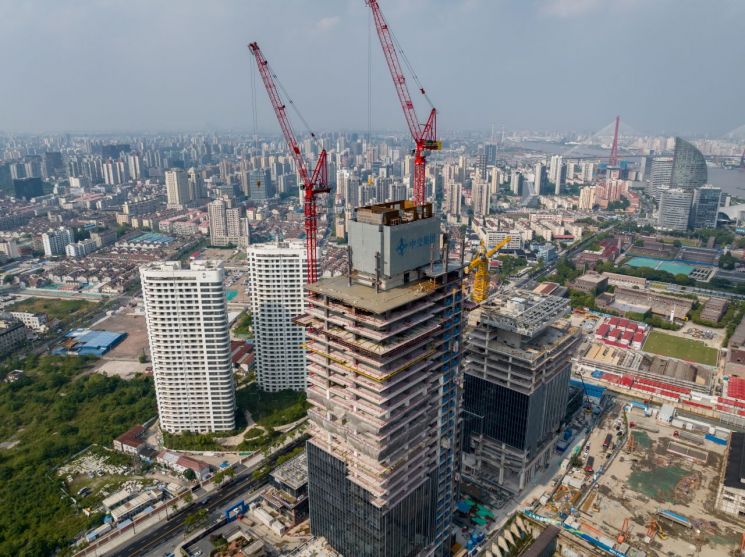
Earlier, on the 2nd, Sichuan real estate conglomerate Langguang's delisting was decided. Both Yangguangcheng and Langguang are large-scale companies ranked among China's top 100 real estate firms. Yangguangcheng's revenue in 2020 was 218 billion yuan, and Langguang's revenue reached 103.5 billion yuan. However, it is known that the situation sharply deteriorated starting from 2021, during the height of the COVID-19 crisis.
According to Caixin data, as of the 14th, there are nine A-share listed real estate companies whose closing prices have been below 1 yuan for 20 consecutive trading days. Several companies, including Jinke Real Estate, ST Simao, and Zhongnan Construction, are trading between 1 and 1.5 yuan and are on the verge of delisting. According to recent statistics from Bank of China Securities, only 10 real estate companies have been delisted (A-share basis) over the past 21 years from 2001 to last year. If all the crisis-hit companies are delisted, an unprecedented 'record-breaking' wave of delisting will sweep through the Chinese stock market.
The biggest problem is that the recovery of the Chinese real estate market seems distant. Deng Hao, CEO of Beijing GEC Asset Management, told Caixin, "The biggest problem is the sluggish real estate market," adding, "The companies being delisted mainly have high debt ratios that become riskier during economic downturns." An industry insider explained, "Housing demand briefly revived until the end of March, but market transactions have sharply declined again."
Real estate listed companies are raising funds to overcome the crisis. Since the end of May, six local real estate companies including Shekou, Zhongjiaotichan, Fuxing Real Estate, Damingcheng, Lujiazui, and Baoli Development have conducted capital increases. According to a research report released by Guojin Securities on the 11th, the scale of these capital increases is estimated to exceed 40 billion yuan.
The Chinese government is reportedly considering large-scale stimulus measures to revive the prolonged real estate market. The Wall Street Journal (WSJ) recently reported, citing sources, that China is considering issuing special government bonds worth about 1 trillion yuan to be used for new infrastructure construction and economic stimulus projects.
However, the investment banking industry leans toward the view that the Chinese real estate downturn will be prolonged. A team of Goldman Sachs analysts led by Chinese economist Wang Lisheng stated in an investor note on the 11th, "Due to demographic demand decline, shifts in government stimulus policy focus, and weakened home purchasing power, the Chinese real estate market will experience a multi-year downturn," predicting that the Chinese real estate market will continue an L-shaped recession for the coming years.
© The Asia Business Daily(www.asiae.co.kr). All rights reserved.
![From Hostess to Organ Seller to High Society... The Grotesque Scam of a "Human Counterfeit" Shaking the Korean Psyche [Slate]](https://cwcontent.asiae.co.kr/asiaresize/183/2026021902243444107_1771435474.jpg)
















