The government has raised the issue of the appropriateness of the recent price increase of ramen, a representative staple food for the common people. While the price of wheat, the main ingredient of ramen, has fallen by nearly half compared to a year ago, the ramen industry has steadily raised prices during the same period. The government recently recommended that the industry reflect the international wheat price trends, but the market believes that since there is a time lag of up to six months for international wheat prices to be reflected in actual import prices, the situation needs to be reviewed from multiple perspectives.
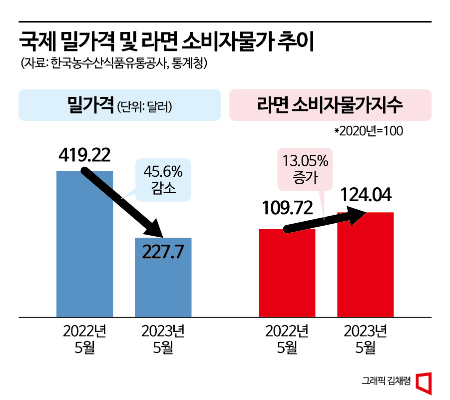
According to the Food Industry Statistical Information of the Korea Agro-Fisheries & Food Trade Corporation (aT) on the 19th, the international wheat (SRW) price in May was $227.7 per ton, down 45.6% from the same month last year ($419.22). The wheat price, which hit its highest point in May last year, has since been on a downward trend. On the other hand, the consumer price index for domestic ramen during the same period reached an all-time high of 124.04. Compared to a year ago (109.72), it rose by 13.05%. This is the largest increase in 14 years and 3 months since February 2009 (14.3%) during the global financial crisis.
The price increase of ramen is higher than that of bread (11.5%) and cakes (9.5%), which also use flour as their main ingredient. This figure is about 9 percentage points higher than the consumer price increase rate of 3.9% for 'food and non-alcoholic beverages' reported by Statistics Korea last month. This is also why Deputy Prime Minister and Minister of Economy and Finance Choo Kyung-ho recommended the day before that "companies should appropriately lower prices in line with the decrease in wheat prices."
The government's direct mention of the appropriateness of ramen prices is interpreted as a judgment that, unlike the recent stabilization of consumer prices, the prices of staple foods for the common people have not yet been properly controlled. It is expected that by normalizing the prices of representative staple foods, starting with ramen prices, the effect of entering the 2% range of consumer price inflation next month will be fully realized.
However, it is uncertain how much the ramen industry will reflect the government's recommendation. This is because it takes about six months of lag time to actually reflect the international wheat import price in the product price. Some in the industry expressed discomfort with the government's direct mention of ramen prices and the pressure to adjust prices. A distribution industry official said, "In a situation where prices of products using wheat as a raw material, such as bread and spaghetti, have all risen due to the increase in international wheat prices, directly mentioning ramen items sounds like an instruction for artificial price adjustment."
In response, the government drew a line, saying it is not controlling ramen prices. Deputy Prime Minister Choo emphasized, "The government cannot investigate costs and control prices." Meanwhile, the government expects the consumer price inflation rate to enter the 2% range this month and anticipates that the trade balance will turn to a surplus as early as August or September, signaling the start of an economic upturn in the second half of the year. Some expect that, following this trend, the government will focus its economic policy direction in the second half of the year on responding to the economy.
© The Asia Business Daily(www.asiae.co.kr). All rights reserved.

















