Favorable Response from Women's Community "Respect for Decision-Making Authority"
"A woman's most powerful strength is choosing not to have a baby."
Recently, an online debate has erupted over a one-line full-page advertisement that appeared in a newspaper. Especially amid South Korea's deepening low birthrate crisis, fierce controversy surrounds women's 'reproductive choice' and the nation's sustainability.
The ad became known after a Twitter user captured and posted it on the 17th. It was a paid full-page ad on page 5 of the March 14th edition of the Mi Ju Hanguk Ilbo (Korean American Daily), featuring only the phrase "A woman's most powerful strength is choosing not to have a baby" on a white background. The person who placed the ad is known by the name 'Bang Seong Sam.'
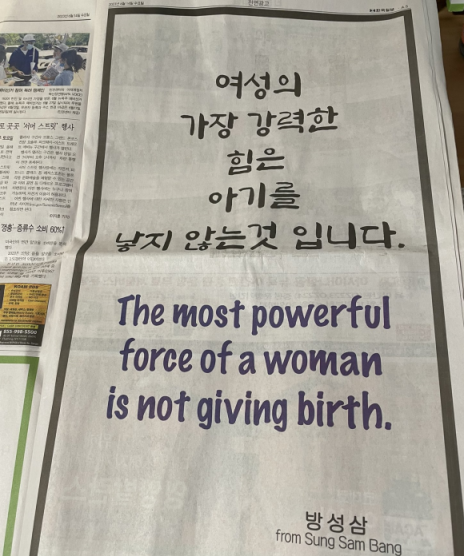
The user who captured the ad said, "This is a personal full-page ad. This spirit is so admirable," but also added, "I am curious about what story led to this thought and action."
The image quickly spread across other social networking services (SNS) and online communities.
As the ad became known, netizens' perspectives sharply diverged.
On women-centered online communities, the response was favorable. One cafe user pointed out, "Women bear almost all the physical and mental risks of childbirth alone, but our society has long regarded childbirth as a public matter." Another netizen emphasized, "We must respect women's right to self-determination."
On the other hand, male-dominated communities reacted strongly. Comments such as "In reality, with low birthrates, the future labor population will shrink and only the dependent population will grow, causing hardship in old age," and "If you don't want to continue the family line, then go to the military," gained sympathy.
Meanwhile, according to the 'March 2023 Population Trends' released by Statistics Korea on the 24th of last month, the total fertility rate for the first quarter of this year (January to March) was 0.81, marking the lowest ever for a first quarter. This is 0.06 lower than the previous lowest of 0.87 in the first quarter of last year.
The total fertility rate is the sum of the expected number of children a woman of childbearing age will have in her lifetime, meaning couples are having less than one child on average throughout their lives. South Korea's total fertility rate has not exceeded 1.0 for 16 consecutive quarters since the first quarter of 2019.
© The Asia Business Daily(www.asiae.co.kr). All rights reserved.

















