Writers' Union Launches Largest-Ever Strike Since Last Month
KOCCA Analyzes Market Changes Due to OTT Growth
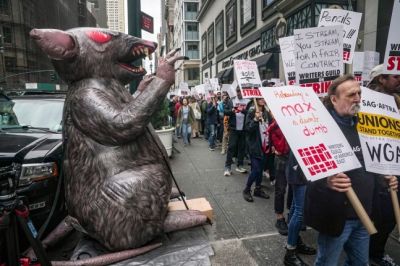
The strike by the Writers Guild of America (WGA), which began on May 2 (local time), is becoming prolonged. This strike, involving about 15,000 union members, is the largest since 2007 and 2008, and the union leadership approved the strike unanimously.
In this context, an analysis has emerged that the fundamental cause of the WGA strike is the rapid growth of global online video services (OTT) such as Netflix.
The WGA, which has gone on strike, criticizes the unfair contracts of global OTT companies. Writers argue, “Although the production environment has changed significantly since OTT became the mainstream for broadcasting and movies, treatment remains the same,” and claim that “compensation also needs to change.”
According to the WGA, the number of episodes per season of OTT series is fewer than in the past, and there are no reruns from overseas broadcasts, but the overall workload has increased.
In response, Korean writers have also expressed concerns that unfair practices common in domestic broadcasters and production companies will worsen with the development of OTT and artificial intelligence (AI), and have held solidarity protests.
The Korea Creative Content Agency recently analyzed in its publication “U.S. Content Industry Trends” that “the expansion of the streaming industry since 2019 has opened markets for scenario writers but has also caused a decline in writers’ income.”
Before the COVID-19 pandemic began in 2019, in addition to existing platforms such as Netflix, Amazon Prime, Peacock, and HBO Max, Apple TV Plus, DC Universe, and Disney Plus were established, ushering in an era of intense competition among OTT platforms.
Since 2016, when OTT began producing original content in earnest, the number of writers earning income increased significantly, and this upward trend continued until 2019. However, after 2019, it dropped by 9% and has been declining steadily since.
The Korea Creative Content Agency explained, “This pattern is also seen when looking at writers’ annual income.” This is because opportunities for so-called ‘syndication’ in the OTT market have decreased, causing this phenomenon.
Syndication refers to the method of delivering TV series directly from production companies to individual independent broadcasters without going through a network. This has historically accounted for a large portion of writers’ income.
The Korea Creative Content Agency explained, “The growth of OTT platforms has changed the market centered on syndication, and the number of series that can meet the syndication standard of 100 episodes has gradually decreased.”
They added, “Although the total number of production titles has increased significantly due to the rise in OTT platform productions, episodes have decreased because they do not follow the scheduling of terrestrial TV or cable networks. Ultimately, the workload has increased, but the frequency of income payments has decreased, and writers have had to divide the allocated money into smaller amounts.”
They further predicted, “The monopoly situation of OTT platforms is expected to continue,” and “the emergence of generative AI and the resulting decrease in writer employment will also impact the industry.”
Meanwhile, regarding this strike, major studios agree on the need for change but believe that now is not the time for major changes. They argue that worsening business conditions prevent them from fully accepting writers’ demands. Netflix experienced its first net subscriber decline in 10 years last October, and Disney, which operates Disney Plus, recently laid off about 7,000 employees.
© The Asia Business Daily(www.asiae.co.kr). All rights reserved.
![Clutching a Stolen Dior Bag, Saying "I Hate Being Poor but Real"... The Grotesque Con of a "Human Knockoff" [Slate]](https://cwcontent.asiae.co.kr/asiaresize/183/2026021902243444107_1771435474.jpg)











