Considering Overseas Market Expansion and International Sanctions
Also Mindful of This Year's Scheduled Initial Public Offerings (IPO)
The number of Chinese companies relocating their headquarters abroad due to various international sanctions against China has increased.
On the 15th (local time), foreign media including The New York Times (NYT) reported that many Chinese companies have made such decisions with overseas markets in mind. The media interprets this as preparatory work for initial public offerings (IPOs) expected to be implemented in the United States within this year.
The most representative company is the Chinese fashion company 'Shein,' which rose to the top of the fast fashion industry based on the internet. Founded in 2008, Shein recently moved its headquarters to Singapore and canceled its corporate registration in Nanjing, China.
It also established branches in Ireland and Indiana, USA, and contracted with a lobbying firm in Washington DC.
Shein recently emphasized in a statement, "We are a multinational company operating in 150 markets worldwide."
Shein has faced allegations that it produced products using cheap textiles made with forced labor within China, which allowed it to overwhelm competitors with low-priced goods.
Such allegations could become obstacles to a mega IPO expected to exceed $100 billion (approximately 130 trillion won). Therefore, the move to relocate the headquarters is interpreted as an attempt to remove as much Chinese association as possible.
Chinese major e-commerce company Pinduoduo's overseas shopping app 'Temu' established its headquarters in Boston. Temu, which entered the US market in September last year, has gained popularity by offering various low-priced products. Earlier this year, it also expanded into Canada, Australia, and New Zealand.
Pinduoduo, the parent company of Temu, also moved its headquarters from China to Ireland.
Chinese company 'JinkoSolar,' which produces 10% of the world's solar panels, recently relocated its production facilities abroad.
This is a measure to circumvent export regulations, as the US has imposed anti-dumping tariffs on Chinese solar panels since 2012 and blocked the customs clearance of solar panels from Chinese companies suspected of using forced labor in the Xinjiang Uygur region.
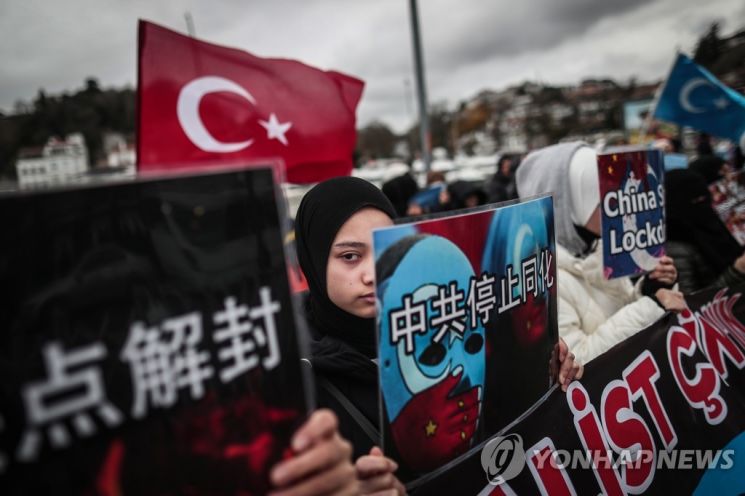 A rally criticizing the Chinese government's oppression of the Uyghur people. [Image source=Yonhap News]
However, it is uncertain whether the 'strategy' of Chinese companies to remove Chinese association by relocating their headquarters will yield results.
Even if Shein or Temu relocate their headquarters, it is difficult to shake off the perception that they are Chinese companies as long as they sell Chinese-made products to consumers.
Marco Rubio, a Republican U.S. Senator from Florida who is leading the political response to forced labor issues in the Xinjiang Uygur region, recently stated, "No matter how much Shein tries to hide, no one can be fooled."
© The Asia Business Daily(www.asiae.co.kr). All rights reserved.


















