Ministry of Land, Infrastructure and Transport Announces Supply of Two New Public Housing Sites
Total of 39,000 Units to be Supplied... Districts to be Designated Next Year
Land Transaction Permission Zones Designated to Prevent 'Speculation'
On the 15th, the Ministry of Land, Infrastructure and Transport announced that it will supply new public housing sites capable of accommodating a total of 39,000 households (including 20,000 New:Home units) in the Jije Station area of Pyeongtaek City, Gyeonggi Province, and the Munsan-eup area of Jinju City, Gyeongsangnam-do. The plan is to complete the designation of the districts in the second half of next year, obtain district plan approval by 2026, and then implement the New:Home pre-subscription. New:Home is the new name for public sale housing under the Yoon Seok-yeol administration.
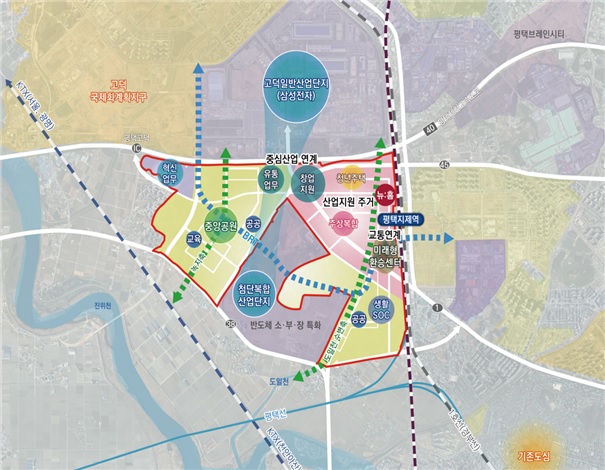 Development Concept Map of Pyeongtaek Jije Station Area Public Housing District / Image provided by Ministry of Land, Infrastructure and Transport
The Pyeongtaek Jije Station public housing site will be developed as a "self-sufficient compact city." The area spans 4.53 million square meters, which is 1.56 times the size of Yeouido in Seoul, and will accommodate a total of 33,000 households. It will be developed in a compact and high-density manner by improving residential conditions through enhanced access to living infrastructure and the supply of New:Home units.
It aims to function as a residential complex supporting the "semiconductor mega cluster" extending through Pyeongtaek, Hwaseong, and Yongin. The Ministry of Land explained that considering the increase in young people and key talents due to the presence of advanced semiconductor complexes such as the Godeok General Industrial Complex and Pyeongtaek Brain City nearby.
To strengthen self-sufficiency, a convergence and complex industrial cluster supporting the national advanced semiconductor industry will also be established. This is expected to enable linked research and development (R&D) among large corporations, small and medium-sized enterprises, and startups, as well as support for startup scale-up.
The Ministry of Land will leverage the advantage of the Pyeongtaek Jije Station site being an existing major transportation hub, and also improve conditions for extending the Seoul Metropolitan Area Express Railway (GTX) lines A and C. A Bus Rapid Transit (BRT) system connecting Godeok International New City and Pyeongtaek City Hall will be established, and roads connecting the old town (West Pyeongtaek) and the new town (East Pyeongtaek) will be expanded and developed into multi-level roads.
Additionally, to lead the transition to future mobility services such as user-centered Urban Air Mobility (UAM), a complex transfer center will be constructed to align the urban spatial structure with mobility flows.
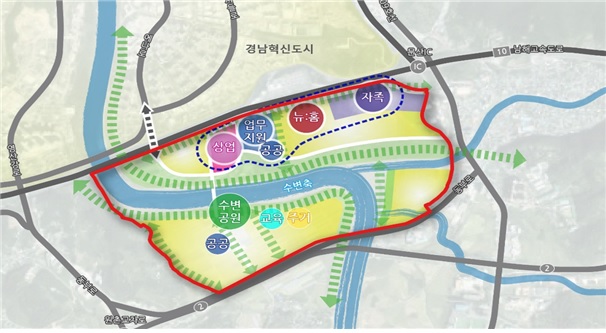 Development Conceptual Plan for Jinju Munsan Public Housing District / Image provided by the Ministry of Land, Infrastructure and Transport
The Jinju Munsan public housing site covers an area of 1.4 million square meters and will accommodate 6,000 households. It is a government-designated satellite-specialized zone within the space industry cluster and provides high-quality residential complexes in the western region of Gyeongsangnam-do, where major companies in the space and aerospace sectors such as Korea Aerospace Industries (KAI) are located.
The Ministry of Land plans to enhance the self-sufficiency of this area by arranging social overhead capital (SOC) facilities and community spaces linked with Jinju Innovation City and Munsan IC. Along with a waterside village, the Yeongcheon River within the district will be developed into an ecological stream to improve the quality of life for local residents.
Regarding the metropolitan transportation connection and expansion plan for the area, it will enable access within 10 minutes by connecting Jinju Station (serving KTX and SRT) and Jinju Express Bus Terminal (scheduled for 2025). Furthermore, with the opening of the Southern Inland Railway in 2027, travel time from Seoul to Jinju will be reduced to approximately 2 hours and 20 minutes.
The Ministry of Land also announced measures to prevent speculation on these public housing sites. First, an investigation targeting all employees of the Ministry of Land and Korea Land and Housing Corporation (LH), as well as their direct relatives, found no landowners within the districts.
Regarding actual transactions, based on records from the past five years, explanatory materials will be sent for suspicious transactions, and detailed investigations will be conducted through collection procedures. To block speculative land transactions, the public housing sites and surrounding areas will be designated as land transaction permission zones, and development activities will be restricted to prevent speculative compensation claims.
A Ministry of Land official stated, "We will form a joint inspection team with metropolitan and local governments to conduct practical crackdowns. Illegal transactions and speculative activities detected will be reported to related agencies such as the National Police Agency and the National Tax Service to ensure criminal investigations, imposition of fines, and tax evasion analyses are carried out."
© The Asia Business Daily(www.asiae.co.kr). All rights reserved.


















