Lifting Investment Restrictions, Designation of Opportunity Development Zones, and Strengthening Incentives
Gwangyang City in Jeollanam-do announced that, amid a surge in investment in the secondary battery materials industry centered on the POSCO Holdings group companies, it will develop Gwangyang into a global 'secondary battery industry specialized city.'
To this end, the city plans to nurture the secondary battery materials and components industry as a core future industry by lifting investment regulations, designating opportunity development zones, and strengthening investment attraction incentives.
With the expansion of electric vehicle production, recognized as a key means to achieve the global carbon neutrality goal, the importance of the secondary battery materials industry is increasing. The enactment of the U.S. Inflation Reduction Act (IRA) and the draft announcement of the EU's Critical Raw Materials Act (CRMA) have become opportunities for the POSCO Group, which has proactively secured raw material supply chains.
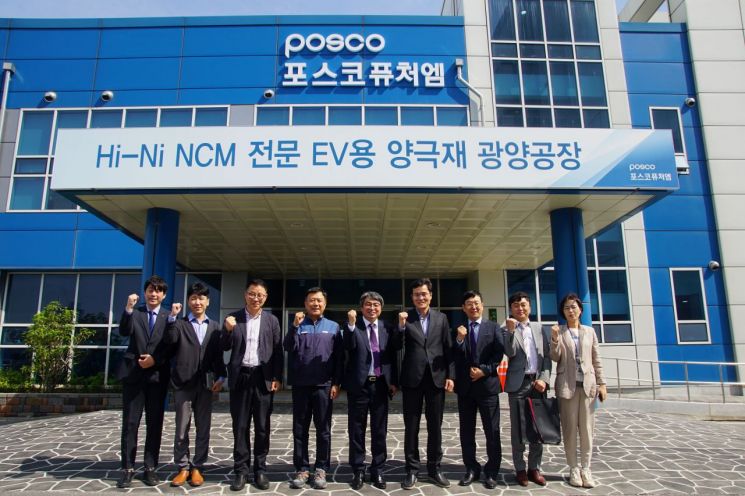
In Gwangyang Yulchon 1 Industrial Complex, POSCO Future M's cathode material production plant, the world's largest single factory of its kind, was comprehensively completed in November last year. The Gwangyang plant produces about 90,000 tons of cathode materials annually, enough for approximately one million high-performance electric vehicles.
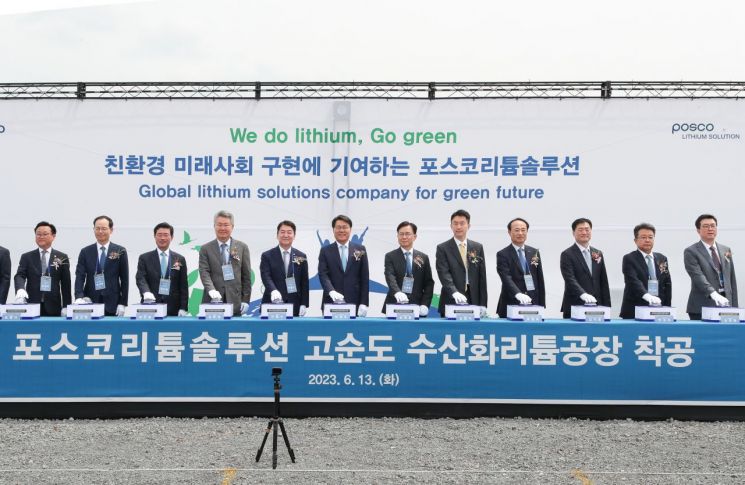
Nearby, POSCO HY Clean Metal Co., Ltd. began its first mass production in June this year, recycling used batteries to extract lithium, nickel, and cobalt. POSCO Philbar Lithium Solution Co., Ltd.'s 43,000-ton annual lithium hydroxide production plant had its first phase completed in October this year and is scheduled for full completion in February 2024.
Additionally, S&NC Co., Ltd., located in Donghoan of the Gwangyang National Industrial Complex, produces high-purity nickel, and CIS Chemical Co., Ltd. in the Sepung Industrial Complex plans to produce cathode materials and precursors.
Thus, Gwangyang City is gaining attention as a city with optimal conditions for the global growth of the secondary battery industry, with a production value chain centered on POSCO Holdings Group that covers raw material supply and processing, intermediate and final material production, and used battery recycling.
Accordingly, the city plans to boldly lift regulations hindering investment and respond swiftly to the global battery industry's rapid pace through prompt administrative support such as one-stop permits.
▲ Lifting Regulatory Restrictions That Hampered Future Industry Investment
On April 19, Prime Minister Han Duck-soo visited the site to resolve regulations for developing the Donghoan reclaimed land in the Gwangyang National Industrial Complex and promised to revise the Enforcement Decree of the Industrial Location Act by June this year, opening the way for POSCO Holdings Group's future industry investment.
The reclaimed land was restricted under current laws to steel-related industries only, and only POSCO was allowed as a tenant, causing difficulties in timely supply of industrial land for new industries such as secondary batteries, hydrogen, and energy industries.
To resolve this, since October last year, Mayor Jeong In-hwa, Deputy Mayor Joo Soon-seon, and related officials have continuously consulted with central government ministries, National Assembly members Seo Dong-yong and Jo Soo-jin from the People Power Party, and other lawmakers across parties to discuss improvement measures.
Originally, in 1989, POSCO obtained development plan approval from the Ministry of Land, Infrastructure and Transport for expanding the Gwangyang Steelworks facilities and constructing a slag treatment plant on Donghoan, sequentially expanding steel-related facilities and infrastructure. Of the 950,000 pyeong of reclaimed land, 270,000 pyeong has been reclaimed, with plans to reclaim the remaining 680,000 pyeong by 2050.
POSCO Holdings Group announced a 4.4 trillion KRW investment plan over 10 years for the Donghoan site, forecasting an annual production inducement effect of 3.6 trillion KRW and employment inducement of about 9,000 jobs per year.
The Donghoan regulatory reform is expanding a second economic territory on the dormant 950,000 pyeong of reclaimed land, breathing new life into future growth industries. This bold deregulation has created a groundbreaking turning point not only for POSCO Holdings Group but also for the development of new industries in Gwangyang City.
▲ Application for Designation as a Secondary Battery Industry ‘Opportunity Development Zone’
On May 25, Gwangyang City, in line with the passage of the 'Special Act on Decentralization and Regional Balanced Development,' is jointly responding with Jeollanam-do and Jeonnam TP to apply for designation as an 'Opportunity Development Zone,' one of the current government's key national tasks.
The Opportunity Development Zone is a special zone to promote investment outside the metropolitan area. Governors of non-metropolitan provinces apply to the Minister of Trade, Industry and Energy for designation, and the final selection is made through deliberation and resolution by the Local Era Committee, scheduled to officially launch in July.
Companies investing in the Opportunity Development Zone receive exceptional tax benefits such as reductions in corporate tax, income tax, property tax, and acquisition tax, along with administrative support including rapid regulatory confirmation, test exemptions, and temporary permits, encouraging corporate relocation to local areas and expanding regional investment.
To secure designation as an Opportunity Development Zone, the city has operated a joint task force (TF) led by Deputy Mayor Joo Soon-seon since January, involving companies, universities, and administrative agencies, and began a feasibility study with Jeonnam Province on the 12th.
The Ministry of Trade, Industry and Energy is currently coordinating with the Ministry of Economy and Finance, Ministry of Land, Infrastructure and Transport, and others to prepare detailed guidelines on tax benefits and regulatory relief measures, with plans to announce a call for applications by the end of this year or early next year.
Gwangyang City, together with Jeonnam Province and Jeonnam TP, will form a consultative body with experts including companies, universities, and researchers to precisely analyze and reflect in the business plan the investment scope, scale, workforce training plans, participation of partner and small businesses, and improvement of living conditions.
The city expects that the first designation as an Opportunity Development Zone will not only expand investment in the secondary battery industry but also significantly boost the advancement of the industry and the formation of upstream and downstream industrial value chains.
▲ Expansion of Investment Incentives Including Subsidies for Investing Companies
Through a complete revision of the 'Gwangyang City Investment Promotion Ordinance,' the city plans to greatly improve investment conditions with groundbreaking support measures such as site and facility subsidies, infrastructure support, support for domestic return companies, and agency services for land purchase for strategic industry investors.
In addition, the city is implementing expanded subsidy support policies such as support for issuance fees of performance guarantee insurance certificates and site subsidies for the Iksin Industrial Complex, reducing the burden on investing companies and creating a business-friendly urban environment.
To ensure the full settlement of investing companies in the region, the city will strengthen infrastructure development such as site preparation, water and power supply, and follow-up management through continuous communication with companies.
Mayor Jeong In-hwa of Gwangyang said, "Following the steel industry, which has been Gwangyang's main industry, the battery industry infrastructure is being expanded and investment attraction is actively progressing. We will spare no support to help Gwangyang become a global 'secondary battery industry specialized city' with world-class competitiveness based on the battery industry."
Meanwhile, the secondary battery industry has attracted investments totaling 2.8852 trillion KRW and created 1,259 jobs in Gwangyang's Yulchon 1 and Sepung Industrial Complexes to date.
Furthermore, on the 145,000-pyeong former Hanla IMS site in Yulchon 1 Industrial Complex, following the lithium hydroxide plant of Lithium Hydroxide Solution, which broke ground on the 13th, POSCO Future M's cathode material plant and others are scheduled to invest 3.18 trillion KRW and create 832 jobs by next year.
Asia Economy Honam Reporting Headquarters, Reporter Heo Seon-sik hss79@asiae.co.kr
© The Asia Business Daily(www.asiae.co.kr). All rights reserved.


















