Solutions for Regional Extinction Emphasize Local-Based Branding
Local Brand → Reputation Building → Virtuous Cycle of Population Growth
"Support for Youth Creator Communities Must Increase"
Professor Mo Jong-rin of Yonsei University Graduate School of International Studies, known as the "Alleyway Economist," emphasized on the 14th that "active investment is needed to discover local brands based on regions" as a solution to regional extinction.
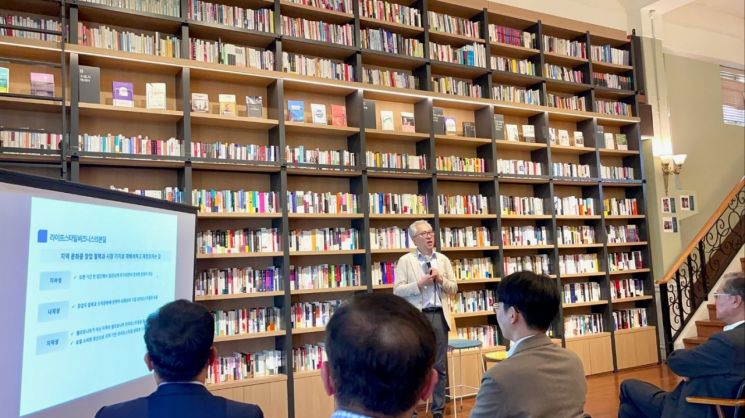 Professor Mo Jong-rin of Yonsei University Graduate School of International Studies is giving a lecture on "The Spirit of the Age of Regional Regeneration" at a bookstore in Gangnam, Seoul, on the 14th. Photo by Korea Institute for Industrial Economics and Trade
On the same day, Professor Mo gave a lecture titled "The Spirit of the Age of Regional Regeneration" at a bookstore in Gangnam, Seoul. At the lecture hosted by the Korea Institute for Industrial Economics and Trade, he said, "Building a reputation through local branding can create a virtuous cycle where young people gather and lead to job creation," adding, "There must be local culture and local brands that cannot be experienced elsewhere to sustain the tourism industry." He stressed the importance of irreplaceable regional uniqueness.
He cited Jeju Island and Yangyang in Gangwon Province as successful examples of domestic local branding. He said, "These areas are in the provinces, but they are neighborhoods where you can enjoy urban culture at the level of Seoul," emphasizing, "There should be 'small cities' with residential conditions even in rural areas." He evaluated, "Starting from Jeju and Gangwon, other domestic cities are now trying to follow," and said, "A new opportunity has come for regional development." He further emphasized, "When independent regional culture and identity develop, new business models emerge and global lifestyle companies can appear." According to Professor Mo, lifestyle is a reinterpretation and recreation of regional culture based on entrepreneurial philosophy and market value.
However, he pointed out that competitiveness in the global market is still lacking. He said, "Starbucks (Seattle), Nike (Portland), and IKEA (Sm?land) all started from the lifestyle of small cities and grew into global brands exported worldwide," diagnosing, "Korea lacks a lifestyle worth exporting overseas, so domestic living industry companies have weak competitiveness." Professor Mo stated, "Korean export industries are 'Korean-style,'" and said, "Idols leading K-pop culture are not 'artists' but merely 'people mobilized' by K-pop." He advised, "The lifestyle that a brand advocates should be clearly defined and exported overseas as is."
Professor Mo emphasized that active government support for talent development is necessary to succeed in local branding. This means discovering small business owners who can create unique content, so-called 'Creators (content creators).' He pointed out, "There are no startup education institutions in the regions," and proposed, "The establishment of a 'Local Content Promotion Agency' can also be considered." He also stressed, "Support for regional creator communities led by young people is needed," and added, "Regional youth should be able to find their own content style and move toward developing business models."
© The Asia Business Daily(www.asiae.co.kr). All rights reserved.
![User Who Sold Erroneously Deposited Bitcoins to Repay Debt and Fund Entertainment... What Did the Supreme Court Decide in 2021? [Legal Issue Check]](https://cwcontent.asiae.co.kr/asiaresize/183/2026020910431234020_1770601391.png)
















