Significant Relaxation of Japan's Child Allowance Eligibility
Mid-3 Trillion Yen Budget Expected
Criticism Over Insufficient Relief for Youth Economic Anxiety
Japanese Prime Minister Fumio Kishida, who has emphasized solving the low birthrate issue since the beginning of his term, directly announced a childbirth promotion policy on the 13th. The Kishida Cabinet identified the cause of the low birthrate problem as the decline in income among young people and focused on increasing cash support. However, some critics argue that the policy is short-sighted and fails to fundamentally resolve the economic insecurity of young people.
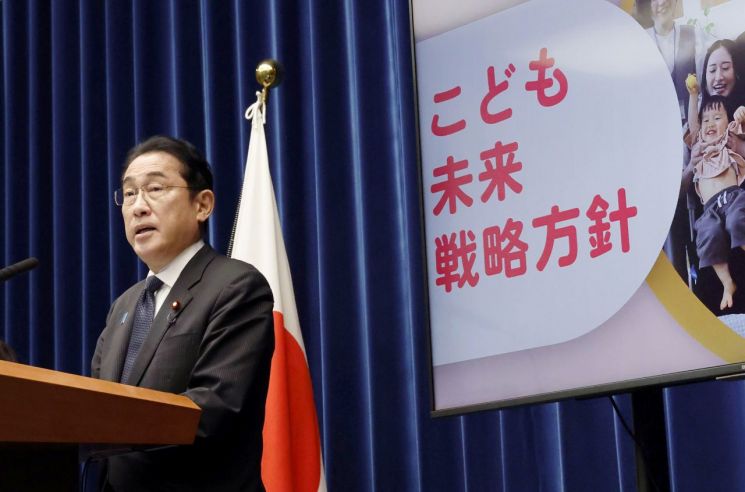 Japanese Prime Minister Fumio Kishida held a press conference on the 13th and directly announced measures to address the low birthrate.
 [Image source=Yonhap News]
On the 13th, Prime Minister Kishida held a press conference and announced a comprehensive low birthrate countermeasure called the ‘Children’s Future Strategy Policy.’ The main point of this policy is that the government will support the costs of child-rearing and childbirth.
First, the age range for child allowance payments will be extended from the current middle school level to high school students. Accordingly, starting from October, infants under 3 years old will receive a monthly child allowance of 15,000 yen (approximately 126,000 KRW) per child, and children aged 3 to high school students will receive 10,000 yen (approximately 90,000 KRW) per month. For the third child and beyond, 30,000 yen (approximately 270,000 KRW) per month will be provided.
In addition, measures to increase the childcare leave benefit rate were proposed to prevent monthly income from decreasing due to childcare leave. From the year after next, a policy will be introduced to support parents raising children under 2 years old so that their actual monthly salary does not decrease even if their working hours are reduced. The target recipients of scholarship-type benefits, previously given to low-income groups, will also be expanded to focus on middle-income households (with an annual income of 6 million yen or less), including families with multiple children and students in science and engineering fields.
The Japanese government estimates that a budget in the mid-3 trillion yen range will be required to implement these policies. Of this, 1.2 trillion yen, approximately 10 trillion KRW, will be spent on child allowance payments.
The reason this low birthrate policy focuses on cash support is that the Japanese government has pointed to the decline in income among young people as the cause of the falling birthrate. Prime Minister Kishida stated, "The major factors behind the rise in the unmarried rate and the decline in the birthrate are income issues among the younger generation," and emphasized that it is difficult to raise the birthrate unless a society is created where young people can marry and have children. Accordingly, the Japanese government placed policy emphasis on cash support measures to ensure that household income does not decrease even if children are born.
However, some critics argue that cash-based policies alone are insufficient to raise the birthrate. They claim that the low-wage structure is the fundamental reason why young people choose not to marry and have children. The Nihon Keizai Shimbun cited statistics compiled by the Ministry of Internal Affairs and Communications in 2017, stating, "The marriage rate for men with an annual income of around 6 million yen was 74.8%, but for those earning between 2.5 million and 2.99 million yen, the marriage rate was only 38%," and criticized that "increasing child allowances cannot be seen as a policy for young people who do not want to marry and have children due to economic insecurity."
There were also remarks that cash support policies should be accompanied by family-friendly management in companies. Germany, which implements cash-focused low birthrate policies, has increased the birthrate by having the government and companies collaborate to extend fathers’ childcare time. The Nihon Keizai emphasized, "To increase fathers’ childcare time, the usage rate of paternity leave by men must be raised, but as of 2021, only 14% of men took leave," and stressed that "the burden of household chores, which is skewed toward women, must be reduced while promoting men’s use of childcare leave."
© The Asia Business Daily(www.asiae.co.kr). All rights reserved.

















