KMA Reduces Typhoon Forecast Interval from 6 Hours to 3 Hours
Due to rising sea temperatures, forecasts indicate that a 'monster typhoon' could make landfall in South Korea this summer.
According to the Korea Meteorological Administration on the 13th, sea water temperatures have risen simultaneously in the Pacific, Indian, and Atlantic Oceans, leading to the emergence of typhoons that rapidly grow in size and have long lifespans, such as 'Freddy' and 'Mokha' that swept through Africa and Southeast Asia this spring, and 'Mawar' that struck Guam.
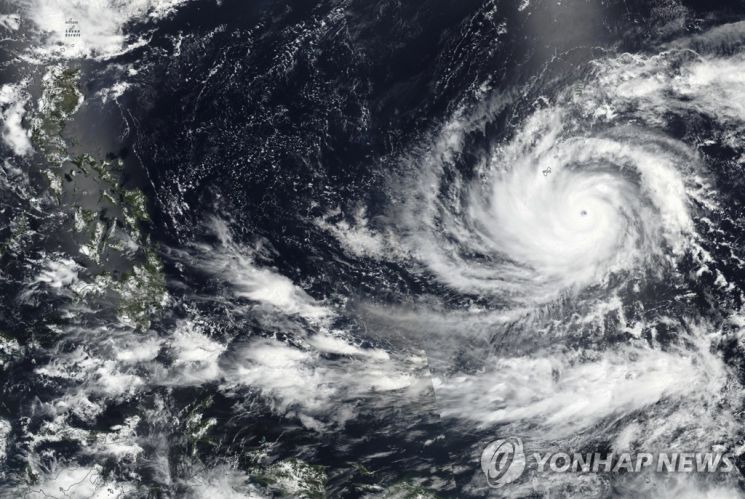 Satellite image of Typhoon Mawar released by the National Aeronautics and Space Administration (NASA). [Image source=Yonhap News]
When sea water temperatures rise, even with the same amount of sunlight, the evaporation of water vapor increases, causing a phenomenon called 'rapid intensification,' where typhoons develop rapidly in a short time. Once a typhoon forms, it quickly absorbs surrounding water vapor and grows rapidly in size.
Simply put, water vapor acts as the 'fuel' for typhoons. If this fuel is not supplied in time, the typhoon weakens and eventually dissipates. However, this year, sea water temperatures have risen globally, ensuring a steady supply of fuel for typhoons regardless of the ocean basin they pass through. With fuel continuously replenished, the time it takes for typhoons to dissipate has naturally increased. Recently, 'Freddy' survived for 37 days, setting a record as the longest-lasting cyclone in history.
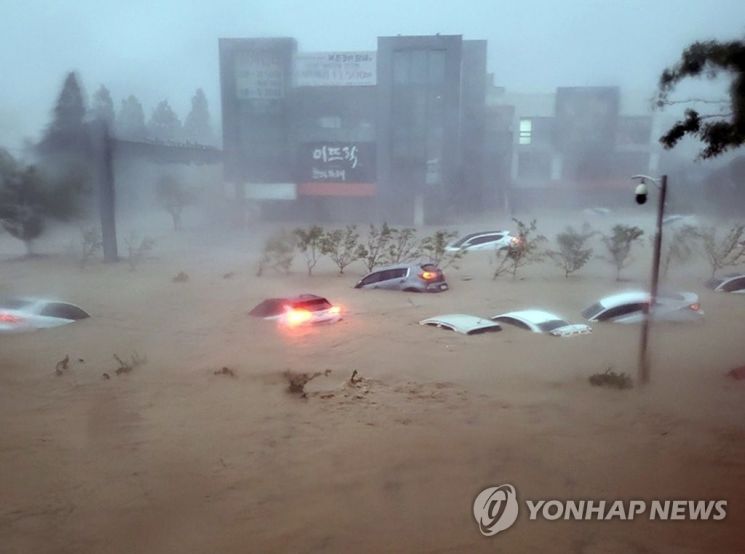 Due to the impact of Typhoon Hinnamnor, parts of the E-Mart store in Indeok-dong, Nam-gu, Pohang-si, Gyeongbuk, and some roads were flooded in June last year. [Image source=Yonhap News]
Concerns are rising that South Korea will not be an exception.
From 2020 to last year, South Korea was under conditions that frequently exposed it to typhoons. The La Ni?a phenomenon, which lowers sea surface temperatures in the tropical eastern Pacific, lasted for three years, causing sea water temperatures in the nearby western Pacific to rise. This led to frequent typhoon formation in the western Pacific, affecting South Korea as well. For example, 'Hinnamnor,' which struck Pohang in September last year, was the third most damaging typhoon in South Korean history.
This year, as El Ni?o develops, temperatures in the distant eastern Pacific are rising. Normally, typhoons originating in the eastern Pacific would likely dissipate before reaching South Korea. However, given this year's typhoons are characterized by 'large size' and 'long survival,' there is a possibility that they could grow in size while circulating over ocean basins for an extended period before striking South Korea.
For instance, 'Mokha,' which recently hit Myanmar, rapidly increased in size before moving inland, causing significant casualties and property damage. A similar scenario could occur in South Korea.
In response, the Korea Meteorological Administration has decided to shorten the interval for typhoon forecasts from the current 6 hours to 3 hours if a typhoon is expected to make landfall in South Korea after the 26th. Additionally, the number of points indicating the distance to the typhoon will be increased from 165 to 173.
© The Asia Business Daily(www.asiae.co.kr). All rights reserved.


















