Slogan Expressing Determination to Pioneer Global Market through Culture and Arts
Art Market and Exchange Cooperation Programs Held Until the 15th
The 16th ‘Jeju Haevichi Art Festival,’ the largest performing arts art market festival in Korea hosted by the Korea Culture and Arts Centers Association (KoCACA), opened on the 12th.
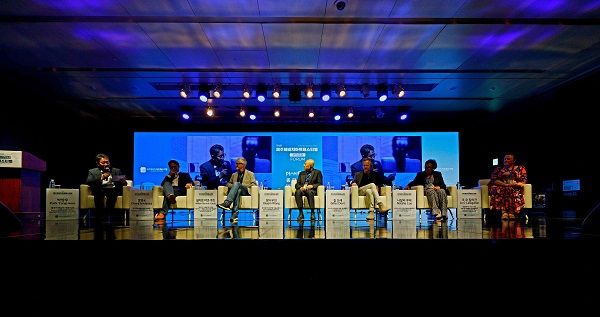 The opening forum of the 16th 'Jeju Hebichi Art Festival' is taking place on the 12th at Jeju Hebichi Hotel & Resort.
 [Photo by Korea Arts & Culture Centers Association]
The Jeju Haevichi Art Festival has established itself as a core platform for distribution by bringing together cultural and arts center staff under local governments nationwide, arts organization workers, and cultural arts stakeholders to exchange information and promote their work. This year’s festival adopts the slogan ‘PIONEER’ with the ambition to mark the inaugural year of pioneering the performing arts market.
KoCACA, which traditionally held opening events through performances every year, this year prominently featured an opening forum with cultural arts figures from five countries, including the Edinburgh Festival in the UK, the Canadian Performing Arts Association, and the Adelaide Festival in Australia, solidifying the festival’s direction toward revitalizing diverse performance distribution and expanding opportunities for cultural enjoyment.
Lee Seung-jeong, president of KoCACA, said, “The festival slogan this year, ‘PIONEER,’ embodies the ambition to pioneer new markets. While humanity’s pioneering efforts have historically involved guns and swords, now we must pioneer the global market through culture and the arts. I hope the paths participants pioneer will develop into even greater dreams.”
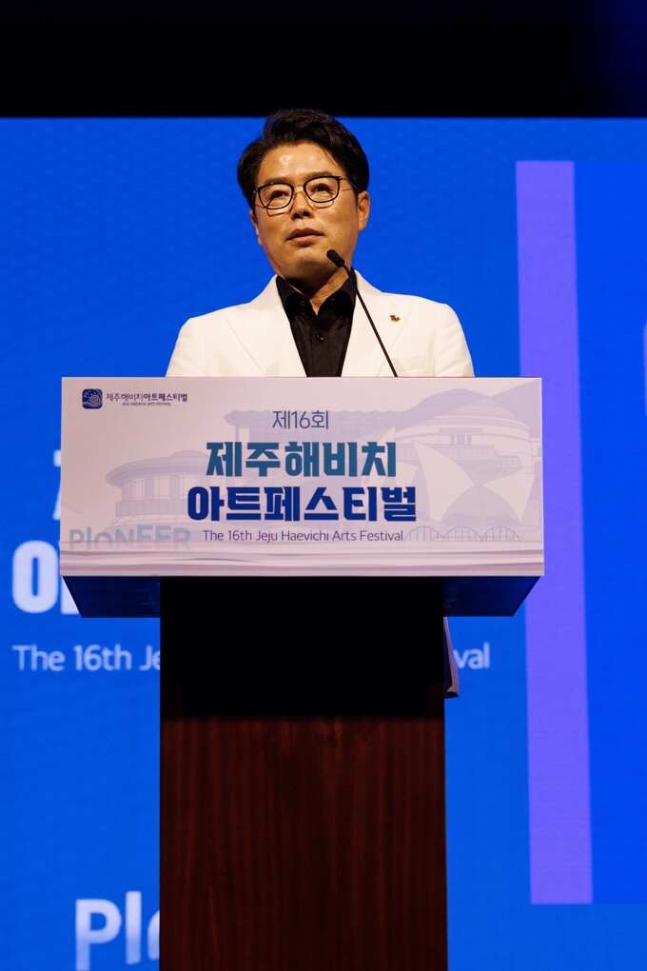 Lee Seung-jeong, President of the Korea Cultural and Arts Center Association, is delivering the opening ceremony greeting. [Photo by Korea Cultural and Arts Center Association]
Following the opening ceremony, the opening forum was held on the evening of the 12th at the Crystal Hall of Jeju Haevichi Hotel & Resort under the theme ‘Performing Arts Exchange and New Market Pioneering between Domestic and International Theaters.’ Presenters included Jeong Byeong-guk, chairman of the Korea Arts Council (former Minister of Culture, Sports and Tourism), William Burdett-Coutts, theater director and festival artistic director of the Edinburgh Assembly Hall in the UK, Jill Dore, general director of the Canadian CINARS Biennale, and Wang Xiuchun, deputy general manager of the China Association of Performing Arts Theaters.
Jeong Byeong-guk emphasized the creation of value in domestic culture and arts and responding to the crisis of regional extinction, stating, “We must seek solutions to regional extinction through culture and the arts to ensure equal opportunities for enjoying high-quality cultural content anywhere in the country. The Korea Arts Council will support many artists in various ways so they can fully demonstrate their capabilities.”
William Burdett-Coutts, artistic director of the Edinburgh Assembly Festival, introduced the Korean Season as a case of pioneering the global market for Korean performances from the perspective of an overseas festival planner. He added, “In the post-COVID-19 Netflix era, audiences generally lack the ability to read or watch stage performances in other languages, so non-verbal performance forms like magic and dance, which are not language-based, have better audience accessibility. For the international expansion of Korean cultural arts works, a careful approach considering language differences is necessary. Therefore, it is important to visit festival sites such as the Edinburgh Festival in advance to observe local audience reactions.”
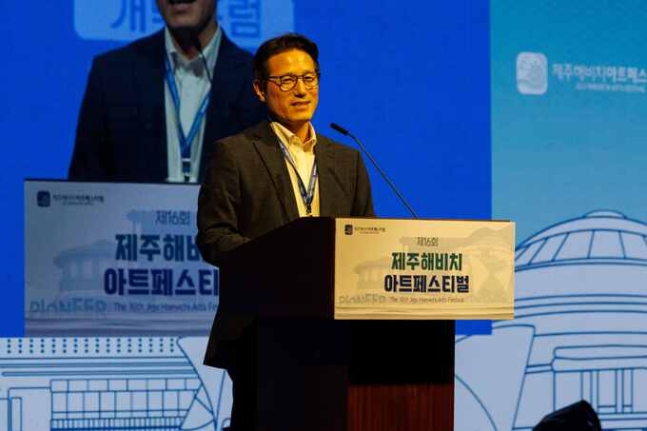 Jung Byung-guk, Chairman of the Korea Arts & Culture Commission, is making a presentation. [Photo by Korea Arts & Culture Centers Association]
Wang Xiuchun, deputy general manager of the China Association of Performing Arts Theaters, explained the value China holds as a market that the Korean performing arts sector should pay attention to, saying, “Although China’s performing arts environment still has shortcomings compared to the US, UK, and Korea, this also means potential for development. Between 2000 and 2009, about 1,300 theaters were newly established, and every year around 100 new plays are staged in new theaters, indicating great growth potential. We look forward to those who will enter the Chinese market and grow together.”
Jill Dore, director of the CINARS Biennale, introduced CINARS’s unique international network strategy and ideas involving participation from 51 countries across five continents. She explained, “We focus more on activities that transcend borders, covering various genres such as dance and theater. While artists and performance planners work regionally, it is important to have a global perspective.”
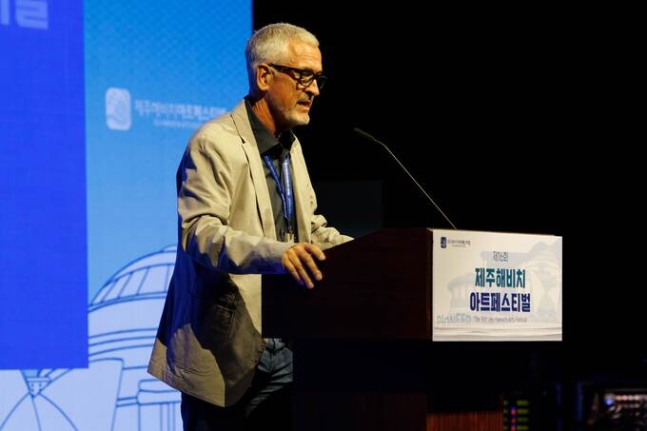 William Burdett-Coutts, Theatre Director and Festival Artistic Director of the Assembly Hall Theatre in Edinburgh, UK, is making an announcement.
 [Photo by Korea Arts & Culture Centers Association]
After the keynote presentations, a discussion chaired by Park Yang-woo, director of the Gwangju Biennale (former Minister of Culture, Sports and Tourism), included presenters as well as Natalie Lue, director of the Canadian Performing Arts Association, and Jo O’Callaghan, artistic director of the Adelaide Festival, who offered diverse opinions.
Natalie Lue introduced various projects attempted to secure online audiences during the operation of stages and theaters that lost audiences after COVID-19, as well as efforts to pioneer overseas markets.
Jo O’Callaghan described the Adelaide Festival as “Australia’s largest festival, a platform that utilizes shared global values of theater, arts, and culture to introduce the country’s culture,” and expressed hope that Korean performance teams will continue to participate.
Park Yang-woo, director of the Gwangju Biennale, said, “I believe culture is an intangible treasure that enhances a country’s brand power. Having confirmed the current status and potential of cultural pioneering to the world through culture and the arts at this forum, I hope the various discourses presented here will serve as valuable resources for the government to create good cultural policies.”
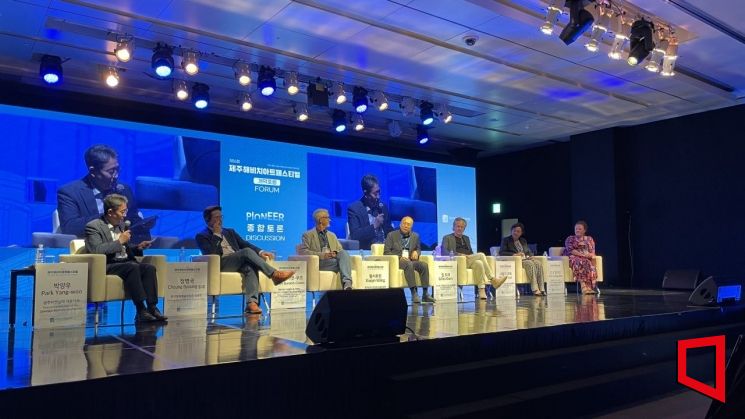 On the 12th, the opening forum discussion of the 16th 'Jeju Hebichi Art Festival' was held at Jeju Hebichi Hotel & Resort.
 [Photo by Kim Heeyoon]
The festival continues on the 12th and 13th with an art market where arts organizations supplying related works promote their works to demand-side cultural centers and propose joint production and collaboration of performance content through ‘repertoire pitching.’
Additionally, a showcase event will be held featuring performance highlights by 24 cultural centers and private arts organizations selected through a public contest. On the 14th, cultural centers will set up booths for mutual cooperation and exchange of information on works and performances to promote themselves.
Closing on the 15th, this festival is co-hosted by the Korea Culture and Arts Centers Association (President Lee Seung-jeong) and Jeju Special Self-Governing Province (Governor Oh Young-hoon), with support from the Korea Arts Council (Chairman Jeong Byeong-guk) and Hyundai Motor Group (Chairman Chung Eui-sun).
© The Asia Business Daily(www.asiae.co.kr). All rights reserved.



















