SEC Files Lawsuits Against Binance and Coinbase, Deems Related Coins as Securities
If Recognized as Securities, They Will Be Subject to SEC Oversight and Stricter Regulations
Controversy Leads to Approximately 100 Trillion Won Drop in Total Cryptocurrency Market Cap
The U.S. Securities and Exchange Commission (SEC) has filed lawsuits against global cryptocurrency exchanges Binance and Coinbase for violations of securities laws, stating that a total of 19 coins listed on their platforms have "securities characteristics." As the SEC clamps down on these 19 well-known altcoins, the cryptocurrency market is shaking.
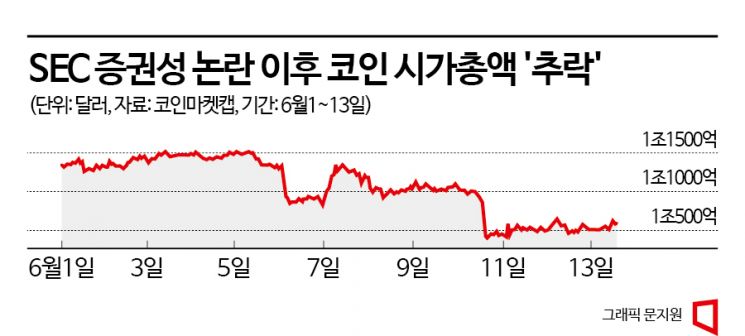
According to the global cryptocurrency market tracking site CoinMarketCap, as of 2 p.m. on the 13th, the total market capitalization of all cryptocurrencies was $1,058,425,800,000 (approximately 1,347.8884 trillion KRW). This represents a decrease of about 100 trillion KRW compared to the market capitalization of $1,134,691,740,000 (approximately 1,445.0299 trillion KRW) at the beginning of this month. Furthermore, compared to the $1,171,000,000,000 market cap on the 5th, when the SEC filed the lawsuit against Binance, it has dropped by more than 117 trillion KRW.
The decline in cryptocurrency market capitalization following the SEC's lawsuit is due to the securities controversy surrounding well-known altcoins. The SEC filed lawsuits against Binance and Coinbase, respectively, and judged that 19 coins listed on their platforms have securities characteristics. These include Binance Coin and BUSD issued by Binance, as well as Polygon, Ada, Solana, Filecoin, Sandbox, Axie Infinity, Algorand, Decentraland, COTI, Cosmos, Chiliz, Flow, Dfinity, Near Protocol, Dash, Voyager, and Nexo. Binance Coin ranks 4th in total cryptocurrency market capitalization, Solana is 9th, and Polygon is 11th. The stablecoin BUSD is also ranked 15th.
If the SEC's claim of securities characteristics is recognized, these coins will fall under SEC jurisdiction and be subject to stricter regulations than before, causing their prices to plummet. The SEC stated that Binance Coin and BUSD were issued in the form of investment contracts and thus are considered securities. As a result, Binance Coin, which traded in the $300 range before the controversy, has dropped to the $230 range. Cryptocurrency trading platform Robinhood announced that it will suspend trading support for Cardano, Solana, Polygon, and others deemed securities by the SEC starting from the 27th.
Among the coins the SEC claims have securities characteristics, Binance Coin, Solana, Ada, and Polygon are also traded on the five major Korean won markets, causing the industry to be on high alert. Previously, the Digital Asset Exchange Joint Council (DAXA), composed of Korean won market operators Gopax, Bithumb, Upbit, Korbit, and Coinone, stated, "We have continuously strived not to violate current laws by independently reviewing the securities characteristics of cryptocurrencies and refraining from supporting trading if they are deemed securities."
Additionally, the Financial Supervisory Service (FSS) has been operating a task force (TF) on securities determination since February. The TF is responsible for preparing checklists for reviewing the securities characteristics of cryptocurrencies, examining industry inquiries, reviewing the technical features of cryptocurrencies in relation to the concept of securities, and preparing opinions on securities characteristics on a case-by-case basis.
In the U.S., the Howey Test is used to determine the existence of securities characteristics. The criteria include: ▲whether money was invested ▲whether there was an expectation of profits from the investment ▲whether the invested money is part of a common enterprise ▲whether the profits come from the efforts of others rather than the investor's own efforts.
In contrast, Korea's Capital Markets Act defines securities as "financial investment products issued by domestic or foreign entities, where the investor does not bear any additional payment obligations beyond the money paid at the time of acquisition." When determining whether something is a security, explicit contracts, terms and conditions, whitepapers, implicit contracts, profit distribution details, advertising, solicitation, and agreements are comprehensively considered. Securities are categorized by form into debt securities, equity securities, beneficiary certificates, derivative-linked securities, depositary receipts, and investment contract securities. Unlike other standardized securities, investment contract securities are broadly applied. Therefore, if cryptocurrencies are deemed to have securities characteristics, they may be classified as a form of investment contract securities.
An industry insider said, "The SEC tends to take a broader view of securities characteristics than Korea does," adding, "Although coins deemed securities by the SEC do not necessarily have securities characteristics in our market, we are continuously monitoring the market impact."
© The Asia Business Daily(www.asiae.co.kr). All rights reserved.


















