Operation of Three Water Reuse Facilities
Seawater Desalination Plant in Preparation
"Easing Regulations and Government Financial Support Needed for Warm Water Discharge Reuse"
In response to the recent intensification of climate change and the increase in water demand due to global and South Korean economic growth and the development of advanced industries, there is an urgent need to establish stable and effective water source securing measures. Accordingly, Korea Water Resources Corporation (K-water) is actively reviewing water supply plans using alternative water resources and continues to promote policies to expand alternative water resources.
On the 14th, a K-water official explained, "Water supply through alternative water resources does not rely on precipitation, enabling relatively stable water supply despite climate change, and can complement the existing dam- and river-centered water supply system. The annual volume of sewage and groundwater reserves account for 60.5% of South Korea's annual water usage, and seawater, surrounding Korea on three sides, is an infinite source that can provide stable water supply."
First, the reuse of treated sewage water involves reprocessing the discharge water from existing sewage treatment plants for use in domestic, industrial, agricultural, landscaping, and river maintenance purposes. K-water already operates reuse facilities with a daily capacity of 137,000 tons at three locations: Asan City, Chungnam (August 2016 to August 2036), Chilgok County, Gyeongbuk (July 2007 to April 2026), and Pohang City, Gyeongbuk (August 2014 to July 2034), supplying industrial water.
Building on this capability, in December 2021, K-water, Yeosu City, Techcross, and two other companies signed an implementation agreement for a 50,000-ton-per-day Yeosu sewage treatment water reuse project. Construction began in June this year and is scheduled for completion in 2025. Through this, sewage treatment water that had been discharged into the southern coast will be reprocessed and supplied as industrial water, resolving the shortage of industrial water in the Yeosu National Industrial Complex and aligning with the government's low-carbon green growth policy, K-water expects.
Seawater desalination involves removing dissolved substances such as salt from seawater, which is difficult to use directly as water, to produce freshwater that can be used for various purposes. This method offers the advantage of stable water source securing through semi-permanent seawater utilization.
The global seawater desalination market is expected to grow from approximately $14.4 billion in 2018 to about $20.2 billion in 2024. Since 2020, K-water has been undertaking the largest domestic seawater desalination project in the Daesan Coastal Industrial Area, which has been vulnerable to drought and chronic water shortages, with a total project cost of 285.1 billion KRW. This project involves constructing the largest seawater desalination plant (water purification plant), intake, and pipeline facilities in Korea to supply industrial water to the Daesan Coastal Industrial Complex. The main construction of the 100,000-ton-per-day seawater desalination plant is scheduled for completion by 2024, after which water will be supplied to four resident companies in the Daesan Coastal Industrial Area: Hyundai Oilbank, LG Chem, Hanwha Total, and Hyundai OCI.
In the Daesan Coastal Industrial Area, excluding the seawater desalination supply, more than 130,000 tons of water per day is expected to be required for the creation of new industrial complexes. An emerging alternative water resource is the reuse of 'warm water discharge.' This refers to cooling water used in the process of cooling heat generated during industrial production processes, which is discharged into the sea. The plan is to purify and reuse this water, which is currently utilized by POSCO domestically. Warm water discharge has the characteristic of flowing through completely closed pipes from heat exchange to discharge, preventing contamination by external substances.
However, warm water discharge used solely as cooling water and discharged from general industrial facilities was estimated at about 910 million square meters in 2019, most of which is discarded. Current law (Act on Promotion and Support of Water Reuse) only allows reuse of warm water discharge from power plants, making it difficult to utilize warm water discharge from other sources.
A K-water official stated, "The law needs to be amended to expand the reuse of warm water discharge from general industrial processes. At the same time, government financial support should be provided for those who install warm water reuse facilities or receive treated warm water discharge, similar to facilities for rainwater, reclaimed water, and sewage treatment water reuse, necessitating legal amendments."
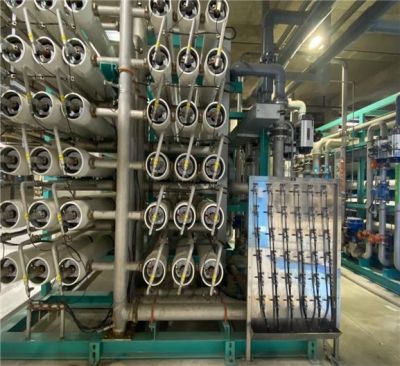 Inside the wastewater treatment water reuse facility operated by the Korea Water Resources Corporation in Asan-si, Chungnam.
© The Asia Business Daily(www.asiae.co.kr). All rights reserved.
!["The Woman Who Threw Herself into the Water Clutching a Stolen Dior Bag"...A Grotesque Success Story That Shakes the Korean Psyche [Slate]](https://cwcontent.asiae.co.kr/asiaresize/183/2026021902243444107_1771435474.jpg)
















