4th Full Meeting of Minimum Wage Commission Held at 3 PM on the 13th
'Differentiation by Industry' as Key Issue
Japan Applies Regional and Industry Differentiation... Korea's Wages and Prices Surpass Japan's
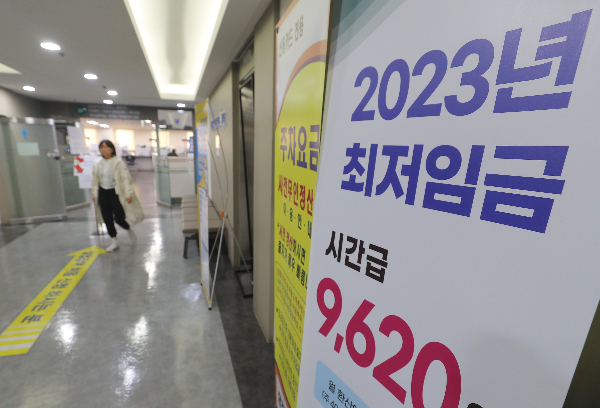 A banner displaying this year's minimum wage information is hung at the Seobu Employment Welfare Plus Center in Mapo-gu, Seoul, where the first meeting of the Minimum Wage Commission to determine next year's minimum wage level was held.
The 4th plenary meeting of the Minimum Wage Commission will be held at 3 p.m. on the 13th, about two weeks before the legal deadline (June 29) to decide next year's minimum wage. The main issue in this meeting is expected to be the differentiation of minimum wages by industry. Regional and industry-specific differentiation is a campaign pledge of the Yoon Seok-yeol administration. The idea is to determine wage levels by considering companies' ability to pay, similar to advanced countries such as the United States, Japan, Canada, and Germany.
Japan Applies Regional and Industry Differentiation... Will Seoul Surpass Tokyo's Wages?
Japan, which implemented the minimum wage system in 1959, has long applied regional and industry-specific differentiation. Minimum wages differ across the 47 prefectures, the basic units of local administration. In some industries, wage increases above the regional minimum wage are allowed based on labor-management agreements.
This year, Japan's national average hourly minimum wage is 961 yen (8,886 KRW). South Korea's minimum wage is 9,620 KRW, which, due to high growth rates and the weak yen, surpassed Japan for the first time this year. According to a survey by the Korea Employers Federation, South Korea's minimum wage rose by 41.6% from 2018 to 2022, more than three times Japan's increase of 13.1%.
The highest minimum wage in Japan is in Tokyo, at 1,072 yen (9,912 KRW). Depending on next year's minimum wage increase in Korea and the yen's exchange rate trend, Korea may even surpass Tokyo's minimum wage next year. Including the weekly holiday allowance, which Japan does not have, Korea's minimum wage this year is 11,544 KRW, already higher than Tokyo's. The weekly holiday allowance is a system where employees who work more than 15 hours a week receive an additional day's wage.
Japan has experienced several side effects such as urban concentration while implementing differentiation. However, stable wage increases have contributed to higher employment rates and job stability, as well as promoting balanced economic development by region and industry, among other advantages.
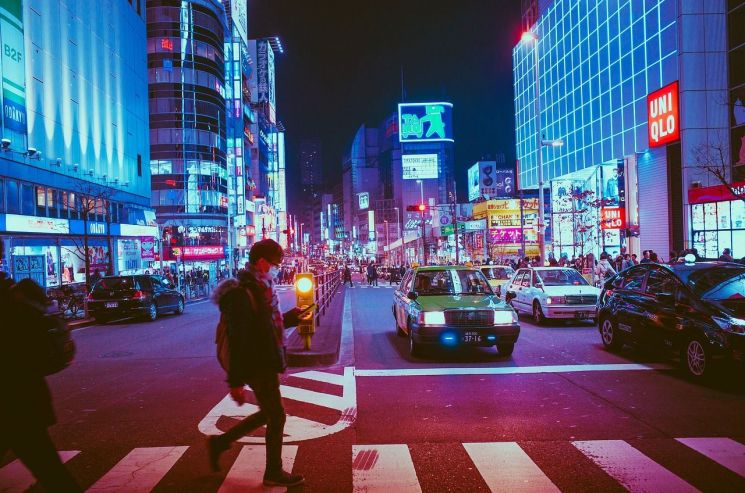
Rapid Minimum Wage Increases Cause High Inflation in Korea... Seoul Surpasses Tokyo in Cost of Living
A country's price level is determined by various factors such as domestic and international economic structures, economic growth rates, and exchange rates. It is difficult to explain inflation by a single cause. However, many experts point to rapid minimum wage increases as a key cause of inflation in Korea.
Japan was once one of the countries with high prices. But due to Korea's rising prices and the weak yen, it is now perceived as relatively inexpensive. Recently, Korean travelers returning from Japan at Incheon Airport were seen carrying shopping bags full of goods. On the other hand, many Japanese tourists visiting Korea are surprised by the high prices. A recent video by famous Japanese YouTuber 'Yuippyo,' who visited the Hampyeong Butterfly Festival, went viral after showing surprise at seeing a bowl of fish cake soup sold for 10,000 KRW. The price of an Americano at a Starbucks in Shibuya, a bustling area in Tokyo, is 445 yen (4,115 KRW). In Korea, it is 4,500 KRW. Even taxis, once notorious for being expensive in Japan, have a base fare of 500 yen (4,623 KRW), now cheaper than Seoul's 4,800 KRW.
This phenomenon is also confirmed by statistics. According to a March survey by international human resource consulting firm ECA International, which analyzed living costs such as housing, clothing, groceries, entertainment, alcohol, and tobacco in 207 cities across 120 countries where foreigners mainly reside, Seoul ranked 9th, surpassing Tokyo (10th) for the first time. Now, although Korea's minimum wage is higher, Japan's lower prices mean that living on the same minimum wage results in little difference in lifestyle.
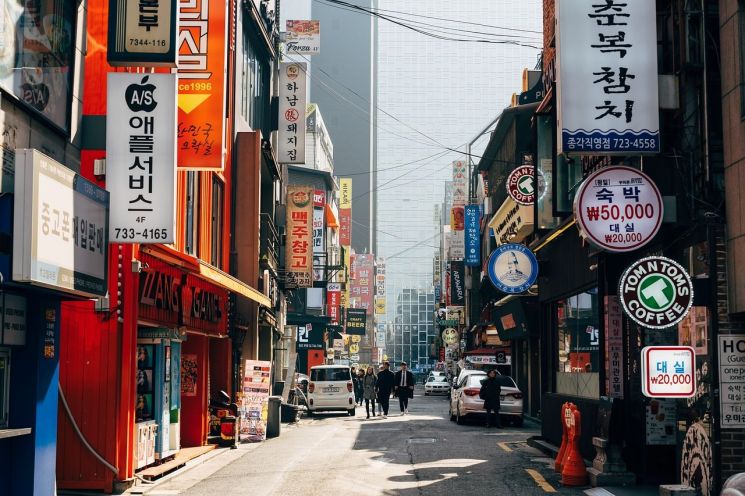
"Minimum Wage Differentiation Should Consider Industry Wage-Paying Capacity"
The labor sector currently opposes differentiation, arguing it stigmatizes low-wage industries. On the other hand, the business sector insists differentiation is necessary to minimize corporate labor cost burdens.
Small and medium-sized enterprises and small business sectors argue that differentiation is needed because there is a large variance in the 'below minimum wage rate'?the proportion of workers earning less than the minimum wage?by industry. According to the Korea Employers Federation's analysis based on Statistics Korea data as of August last year, the below minimum wage rate was over 30% in 'agriculture, forestry, and fisheries' (36.6%) and 'accommodation and food services' (31.2%), but less than 5% in 'professional, scientific and technical services' (2.8%), 'information and communication' (3.1%), and 'manufacturing' (4.6%). Choi Se-kyung, head of the Policy Consulting Center at the Small and Medium Business Research Institute, said, "Industries with a below minimum wage rate exceeding 30% are mostly service sectors with many small-scale self-employed businesses, so minimum wages should be set considering their ability to pay. If immediate differentiation is difficult, it should be applied temporarily to sectors related to small business owners hit by COVID-19."
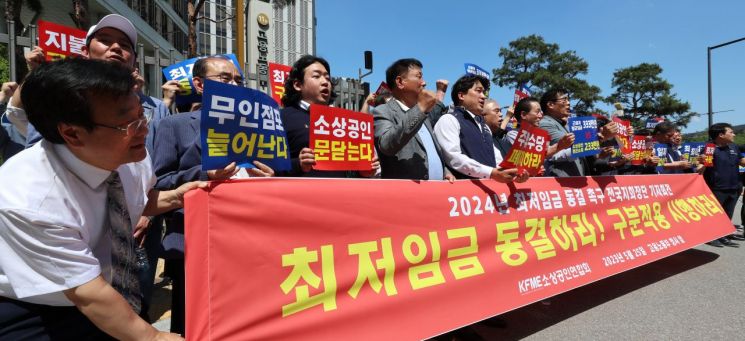 The National Branch Presidents of the Korea Federation of Small and Medium Business held a press conference on the afternoon of the 25th of last month in front of the Ministry of Employment and Labor at the Government Complex Sejong in Sejong City, where the 2nd plenary meeting of the Minimum Wage Commission was held, urging for a freeze on the minimum wage.
 [Image source=Yonhap News]
© The Asia Business Daily(www.asiae.co.kr). All rights reserved.














