UNDP 'Gender Social Norms Index' Study Results
8 out of 10 People Globally Hold Bias Against Women
A recent United Nations (UN) study revealed that prejudices related to women, such as the belief that 'male political leaders or corporate executives are better than females,' have not significantly improved over the past decade. In a global population survey, over 80% of respondents were found to hold biases against women, and South Korea showed a regression in gender awareness, with the percentage of respondents acknowledging such prejudices increasing rather than decreasing during the same period.

On the 12th, the United Nations Development Programme (UNDP) released the Gender Social Norm Index (GSNI) report. The GSNI quantifies the proportion of the population holding biases against women and illustrates how societal beliefs hinder gender equality in areas such as politics and education.
For example, in a survey covering 80 countries representing 85% of the global population, 49% of respondents, including both men and women, believed that men make better political leaders than women, and 43% thought men are better corporate executives than women. Additionally, 46% agreed that men have a greater right to employment than women when jobs are scarce.
Shockingly, one in four respondents justified a husband hitting his wife.
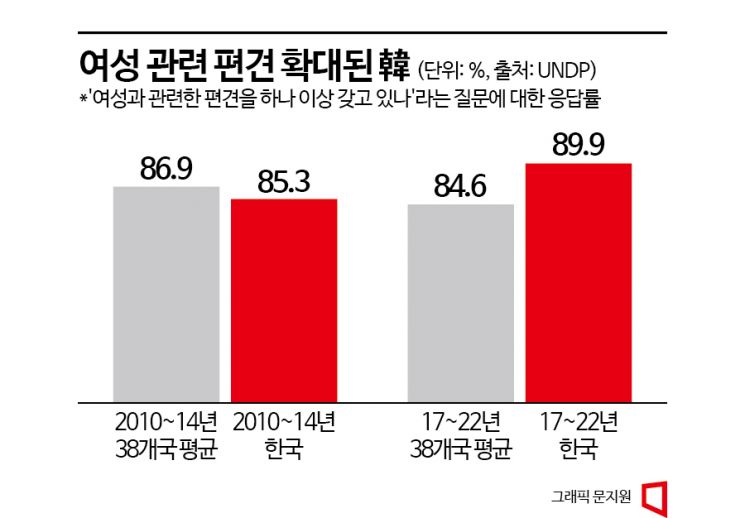
In a survey conducted among 38 countries and regions, representing about half of the global population, which participated in both the 2010?2014 and 2017?2022 surveys, the proportion of respondents holding at least one prejudice decreased slightly from 86.9% in 2010?2014 to 84.6% in 2017?2022, combining both men and women. During the same period, the percentage of men holding prejudices decreased by 3.0 percentage points, which was a larger drop than the 1.5 percentage point decrease among women; however, in absolute terms, men still held more prejudices than women.
In South Korea, among the 38 surveyed countries, it was one of 11 countries where the percentage of respondents admitting to holding 'at least one prejudice' actually increased over the past decade. Notably, it ranked second after Chile for the largest decrease in the percentage of respondents denying any prejudice. The rate of South Koreans acknowledging 'at least one prejudice related to women' rose from 85.3% in 2010?2014 to 89.9% in 2017?2022, an increase of 4.6 percentage points.
By sector, increases were observed across all areas: politics (63.6% → 72.6%), education (22.4% → 33.7%), economy (51.9% → 65.5%), and bodily autonomy (56.0% → 59.2%). By gender, women’s responses increased by 4.84 percentage points and men’s by 4.41 percentage points, showing similar trends.
The country with the most significant improvement in gender prejudice over the past decade was Germany. The proportion of respondents holding at least one prejudice dropped sharply from 57.6% in 2010?2014 to 37.45% in 2017?2022. Conversely, Chile, where prejudices increased more than in South Korea over the decade, saw the rate rise by 5.52 percentage points to 79.74% during the same period.
UNDP noted that such prejudices create obstacles for women and significantly contribute to the severe underrepresentation of women in leadership roles. According to UNDP, since 1995, the proportion of women political leaders has remained around 10%, and women executives in the labor market account for less than one-third.
Pedro Concei??o, Director of the UNDP Human Development Report Office, pointed out, "Social norms that violate women's rights weaken the expansion of human development and have broader negative impacts on society."
© The Asia Business Daily(www.asiae.co.kr). All rights reserved.


















