Identification of the Association Between DNA Methylation and Disease Resistance
Domestic researchers have found a clue to developing plants with high resistance to pests and diseases.
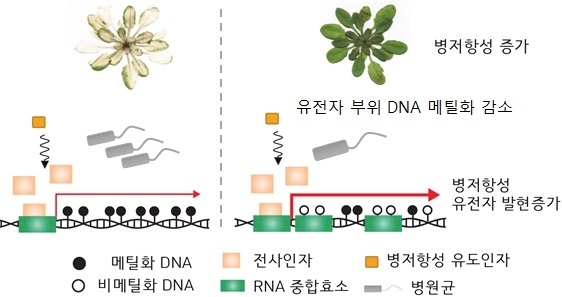 Identification of the correlation between DNA methylation and disease resistance. Image source: Provided by the National Research Foundation of Korea
The National Research Foundation of Korea announced on the 12th that a research team led by Professor Hwang Il-du of Pohang University of Science and Technology, Professor Noh Tae-young of Ewha Womans University, and Professor Hwang Dae-hee of Seoul National University elucidated the mechanism by which plants remember the invasion of pathogens and exhibit a rapid and strong disease resistance response.
Since plants complete their life cycle in a fixed location, having resistance to various stresses is crucial for survival. To this end, plants have evolved to remember previous pathogen attacks and trigger faster and stronger defense responses thereafter.
Plants use an 'epigenetic' method, which regulates gene expression and heritable changes without altering the DNA sequence. This means that acquired environmental factors influence gene expression. However, the role of DNA methylation in gene regions had not been clearly identified. DNA methylation is a phenomenon where a methyl group, a metabolite that suppresses gene expression, attaches to the bases of DNA, representing a chemical modification that regulates gene expression.
The research team hypothesized that plants regulate gene expression through DNA methylation in the memory of pathogen attacks and defense responses. First, to confirm the relationship between DNA methylation and plant disease resistance, they measured disease resistance in related plant mutants. The results showed that plants with reduced DNA methylation in gene regions had high resistance to pathogens. They also confirmed that the gene groups with altered DNA methylation included genes responsive to stress. Furthermore, these genes exhibited distinct chromatin characteristics compared to other genes, revealing that gene expression significantly increased upon pathogen invasion in genes with reduced DNA methylation in their regions. The team also discovered that the levels of DNA methylation vary among different plant populations.
Professor Hwang Il-du said, "We have clarified that DNA methylation in gene regions, which was previously unclear and hypothetical, is related to gene expression regulation," adding, "We will focus on developing eco-friendly, pesticide-free crops with increased yield by enhancing disease resistance through epigenetic regulation."
The research findings were published on the 5th of last month in the international genetics journal Genome Biology.
© The Asia Business Daily(www.asiae.co.kr). All rights reserved.
![User Who Sold Erroneously Deposited Bitcoins to Repay Debt and Fund Entertainment... What Did the Supreme Court Decide in 2021? [Legal Issue Check]](https://cwcontent.asiae.co.kr/asiaresize/183/2026020910431234020_1770601391.png)















