Proposal for Gwangyang-si Response Measures
Choi Dae-won, a member of the Gwangyang City Council in Jeollanam-do, proposed measures for Gwangyang City's response to the plan for the ocean discharge of contaminated water from the Fukushima nuclear power plant during a 5-minute free speech at the 1st plenary session of the 319th regular meeting of the Gwangyang City Council on the 12th.
On that day, Choi said, “The Japanese government plans to begin test operations of key facilities from June 12 despite the absence of the International Atomic Energy Agency's final report on the safety of the ocean discharge of contaminated water from the Fukushima nuclear power plant, opposition from neighboring countries, and domestic public opinion. The timing of the ocean discharge is becoming a reality sooner than expected.”
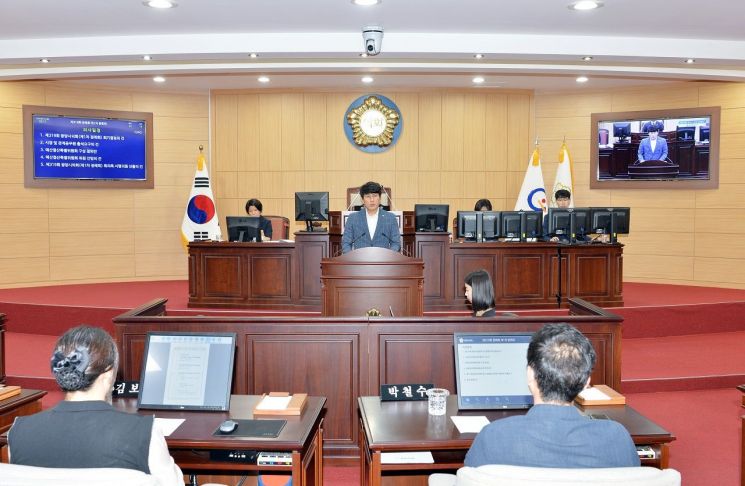
Choi argued, “The government and the nuclear industry maintain that the discharge of Fukushima nuclear wastewater will have little impact on South Korea. However, recent polls show that over 80% of the public opposes the ocean discharge of contaminated water and refuses to purchase seafood. Public concern is growing daily, and expert opinions on seafood safety are sharply divided, making it impossible to predict the damage to the domestic fisheries industry caused by the discharge.”
He continued, “The government has prepared measures such as ‘strengthening radioactive material inspections on Japanese seafood’ and ‘expanding marine radiation monitoring points along the national coastal waters,’ but experts say these measures are insufficient to address the damage that the fisheries and related industries will suffer.”
Accordingly, Choi emphasized that this is an urgent issue that could deal a fatal blow to the fisheries industry in Gwangyang and stressed the need for Gwangyang City to prepare its own policy responses and measures rather than relying solely on government measures. He proposed three measures.
First, he proposed the “establishment of a proactive safety inspection system at the Gwangyang City level for seafood inflow and distribution within the region,” requesting that “Gwangyang City proactively establish a monitoring system at the local government level not only for the Gwangyang Seafood Distribution Center but also for all seafood inflowing and distributed within the region.”
Second, he proposed “strengthening solidarity with neighboring local governments such as Yeosu and Suncheon in seafood safety management,” arguing that “creating a channel to share information in real time with neighboring local governments for joint response and safety promotion would help alleviate the anxiety of local residents and tourists.”
Lastly, he proposed “providing accurate information on the safety of nuclear wastewater to fisheries workers and citizens,” urging, “Please strive to provide accurate information on the safety of nuclear wastewater to fishermen and citizens through group education, video production, and various channels so that all citizens can make informed decisions about seafood.”
Choi concluded his 5-minute free speech by saying, “It is a regrettable reality, but the ocean discharge of contaminated water from the Fukushima nuclear power plant is imminent. Significant damage to the livelihoods of local fishermen and related workers is expected, so I hope the executive agency recognizes this issue as more urgent than any other and responds accordingly.”
Honam Reporting Headquarters, Reporter Heo Seon-sik hss79@asiae.co.kr
© The Asia Business Daily(www.asiae.co.kr). All rights reserved.
![A Woman Who Jumps Holding a Stolen Dior Bag... The Mind-Shaking, Bizarre Con of a "Human Knockoff" [Slate]](https://cwcontent.asiae.co.kr/asiaresize/183/2026021902243444107_1771435474.jpg)
















