The government is launching a large-scale crackdown to prevent fraudulent claims of national treasury subsidies. This comes after audit results revealed that subsidies were being misused, causing taxpayers' money to leak continuously. The government is determined to eradicate fraudulent claims by enhancing internal monitoring systems and expanding the scope of verification for subsidy projects to improve transparency.
According to related ministries on the 12th, the Anti-Corruption and Civil Rights Commission (ACRC), the government's anti-corruption supervisory agency, plans to receive concentrated reports on fraudulent government subsidy claims from mid-July to September. This strategy aims to conduct audits across ministries to eradicate fraudulent claims while encouraging voluntary reporting by internal personnel. Fraudulent claims refer to cases where various subsidies and support funds, provided from central and local government budgets and funds, are falsely applied for or received and used through dishonest means. Earlier, the Presidential Office announced that audits of about 12,000 private organizations that received subsidies over the past three years confirmed 31.4 billion KRW and 1,865 cases of fraud and corruption.
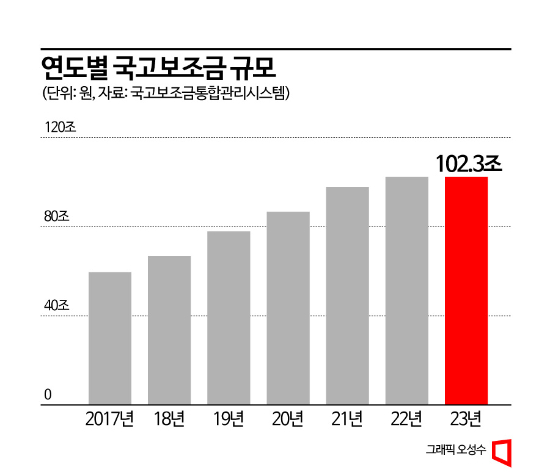
As the scale of national treasury subsidies has increased, the number of reports on fraudulent claims has also surged annually. National treasury subsidies, which were 59.6 trillion KRW in 2017, the first year of the Moon Jae-in administration, increased to 97.9 trillion KRW in 2021, and expanded to 102.3 trillion KRW last year and this year, marking a 71.6% increase over the past five years. During this period, the number of subsidy fraud reports received by the ACRC also surged from 593 cases in 2016 to 960 cases in 2017, and 1,598 cases in 2021. According to the ACRC, since the launch of the Fraudulent Claims Reporting Center in 2013, a total of 10,318 reports have been received. An ACRC official explained, "As fraudulent acts against national finances continue to occur and the tax burden on citizens increases, we plan to operate a concentrated reporting period for fraudulent claims starting mid-next month."
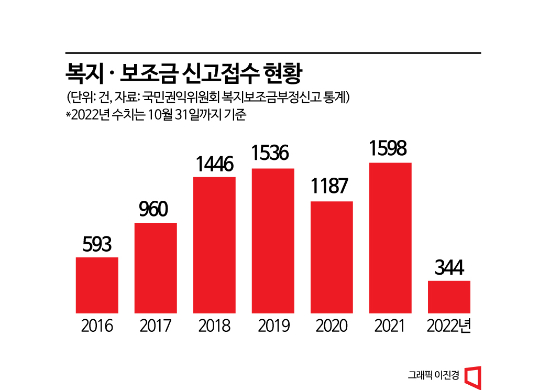
Accordingly, the government plans to focus its crackdown on the labor and welfare sectors, where excessive fraudulent claims occur annually. This is because fraudulent claims related to government unemployment benefits, infant care institutions, and local children's centers are representative cases that recur every year. Other major targets include social welfare facilities, fraudulent claims for medical benefits by office-managed hospitals, basic livelihood security benefits, and corporate research and development (R&D) subsidy fraud. Previously, the government uncovered cases where subsidies were received separately from different ministries for the same project plan, documents for youth intern recruitment were falsified and submitted to the Ministry of Employment and Labor, and about 170 million KRW was embezzled under the name of wage support funds.
The reward for reporting subsidy corruption will also be significantly increased from the previous maximum of 200 million KRW to 500 million KRW. The government plans to actively encourage reporting participation by revising subsidy-related laws such as the Public Finance Recovery Act. Separately, the "compensation" paid when direct public institution revenue is recovered or increased through reporting will remain at a maximum of 3 billion KRW.
The scope of verification for subsidy projects will also be expanded. The government plans to lower the threshold for national treasury subsidy projects requiring external verification from the current 300 million KRW to 100 million KRW, possibly starting next month. Earlier in April, the government announced a partial amendment to the Enforcement Decree of the Subsidy Management Act reflecting this change. By lowering the project scale threshold for external verification, the government expects the number of projects subject to verification to increase more than fourfold, from about 9,100 to 40,000. The number of on-site inspections for fraudulent claims by related ministries will also be expanded from 100 cases in 2021 to 400 cases this year.
© The Asia Business Daily(www.asiae.co.kr). All rights reserved.


















