Hyundai Motor Group is expanding its domestic electric vehicle investments by utilizing retained earnings from overseas subsidiaries.
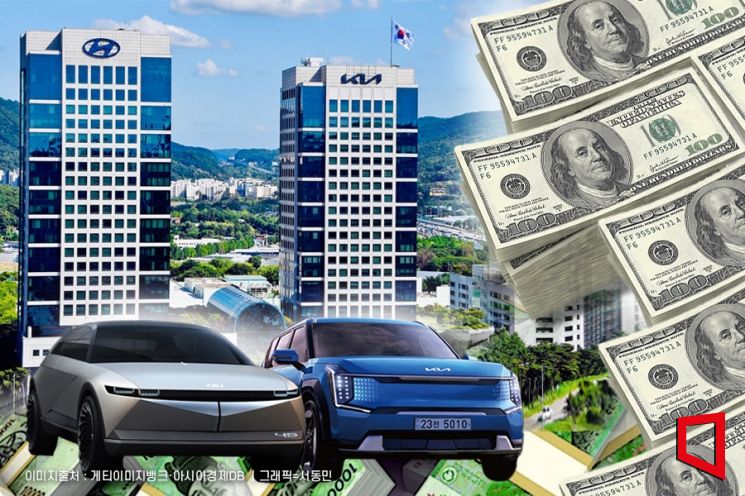
On the 12th, Hyundai Motor Group announced that it will increase the dividends flowing from overseas subsidiaries to the headquarters by 4.6 times compared to the previous year. Through this, $5.9 billion (approximately 7.8 trillion KRW) flowing into Korea will be invested in domestic electric vehicle-dedicated plants such as Hyundai Motor's Ulsan plant and Kia's Autoland Hwaseong.
The planned dividends are $2.1 billion from Hyundai Motor, $3.3 billion from Kia, and $200 million from Hyundai Mobis. Seventy-nine percent of the total dividends will be remitted to the headquarters within the first half of the year, and the remaining 21% will also be brought into Korea within this year. Hyundai Motor Group views this case as 'capital re-shoring,' bringing income earned by overseas subsidiaries back to Korea.
Over the past two years, Hyundai Motor Group's business performance has significantly improved, creating room for overseas subsidiaries to increase dividends to the headquarters. Hyundai Motor's U.S., India, and Czech production subsidiaries increased dividends, and Kia's U.S., Slovakia, and European subsidiaries also expanded remittances to the headquarters.
Recently, the government revised the corporate tax law related to overseas dividends to activate domestic investment. Previously, both overseas and domestic dividends were taxed, with foreign tax credits allowed within certain limits. Starting this year, dividends already taxed overseas are only taxed 5% domestically, and the remaining 95% are exempt from domestic taxation.
With the resolution of the double taxation issue for overseas subsidiaries, an environment has been created where overseas subsidiary dividends can be freely brought into Korea. This not only reduces the tax burden but also improves the convenience of tax payment.
Hyundai Motor Group expects that utilizing overseas subsidiary dividends can reduce external borrowing and improve financial structure. The cash securing effect also enables active investment. Additionally, with over 7 trillion KRW in dividends flowing into Korea, it will partially contribute to improving the country's current account balance.
Hyundai Motor Group will invest the dividends brought into Korea in Hyundai Motor's Ulsan electric vehicle-dedicated plant, the establishment of a customer-tailored electric vehicle-dedicated plant at Kia Autoland Hwaseong, and the conversion of an electric vehicle-dedicated line at Kia Autoland Gwangmyeong. It will also be used for developing next-generation electric vehicle platforms, expanding product lineups, and investing in core parts and advanced technology development.
In April last year, Hyundai Motor Group announced a plan to invest 24 trillion KRW in the domestic electric vehicle sector by 2030 at the groundbreaking ceremony of Kia Autoland Hwaseong's customer-tailored electric vehicle-dedicated plant. The plan aims to advance the electric vehicle ecosystem and lead innovation in the future automotive industry through large-scale domestic electric vehicle investments.
© The Asia Business Daily(www.asiae.co.kr). All rights reserved.

















