Dozens of Foreign Reviews on Google Maps... "Got Overcharged at Myeongdong Cosmetics Shop"
Due to Characteristics of Foreign Tourists, Few Reports and Lawsuits Make Crackdown Difficult
As the COVID-19 situation subsides and the number of foreigners visiting Korea increases again, price gouging targeting foreigners is once again rampant. Although habitual price-gouging businesses have been identified, the authorities are unable to properly grasp the situation because the main victims, foreign tourists, rarely report these incidents.
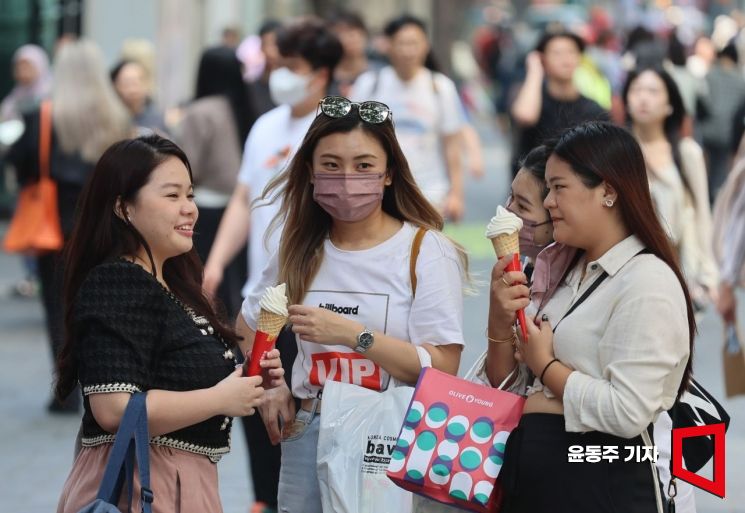 Foreign tourists visiting the Myeongdong shopping street in Jung-gu, Seoul, are cooling off by eating ice cream. Photo by Dongju Yoon doso7@
On the 4th, the Bank of Korea stated in its 'Financial and Economic Issue Analysis' report that "the number of foreign tourists in Korea in April was 900,000, showing a 55% recovery rate compared to April 2019." The number of tourists who visited Korea last month increased about 18 times compared to the previous year. According to an analysis by Trip.com on May departure bookings worldwide as of the 3rd of last month, reservation demand increased by 1,738%.
As the number of foreign tourists recovers, price gouging at popular tourist spots they visit has started to surge again. A Seoul Metropolitan Police Agency official said, "In Seoul’s Myeongdong area, reports of price gouging and forced sales come in every day without fail."
Myeongdong, a representative foreign tourist destination, has seen a significant rise in food prices. In Myeongdong, small-sized Dakgangjeong (sweet crispy fried chicken) is sold for 7,000 won, medium size for 10,000 won, and extra-large size for 20,000 won. Tanghulu, which was sold for 3,000 won before COVID-19, is now sold for 5,000 won, and chicken skewers have risen from 3,000 won to 5,000 won. Lamb skewers, which are relatively more expensive, cost up to 8,000 won each. Merchants claim that the price increases are unavoidable due to rising raw material costs, but even among locals, there is a sentiment that the prices are excessive.
According to the Tourist Police Unit, three cosmetic stores in Myeongdong are notorious for habitual price gouging targeting foreigners. Among these, one store has 15 out of the last 20 reviews on the Google Maps application stating things like "I was deceived by the staff and overcharged" and "Prices are higher than other stores." This store is still operating normally.
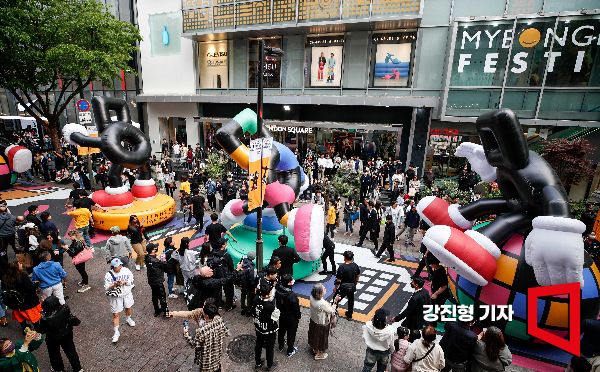 A street parade is taking place at the official opening ceremony of the 'Myeongdong Festival' held in Myeongdong, Jung-gu, Seoul. Photo by Jinhyung Kang aymsdream@
On the 28th of last month, a Japanese tourist posted a video online expressing shock at the food prices at a local festival in Korea. In the video, he visited the Jeollanam-do Hampyeong Butterfly Festival and introduced the food prices. A bowl of fish cake soup costing 10,000 won and a plate of pork barbecue priced at 40,000 won were far from typical prices. When he asked a merchant if he could buy just 5,000 won worth of fish cake, he was told, "We don’t sell it that way." He said, "Is this Korean pricing for real? There’s nothing affordable to eat," and ended up buying a cup of silkworm pupae and a sausage, each costing 4,000 won.
Some mock this behavior of businesses targeting foreigners as "K-bagaji" (K-price gouging). Even though K-bagaji is widespread, punishing the businesses is difficult. Both the police and Seoul city officials agreed, saying, "Because most victims are foreign tourists, they rarely report or file complaints, making it difficult to impose penalties." The Tourist Police Unit had prepared investigations into habitual price-gouging businesses before the COVID-19 pandemic, but these efforts were abandoned when the investigative team under the Tourist Police Unit was disbanded in 2021.
The low level of penalties is also under scrutiny. According to the Enforcement Decree of the Price Stabilization Act, price gouging behaviors can be fined up to 10 million won for violations such as 'failure to display prices.' Businesses caught are given corrective recommendations for the first violation, and fines ranging from 300,000 to 10 million won are imposed depending on the number of violations for repeat offenders. However, even businesses caught dozens of times cannot face severe penalties such as business suspension.
If prices are displayed, even fines are difficult to impose. Administrative agencies cannot penalize businesses simply for raising prices. Selling products at high prices is not illegal unless the business charges more than the displayed price.
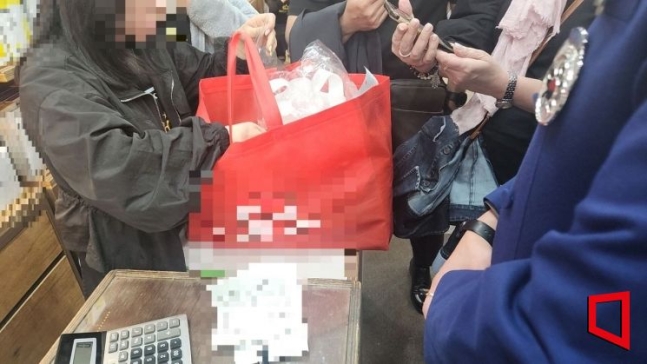 Foreign tourist Rodrigo Monsonis, who suffered from overcharging, is seen protesting with police officers from the Seoul Metropolitan Police Agency Tourist Police Unit at a cosmetics store in Myeongdong, Jung-gu, Seoul, around 4 p.m. on the 2nd of last month.
 Photo by Tae-won Choi skking@
Ulsan Dong-gu Office has formed an unfair business practice inspection team ahead of the opening of Ilsan Beach on the 1st of next month. However, setting prices higher than usual is not included in the inspection targets because there is no legal basis for inspection. The inspection targets include excessive price increases, illegal fee collection, failure to display price tags, and charging more than the displayed price.
Professor Jeong Ransu of Hanyang University’s Department of Tourism said, "(Due to price gouging) Korea’s national image and Seoul’s city image have already declined," adding, "Since it is impossible to force stores to set product prices, efforts should be made to encourage reasonable price announcements and to inform that selling at high prices is not beneficial in the long term, thereby promoting self-regulation."
© The Asia Business Daily(www.asiae.co.kr). All rights reserved.



















