Breaking Seniority System with 'Executives in Their 30s' Strengthening Performance-Based Promotion
In 10 Years, Female Executive Ratio Increased 1.3 Times, Executives 4.9 Times Up
Samsung Electronics Chairman Lee Jae-yong is said to have successfully inherited the late Chairman Lee Kun-hee's policy of prioritizing technology experts and increasing the proportion of female executives over the past decade since the late chairman suffered a myocardial infarction in 2014. The reform of the personnel system to strengthen employee motivation by transforming Samsung into a flexible and horizontal organization like Silicon Valley in the United States has also been positively evaluated.
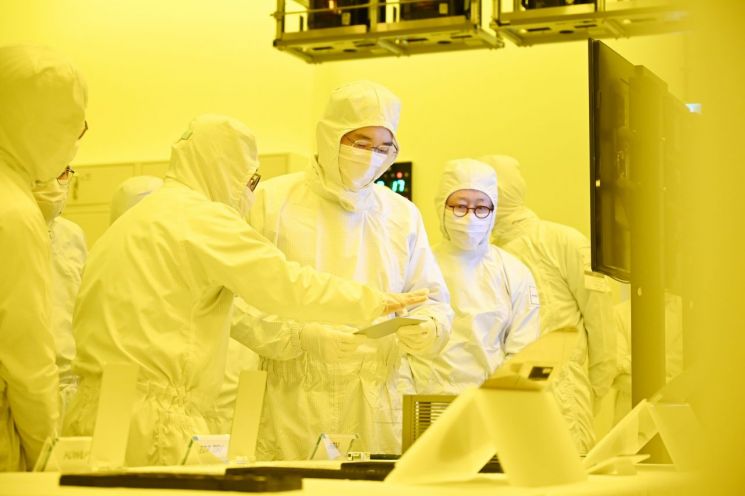 Samsung Electronics Chairman Lee Jae-yong visited the Samsung Electronics Cheonan Campus on February 17 to tour the package line and review business strategies. [Image source=Yonhap News]
In the executive personnel reshuffle announced in December 2015, Chairman Lee Jae-yong placed 'technology experts' at the forefront. He promoted Go Dong-jin, head of the Wireless Business Division of Samsung Electronics' IM (IT & Mobile) division, and Jung Chil-hee, vice president of Samsung Advanced Institute of Technology (now SAIT). Yoon Joo-hwa, head of Samsung C&T's Fashion Division who led the Everland listing and the merger of Cheil Industries and Samsung C&T, was appointed chairman of the Samsung Social Contribution Committee. At the time, it was said that "financial experts stepped down while technology experts advanced."
In this year's executive reshuffle, the first since his inauguration as chairman, technology experts were again prioritized. A representative example is the unusual move last June, outside the usual personnel season, when Vice President Song Jae-hyuk from the Memory Business Division was transferred to head the Semiconductor Research Institute and then promoted to president in this year's reshuffle.
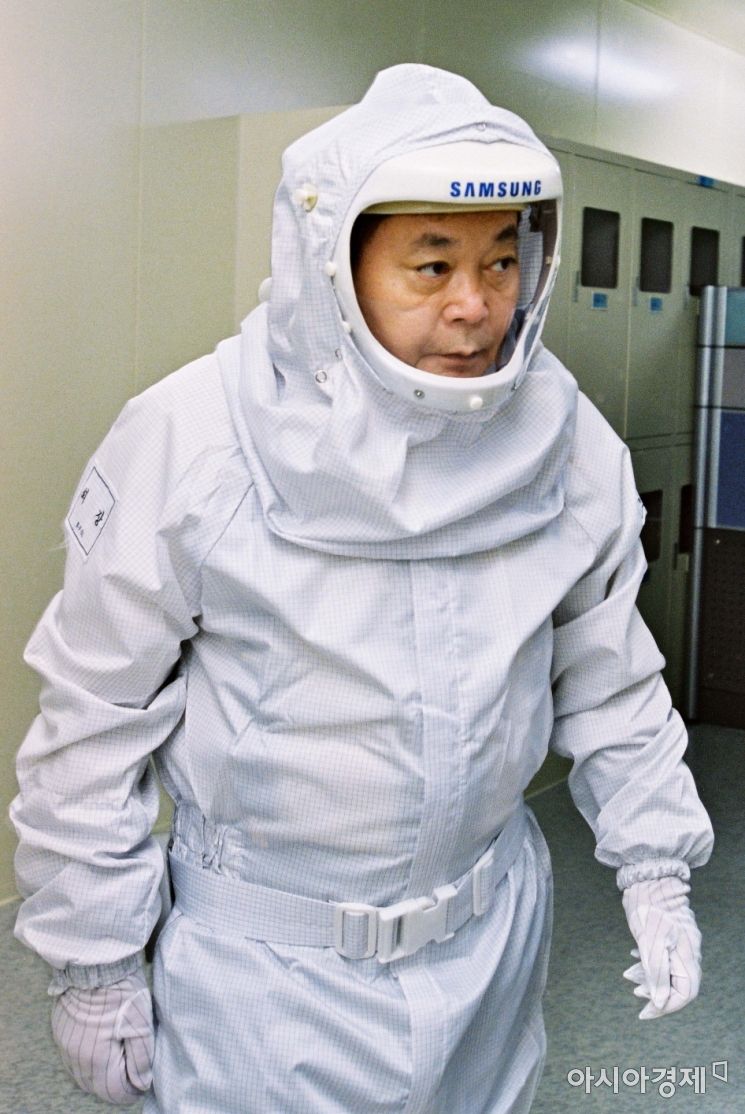 The late Lee Kun-hee, former chairman of Samsung, visiting a semiconductor factory in 2004. [Image source=Asia Economy DB]
The technology-centered personnel policy is similar to the 2000 reshuffle by the late Chairman Lee Kun-hee. In the 2000 executive reshuffle, the late chairman appointed Jin Dae-je, head of non-memory semiconductors, as president overseeing information appliances; Hwang Chang-gyu, head of the Semiconductor Research Institute, as head of memory semiconductors; Lee Sang-wan, vice president of the LCD division, as CEO; and Lim Hyung-gyu, head of memory development, as president of the System LSI Business Division. Former Samsung Electronics President Lim Hyung-gyu described that period as the "relaunch of Samsung's system semiconductors (non-memory semiconductors)." System semiconductors are a core business that Chairman Lee Jae-yong aims to make number one in the world by 2030.
While Chairman Lee Jae-yong's emphasis on technology experts is similar to that of the late Chairman Lee Kun-hee, experts say the detailed policies differ. The biggest difference is the departure from the centralized 'control tower' policy centered on the Future Strategy Office and the horizontal improvement of organizational culture.
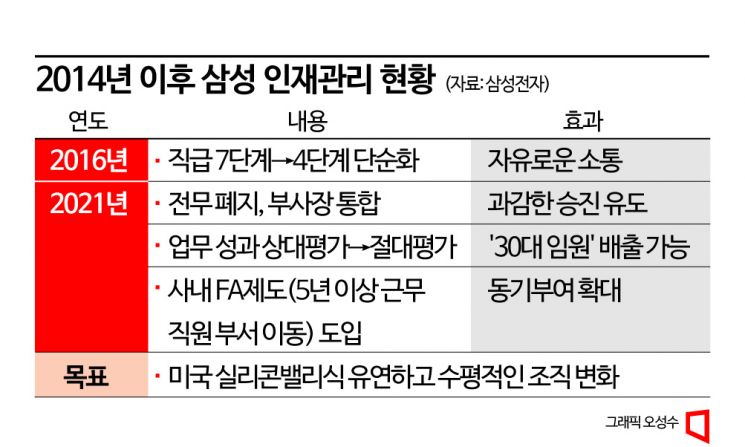
Chairman Lee Jae-yong implemented personnel system reforms in 2016 and 2021. The core was to break the seniority system and refine meritocracy so that outstanding employees in their 30s could be promoted to executive positions. In 2016, the seven-level rank system (Employee 1, 2, 3 - Assistant Manager - Manager - Deputy General Manager - General Manager) was simplified to four levels (CL1~CL4). In 2021, the executive vice president rank was abolished and merged into vice president. The performance evaluation method was changed from relative to absolute evaluation. A 'company-internal free agent (FA) system' was introduced, giving employees who have worked in the same department for more than five years the opportunity to transfer departments. The salary increase system was not changed.
Kim Kyung-joon, former vice chairman of Deloitte Consulting, said, "Simplifying the rank system is meaningful as it reduces hierarchy and evaluates based on roles." Oh Il-seon, director of the CXO Research Institute, an enterprise analysis organization, said, "Simplifying the reporting system and creating a flexible organizational culture strengthened employee motivation and increased business speed."
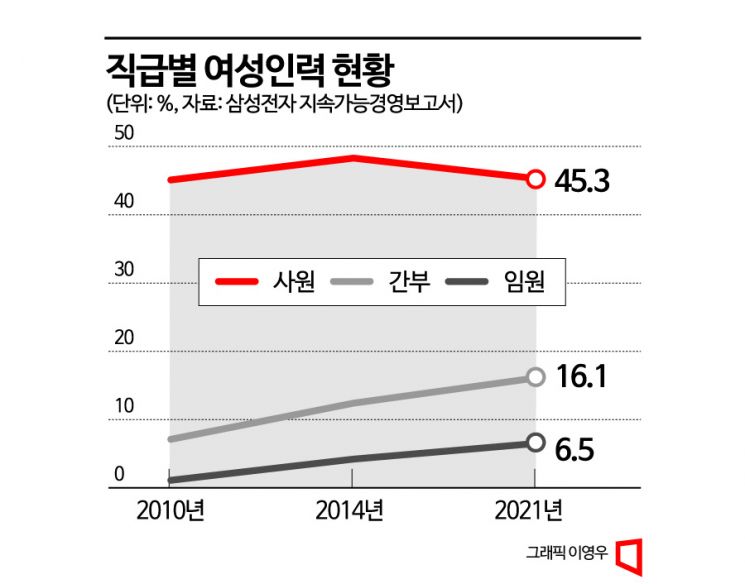
The increase in the proportion of female executives since Chairman Lee Jae-yong's participation in management is also noteworthy. Samsung Electronics promoted a female president for the first time in its 54-year history this year. Lee Young-hee, head of global marketing in the DX (Consumer Electronics & Mobile) division, was promoted to president. The proportion of female employees at Samsung Electronics was similar at 45.1% in 2010, 48.3% in 2014, and 45.3% in 2021, but female managers increased from 7.1% to 12.4% to 16.1%, and female executives from 1.1% to 4.2% to 6.5%.
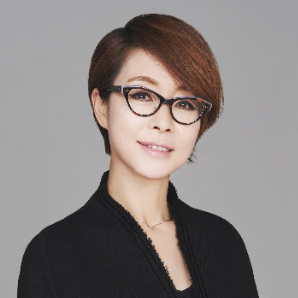 Lee Young-hee, President and Head of Global Marketing Office, DX (Consumer Electronics & Mobile) Division, Samsung Electronics. [Photo by Samsung Electronics]
Experts interpret the increase in the proportion of female managers and executives as a result of Chairman Lee Jae-yong successfully inheriting the 'open recruitment' system introduced by the late Chairman Lee Kun-hee in 1995. Open recruitment removes gender, academic background, nationality, age, and regional ties from the hiring qualifications. Former Vice Chairman Kim Kyung-joon said, "The increase in female managers and executives is the result of Chairman Lee Jae-yong continuing the direction set by the late Chairman Lee Kun-hee."
© The Asia Business Daily(www.asiae.co.kr). All rights reserved.
![Clutching a Stolen Dior Bag, Saying "I Hate Being Poor but Real"... The Grotesque Con of a "Human Knockoff" [Slate]](https://cwcontent.asiae.co.kr/asiaresize/183/2026021902243444107_1771435474.jpg)












