Expansion of Infertility Treatment Support Starting July 1... Income Criteria Removed
Integrated, Demand-Centered Support from Childbirth Preparation to Postpartum Care and Beyond through the Haetbit Center
According to the Organization for Economic Cooperation and Development (OECD) standards, low fertility is defined as a total fertility rate of 2.1 or below, and a total fertility rate of 1.3 or below is considered ultra-low fertility.
However, last year South Korea’s total fertility rate was recorded at 0.78, making the term ultra-low fertility insufficient to describe the situation.
In response, Mapo-gu (Mayor Park Gang-su) is making multifaceted efforts by preparing various policies to address the population extinction crisis beyond ultra-low fertility.
First, the district will expand the target group for infertility treatment support starting July 1.
Previously, support was limited to households with an income below 180% of the median income (monthly income of 6,222,000 KRW for two-person households), but going forward, the income criteria will be abolished and the support program will be expanded to include all infertile couples, including common-law couples.
Additionally, while the number of supported treatments was previously limited to 10 fresh embryo transfers, 7 frozen embryo transfers, and 5 artificial inseminations, the program will now allow couples to freely choose treatments within a total of 22 sessions to guarantee choice among infertility treatment types.
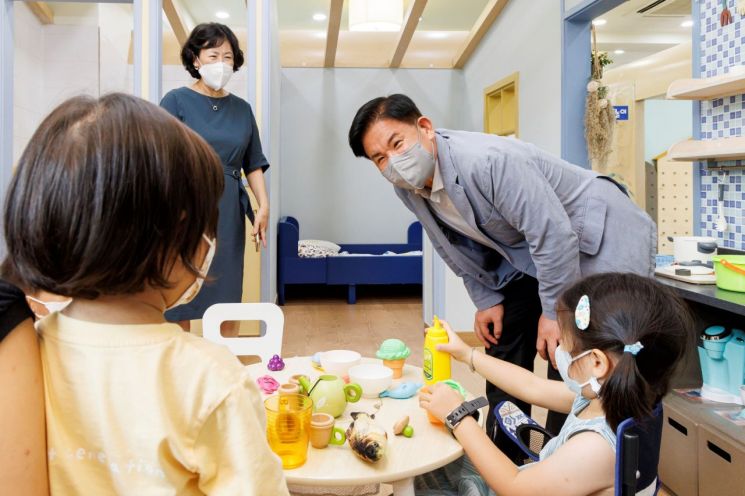 Park Gang-su, Mayor of Mapo District, is visiting the Mapo Childcare Support Center located in Sangam-dong and having a conversation with children.
The support amounts will be maintained at current levels, providing up to 1,100,000 KRW for fresh embryos, up to 500,000 KRW for frozen embryos, and up to 300,000 KRW for artificial insemination for those aged 44 and under (*for age 45, up to 900,000 KRW for fresh embryos, 400,000 KRW for frozen embryos, and 200,000 KRW for artificial insemination).
A district official stated, “Infertile couples seeking treatment are highly motivated to have children, so removing income restrictions will allow more infertile couples to benefit, which we believe will greatly help solve the low fertility problem.”
In line with this, the district will officially begin operating the ‘Mapo-gu Haetbit Center’ in July, providing integrated management from childbirth preparation to postpartum care and health management of newborns all in one place.
The Haetbit Center, created by reorganizing the entire second floor of the Mapo-gu Public Health Center, offers services such as ▲pregnancy preparation support ▲health management for pregnant women ▲postpartum helper support ▲home visit nursing ▲mental health services like postpartum depression ▲specialized programs for pregnant women and infants, all in one location to provide demand-centered childbirth promotion policies.
Mayor Park Gang-su of Mapo-gu said, “Research and analysis on childbirth promotion policies show that building local services and expanding related infrastructure is about three times more effective in increasing fertility rates than cash support policies. Through expanded support for infertile couples and operation of the Haetbit Center, we will create a model case for addressing ultra-low fertility issues unique to Mapo-gu through lifecycle-based childbirth policy support.”
© The Asia Business Daily(www.asiae.co.kr). All rights reserved.

















