Seoul Metropolitan Council's 'Ban on Dog and Cat Meat Consumption'
Dog Breeding Association Strongly Opposes, Citing "Threat to Right to Live"
As the hottest days of summer approach, a debate over dog meat has erupted. When the Seoul Metropolitan Council proposed the 'Ordinance on the Prohibition of Dog and Cat Consumption,' the Dog Meat Industry Association strongly opposed it, claiming it threatens their right to livelihood.
Kim Ji-hyang, a member of the People Power Party on the Seoul Metropolitan Council's Planning and Economy Committee, officially proposed the 'Ordinance on the Prohibition of Dog and Cat Consumption' on the 31st of last month. It was announced for legislative notice on the 8th and will collect public opinions until the 12th.
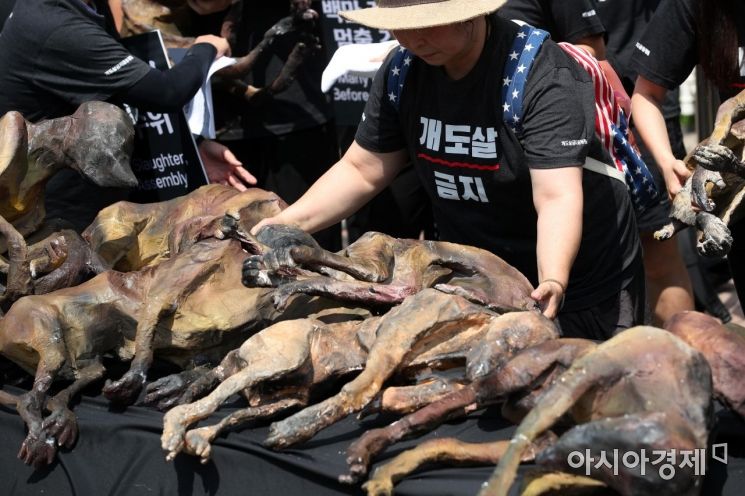 On July 12, 2019, the first day of the dog days of summer, participants at the '2019 Boknal Memorial Action' rally held in front of the National Assembly in Yeouido, Seoul, are holding a dog carcass model while urging the review and passage of the law banning arbitrary slaughter of animals. Photo by Moon Honam munonam@
The ordinance focuses on having Seoul city intensively crack down on the unsanitary conditions of dog meat with unclear origin and distribution channels, and encourages businesses handling dog meat and food service establishments to change their business types.
Businesses handling dog meat will be fined up to 5 million KRW. The ordinance includes provisions to encourage these businesses to change their business types and sets a grace period for fines (one year after promulgation).
The current Food Sanitation Act requires that food or food additives intended for sale be collected, manufactured, processed, used, cooked, stored, subdivided, transported, and displayed in a clean and hygienic manner. Violations can result in fines up to 5 million KRW. This ordinance allows the Seoul mayor to apply these fine regulations while prohibiting the consumption of dogs and cats.
In fact, under current law, selling dog meat is illegal. The Livestock Products Sanitary Control Act defines cattle, pigs, chickens, etc., as livestock for food purposes, and these livestock must comply with detailed regulations from manufacturing to preservation methods under the Food Sanitation Act enforced by the Ministry of Food and Drug Safety.
 [Photo by Asia Economy DB]
Dogs are designated as livestock under the Livestock Act, allowing for mass breeding. However, all acts of slaughtering or selling dog meat are prohibited under hygiene management laws. In other words, dogs are not considered food livestock.
Kim, who proposed the bill, explained, "It is difficult to enforce or prohibit because the law excludes cases where dog meat has been consumed as a long-standing custom. This is why the ordinance is necessary."
The prohibition ordinance is expected to be discussed at the 319th regular session as early as this month. However, even if passed, a one-year grace period before enforcement is set.
If the ordinance is promulgated, support such as business consulting for changing the dog meat industry’s business types will also be provided. Additionally, an operating committee involving dog meat industry representatives and animal protection experts will be established.
Dog Meat Industry "Threat to Livelihood" Opposition
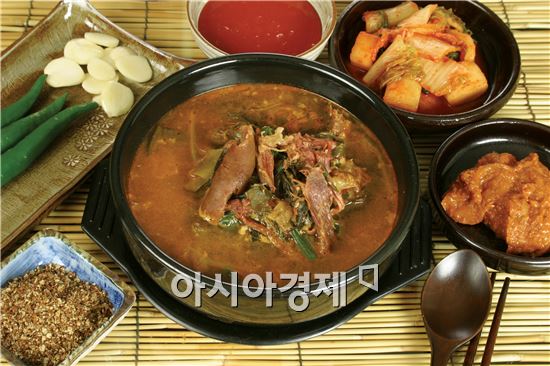 Boshintang [Photo by Asia Economy DB]
Workers in the dog meat industry raised their voices, saying the ordinance threatens their right to livelihood.
At a policy meeting on the 8th attended by Kim, the ordinance’s main proposer, and members of the Korea Dog Meat Association, they demanded the elimination of legal blind spots so that dog meat can be slaughtered and processed hygienically. They also insisted that practical support must accompany smooth business transitions.
Criticism was voiced that "the past government provided education and even subsidies to dog meat industry workers, but now they are being stigmatized as producing a repulsive food."
A representative of the Dog Meat Association said, "About 6 to 7 years ago, then Seongnam Mayor Lee Jae-myung suggested that Moran Market dog meat vendors switch to other jobs, and although efforts were made, it was not easy. The issue of livelihood is urgent."
The related dog meat debate is expected to continue in the National Assembly. Democratic Party lawmaker Han Jeong-ae is reportedly preparing a 'Special Act to End Dog Meat Consumption.' The bill will specifically address who among food-related workers will receive support for career changes and how such support will be provided. It is expected to be officially proposed as early as this month.
A joint public-private 'Committee for Discussion on Dog Meat Issues' formed during the previous administration commissioned Gallup Korea to survey 1,514 adult men and women nationwide in March last year. According to the results, more than half of respondents (55.8%) said "dog meat consumption should be stopped," and 85.5% said they do not eat dog meat.
© The Asia Business Daily(www.asiae.co.kr). All rights reserved.

















