Joint Academic Conference Hosted by Four Institutions Including the Korea National Diplomatic Academy
Sharing the Values of a Principles- and Norms-Based International Order
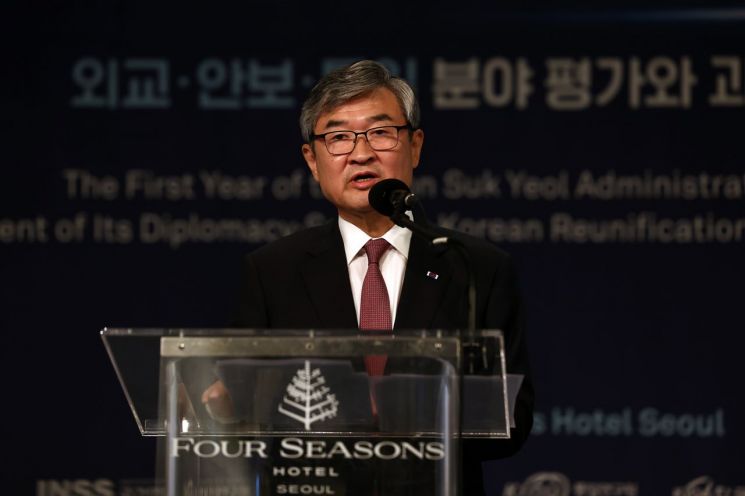
Cho Tae-yong, Director of the National Security Office, stated on the 9th regarding Korea-China relations, "Relations between countries must be based on mutual respect. In line with South Korea's enhanced national power, we will create a healthy Korea-China relationship through confident diplomacy that meets the expectations of our people." This response is interpreted as a reply to the tough remarks made by Xing Haiming, Chinese Ambassador to South Korea, who referred to the Yoon Seok-yeol administration as 'betting on a U.S. victory and China's defeat' and 'a wrong judgment,' with Cho emphasizing 'confident diplomacy' and a 'healthy Korea-China relationship.'
On the same day, Cho made these remarks in his keynote speech at a joint academic conference hosted by four national research institutions?the National Security Strategy Institute, the Korea National Diplomatic Academy, the Institute for Unification Studies, and the Korea Institute for Defense Analyses?held at the Four Seasons Hotel in Jongno-gu, under the theme "Evaluation and Tasks in Diplomacy, Security, and Unification on the First Anniversary of the Yoon Seok-yeol Government."
In particular, regarding the diplomatic orientation of the Yoon Seok-yeol administration, he described it as "a global pivotal state that centers on national interests and cooperates with the international community based on principles and reciprocity," emphasizing that "there is no difference in this regard with China." He further explained, "Our government will cooperate with other countries that share values and pursue common interests to uphold universal values of freedom, human rights, and the rule of law, and to maintain an international order based on principles and norms."
Regarding the Korea-U.S. alliance, Director Cho emphasized, "We will build five pillars?security, industry, science and technology, culture, and information alliances?on the cornerstone of a value-based alliance, and further develop the Korea-U.S. alliance, which has functioned as a core axis of regional peace and prosperity for the past 70 years, into a 'global comprehensive strategic alliance.'" On improving Korea-Japan relations, he noted that the government made a strategic judgment on the necessity of cooperation amid a severe security and economic environment, stating, "As Japan has responded positively, the improvement of bilateral relations is progressing rapidly."
Regarding the national security strategy of the Yoon Seok-yeol administration, he pointed out, "We must have a clear understanding of who threatens our survival and security, and which countries will stand on our side against those threats," adding, "Believing that the current fragile peace, which holds innocent lives hostage, is true peace, deceiving ourselves, and avoiding the truth directly contradict the diplomatic and security philosophy of the Yoon Seok-yeol administration."
In his luncheon speech, Kim Tae-hyo, First Deputy Director of the National Security Office, said, "In South Korean diplomacy, the value of freedom is not merely a style or a luxury but a decisive interest and a matter of survival." He added, "Only countries with freedom can secure advanced technology first, only countries with freedom can develop their economies vigorously, and countries without freedom only copy, steal, and follow."
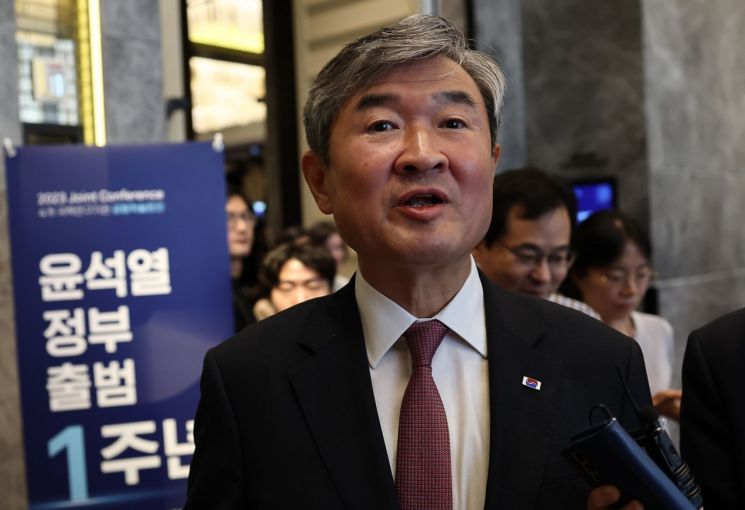
After the academic conference, when reporters asked Director Cho about Ambassador Xing's remarks, he replied, "China was mentioned in the keynote speech. Please accept it as I have said," and refrained from making specific comments, adding, "The Ministry of Foreign Affairs will handle it well." Deputy Director Kim also said, "The Ministry of Foreign Affairs will probably take measures. Please watch closely."
Earlier, Ambassador Xing met with Lee Jae-myung, leader of the Democratic Party of Korea, and claimed, "The responsibility for the difficulties in Korea-China relations does not lie with China," and "Betting on a U.S. victory and China's defeat is a wrong judgment that will surely be regretted later."
Subsequently, reporters asked Deputy Director Kim about the timing of the Korea-U.S.-Japan summit, to which he responded, "The Nuclear Consultative Group (NCG) will meet first, and then preparations for the summit will follow." This reflects the priority of successfully launching the NCG, agreed upon during President Yoon's state visit to the U.S. in April and his summit with President Joe Biden.
Regarding the issue of contaminated water from the Fukushima nuclear plant, and some calls for the government to propose alternatives to Japan's planned discharge, Kim said, "Once the IAEA (International Atomic Energy Agency) report is released, about ten countries including South Korea will verify it first," adding, "Then we will see what can be done in bilateral relations at that time."
© The Asia Business Daily(www.asiae.co.kr). All rights reserved.


















