Border Area Between North Korea and Russia Detected... Sloped Fields Plowed for Farming
North Korea "Must Increase Cultivated Area by Finding New Land... People's Mission"
"Just a Means to Control Residents and Strengthen Unity"
North Korea has been putting all its efforts into 'finding new land' to plant crops, as the recent years of food shortages have been compounded by this spring's drought. Analysts suggest that this policy serves as a means to cover up the economic difficulties caused by nuclear development and to divert the seeds of discontent outward rather than solving the food crisis.
According to photos taken by Kang Dong-wan, a professor of political science and diplomacy at Dong-A University, at the end of last month near the North Korea-Russia border, scenes were captured of North Korean residents beyond the Tumen River railway bridge setting fire to fields or tilling land with draft oxen (burimso). There are also images of slopes and even mountainsides next to buildings presumed to be military barracks being cleared and converted into farmland, as well as scenes of the Korean People's Army carrying fertilizer bags to assist with farming.
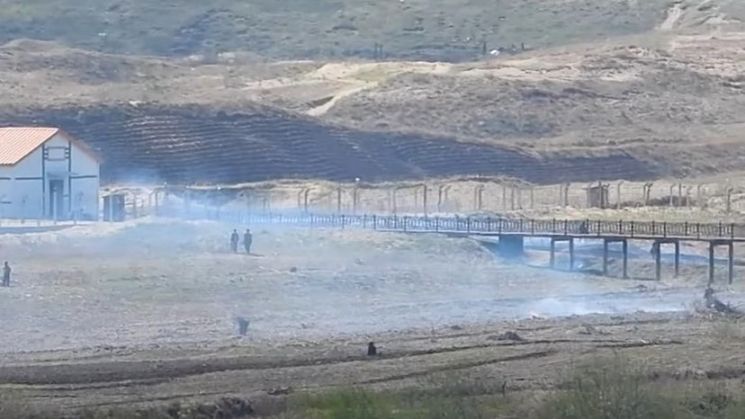 The appearance of North Korean residents beyond the Tumen River railway bridge in the North Korea-Russia border area, photographed in late May. You can see fields being burned to cultivate farmland, or slopes next to military barracks being developed into farmland for "Saettangchajgi" (searching for new land).
 [Photo by Dongwan Kang, Professor at Dong-A University]
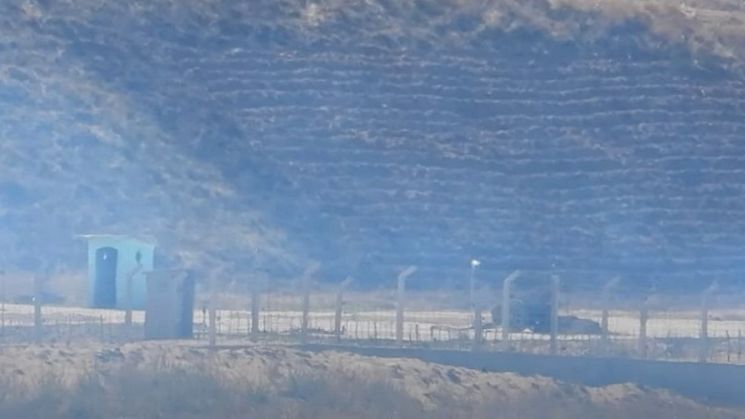 The appearance of North Korean residents beyond the Tumen River railway bridge in the North Korea-Russia border area, photographed in late May. You can see fields being burned to cultivate farmland, or slopes next to military barracks being developed into farmland for "Saettangchajgi" (searching for new land).
 [Photo by Dongwan Kang, Professor at Dong-A University]
Professor Kang, who researches the conditions of North Korean overseas dispatched workers, is reportedly collecting data while traveling between Russia and Mongolia. Regarding the scenes captured in the border area, he explained, "This is a method that is no longer commonly used in our country, where land is burned to create slash-and-burn fields (hwajeon)." He added, "The slopes around the military barracks have all been plowed into fields, which is the result of North Korea's ongoing emphasis on finding new land."
North Korea has recently been focusing on 'finding new land.' The directive is to find unused land and reclaim it as rice paddies or fields. This guideline is also confirmed through state-run media. The Workers' Party's official newspaper, Rodong Sinmun, in an article titled "What Am I Contributing to Filling the Nation's Rice Granaries?" published in April ahead of the rice planting season, listed tasks such as ▲finding new land ▲reclaiming tidal flats ▲producing agricultural machinery. It urged, "Anyone who eats rice should be concerned about agricultural issues," and emphasized, "Those who create new land inch by inch are the great patriots of our era."
For North Korea, May and June are very important months for rice planting. Rodong Sinmun has been reporting daily on the 'rice planting battle,' encouraging achievements by region. As captured in Professor Kang's photos, it appears that even the Korean People's Army has been mobilized to assist with farming. On May 10, Daily NK, a North Korea-focused media outlet, cited an internal military source stating, "The General Staff Department has designated May and June as a period of total mobilization of the People's Army units for socialist economic construction." This is interpreted as an intention to concentrate military resources on food production ahead of the July summer training.
Will Increasing Land Solve Food Shortages? ... North Korea Says "Find New Land"
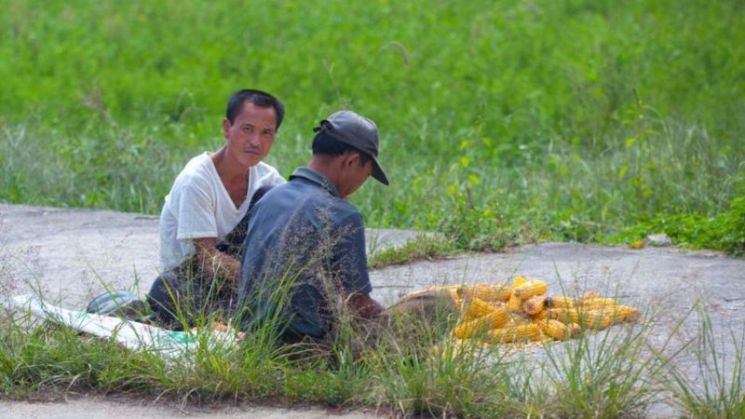
North Korea, with its many mountainous areas, has been obsessed with increasing arable land since the era of President Kim Il-sung. This dates back 70 years. At the 1953 Party Plenary Meeting, Kim Il-sung emphasized, "Because our country has very little arable land, obtaining 'new land' to expand arable land is very important for agricultural development." Since then, through the Kim Jong-il and Kim Jong-un eras, reclamation of tidal flats has also been consistently emphasized. The aim is to overcome the lack of farmland due to geographical characteristics by pioneering new fields.
Especially this year, the third year of the 'Five-Year Economic Development Plan,' Chairman Kim Jong-un is under pressure to show noticeable economic achievements to the people. The impact of COVID-19 in the first and second years likely hindered achieving the planned results. Since the Party Plenary Meeting at the end of last year through early this year, the North Korean authorities have focused on creating momentum to drive economic sector achievements. The unusual order to 'fully mobilize' the People's Army during the rice planting season is interpreted as reflecting the Party leadership's intentions.
However, it is uncertain whether simply increasing farmland through this outdated method can solve the food shortage. There are also concerns about side effects caused by 'finding new land.' Choi Kyung-hee, head of the Sand Research Institute, pointed out, "North Korea has been promoting finding new land and tidal flat reclamation at a national level since the 1980s," but added, "This cannot be a fundamental solution to the food crisis." She warned, "No matter how much idle land you look for, it is mountainous areas. Because trees are cut down and roots uprooted, heavy rains cause landslides and floods, creating a vicious cycle."
"The Enemy's Malicious Schemes"... North Korea Blinds and Deafens Its People
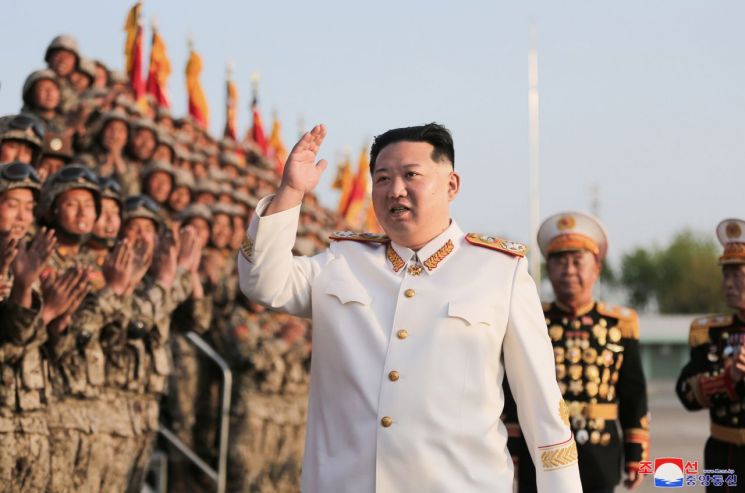 North Korea's Kim Jong-un, April 2022 Celebration Parade for the 90th Anniversary of the Founding of the Korean People's Revolutionary Army
It is highly likely that the North Korean leadership is aware that 'finding new land' is not the answer. Yet, the reason they pressure residents to increase cultivated land is believed to be for 'control.' The Kim Jong-un regime has promoted nuclear development as an 'all-powerful sword,' claiming that possessing nuclear weapons will solve all difficulties. However, in reality, nuclear development triggered international sanctions against North Korea, and amid isolation, food shortages have worsened, making people's lives more difficult.
North Korea's intention to hide this situation is clearly reflected in state media. According to Rodong Sinmun reports, the North Korean authorities define the 'finding new land' campaign as "a part of the struggle to crush the enemy forces' malicious schemes and to demonstrate the example of socialist Korea advancing under the banner of self-reliance." They blame the root cause of the food shortage on hostile forces and indoctrinate the people that through finding new land, they can achieve victory in self-reliance.
Choi Kyung-hee of the Sand Research Institute predicted, "After mobilizing the entire population for farming until June, they will seek to increase cohesion through successive political anniversaries." North Korea is approaching major monthly anniversaries this year, including the 70th anniversary on July 27, the Victory Day marking the founding year (a milestone year counted every 5 or 10 years), August 15, the Day of National Liberation which celebrates Kim Il-sung's liberation of the people from Japanese rule, and September 9, the Foundation Day. Choi forecasted, "They will try to maximize agricultural achievements to hold a grand military parade on Victory Day."
© The Asia Business Daily(www.asiae.co.kr). All rights reserved.
![Clutching a Stolen Dior Bag, Saying "I Hate Being Poor but Real"... The Grotesque Con of a "Human Knockoff" [Slate]](https://cwcontent.asiae.co.kr/asiaresize/183/2026021902243444107_1771435474.jpg)


















