Hankyung Research Institute Analyzes Trends of Involuntary Part-Time Workers from 2012 to 2022
The annual average growth rate of involuntary part-time workers was 2.5%, which is 1.8 times higher than the growth rate of wage workers. The Korea Economic Research Institute (KERI) advised that this is evidence that the quality of employment in South Korea is rapidly deteriorating and that efforts to ease labor market rigidity are necessary.
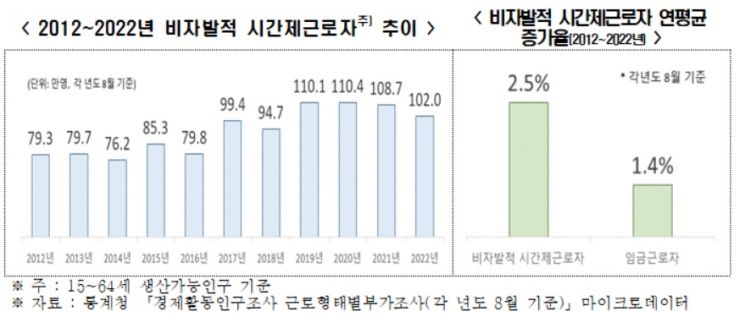
On the 11th, KERI announced that from 2012 to 2022, the annual average growth rate of involuntary part-time workers was 2.5%, which is 1.8 times higher than the overall wage workers' annual average growth rate of 1.4%. As of last year, the number of involuntary part-time workers was 1.02 million, an increase of 227,000 from 793,000 ten years ago.
Over the past 10 years, the trend of involuntary part-time workers by age group showed that those aged 50 and above increased from 287,000 in 2012 to 470,000 in 2022, recording the highest annual growth rate of 5.0%. During the same period, the youth group (ages 15-29) increased from 227,000 to 290,000, with an annual growth rate of 2.5%, and those in their 30s rose from 97,000 to 104,000, an annual growth rate of 0.7%. In contrast, the 40s age group decreased from 182,000 to 156,000, with an annual decline of 1.6%.
KERI interpreted that the youth group was forced to choose part-time work due to the frozen hiring market, while the older age group had no choice but to take part-time jobs due to business closures and recommended layoffs.
Among involuntary part-time workers last year, 6 out of 10 (60.8%) were 'livelihood-type' workers who sought jobs because they needed immediate income for living expenses. In particular, the proportion of livelihood-type part-time workers increased by 7.8 percentage points over 10 years, from 9.4% in 2012 to 17.2% in 2022.
Analyzing the trend of livelihood-type part-time workers by age group over 10 years, the youth group (ages 15-29) showed the highest annual growth rate of 6.6%, increasing from 71,000 in 2012 to 134,000 in 2022. Those aged 50 and above increased from 234,000 to 361,000, with an annual growth rate of 4.4%. This contrasts with the 30s (annual average -1.7%) and 40s (annual average -4.4%) age groups, where livelihood-type part-time workers decreased during the same period.
The fastest increase in livelihood-type part-time workers among the youth over the past 10 years is due to the lack of quality jobs, which has prolonged job search periods, leading more young people to secure living expenses through part-time jobs. Compared to OECD countries, South Korea's proportion of involuntary part-time workers is high. In 2021, the proportion of involuntary part-time workers among all part-time workers in South Korea was 43.1%, ranking 7th among the 30 OECD countries surveyed. This is 1.5 times the OECD 30-country average of 29.1%.
Choo Kwang-ho, Director of Economic Policy at KERI, said, "The fact that the increase in involuntary part-time workers over the past 10 years was steeper than that of wage workers means that the jobs desired by job seekers were not sufficiently supplied," adding, "Efforts to enhance private sector vitality through regulatory reform and to ease labor market rigidity are necessary to create more quality jobs."
© The Asia Business Daily(www.asiae.co.kr). All rights reserved.

















