On the 9th, Air Premia announced that it received approval from the Ministry of Land, Infrastructure and Transport on the 4th to extend the maximum diversion time of its aircraft, the Boeing 787-9 (hereinafter B787-9), to 180 minutes under the 'Extended Diversion Time Operation (EDTO)' regulation. This achievement comes about eight months after launching its Los Angeles (LA) route in October last year, marking the start of its operations on transpacific routes.
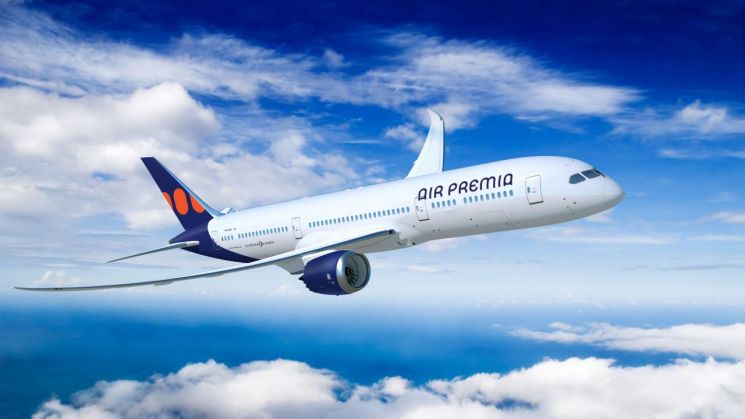
Having obtained the EDTO-180 rating, Air Premia will now be able to operate medium- to long-haul routes along the same flight paths as major domestic and international full-service carriers (FSCs). Consequently, the airline’s recent acceleration in expanding its long-haul routes to the Americas and Europe is expected to gain further momentum.
EDTO refers to regulations concerning the allowable flight time for twin-engine aircraft to divert to an alternate airport on a single engine in case one engine fails during flight. For example, an aircraft certified for EDTO-120 must be able to make an emergency landing at a nearby airport within 120 minutes immediately after one engine fails during flight.
Airlines receive EDTO approval from internationally accredited organizations or respective national governments based on the engine condition and operational experience of their aircraft. In South Korea, aircraft must obtain EDTO approval from the Ministry of Land, Infrastructure and Transport in accordance with Article 74 of the Aviation Safety Act. The maximum diversion time for twin-engine aircraft starts at a basic 60 minutes and can be increased to 75, 120, 180, or 207 minutes with government approval upon meeting certain criteria for each segment.
The reason airlines seek higher EDTO certification levels is that longer maximum diversion times allow for more efficient route selection. Particularly for European routes, which must pass over land according to Korean standards, there are many alternate airports available for emergency landings. However, for transpacific routes to the Americas, the EDTO rating becomes a critical factor.
For instance, if an EDTO-75 aircraft is deployed on a transpacific route, it must fly closer to land so that it can make an emergency landing within 75 minutes in case of engine failure, which increases flight time. Even if both engines are operating normally, if the designated alternate airport is unavailable due to adverse weather or other operational issues, the flight schedule must be delayed or rerouted until the problem is resolved.
On the other hand, an EDTO-180 aircraft only needs to land at an alternate airport within 180 minutes in an emergency, allowing it to use more efficient and stable routes that cross oceans while maintaining distance from land. This is why flight times can vary between airlines and aircraft even on the same route.
Currently, Air Premia operates a total of five B787-9 Dreamliners and has been flying the LA route since receiving EDTO-120 certification in September last year. In May, it launched its second transpacific route to New York. With the recent approval of EDTO-180, it is expected that the airline’s strategy to expand long-haul routes to the Americas and Europe will accelerate further.
Geum Chang-hyun, Head of Passenger Business at Air Premia, stated, “With the EDTO-180 approval, Air Premia can now operate long-haul flights on the same routes as major domestic and international full-service carriers (FSCs). This will reduce the possibility of delays caused by adverse weather conditions along the route and expand the range of alternate airports, enabling more stable route operations.”
© The Asia Business Daily(www.asiae.co.kr). All rights reserved.
![Clutching a Stolen Dior Bag, Saying "I Hate Being Poor but Real"... The Grotesque Con of a "Human Knockoff" [Slate]](https://cwcontent.asiae.co.kr/asiaresize/183/2026021902243444107_1771435474.jpg)
















