Half of April Jeonse Households Face Reverse Jeonse Risk
Deputy Prime Minister Choo Kyung-ho: "Jeonse Deposit Return Loans Will Be Exempt from DSR Regulations"
The government is considering easing the Debt Service Ratio (DSR) loan regulations solely for the purpose of returning jeonse deposits to resolve the severe reverse jeonse crisis. As the situation worsens, with one out of every two households living in jeonse exposed to reverse jeonse risks, it appears that the government has hurriedly introduced countermeasures. Experts evaluate that the DSR loan easing measure could help curb instability in the jeonse market but also point out that it may encourage contract practices such as tenants using new loans to repay old ones.
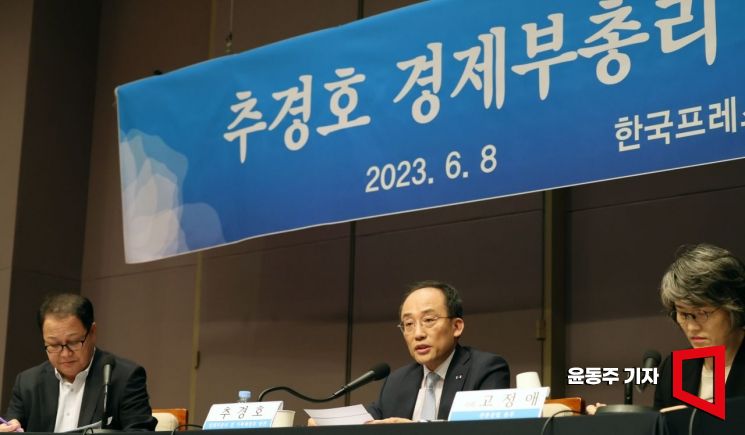 Deputy Prime Minister for Economy Choo Kyung-ho is delivering opening remarks at the Economic Deputy Prime Minister Invitation Kwanhoon Forum held at the Press Center in Jung-gu, Seoul on the 8th. Photo by Dongju Yoon doso7@
On the 8th, Deputy Prime Minister and Minister of Economy and Finance Choo Kyung-ho said at the Kwanhun Forum held at the Taepyeongno Press Center in Seoul, "We are considering temporarily easing the DSR regulations only for the purpose of returning jeonse deposits," adding, "We will ease the regulations by July at the latest."
Specifically, it seems that the easing will apply only to the difference between the existing deposit and the new deposit. For example, if the previous jeonse price was 500 million won and the current jeonse price is 300 million won, the DSR application will be relaxed when the landlord borrows the 200 million won difference from the bank.
Experts have evaluated Deputy Prime Minister Choo’s announcement on easing DSR loans as a temporary loan regulation measure to resolve the reverse jeonse problem, which can block instability in the jeonse market, and if the government’s policy goal is to protect ordinary citizens, it aligns with that purpose.
According to data from the Bank of Korea on the status and implications of "empty shell jeonse" and reverse jeonse, as the housing market has continued to decline since the second half of last year, the proportion of households at risk of empty shell jeonse among remaining jeonse contracts surged nearly threefold from 2.8% (56,000 households) in January last year to 8.3% (163,000 households) in April this year. During the same period, the proportion of households at risk of reverse jeonse doubled in 15 months from 25.9% (517,000 households) to 52.4% (1,026,000 households).
Seo Jin-hyung, co-representative of the Fair Housing Forum and professor at Gyeongin Women’s University, forecasted, "This can have a positive effect by allowing tenants to move freely and thus activate lease transactions, and landlords will have more time to secure funds, which can block jeonse market instability caused by reverse jeonse concerns."
Park Hap-soo, adjunct professor at Konkuk University Graduate School of Real Estate, said, "There are criticisms about whether landlords who bought houses through gap investment by raising jeonse deposits should also be protected, but the purpose of this policy should be seen as emphasizing the protection of tenants’ deposits for the ‘protection of ordinary citizens’ rather than helping landlords secure deposits."
However, some experts expressed concerns that it could exacerbate the already risky household debt problem. Park Won-gap, senior real estate specialist at KB Kookmin Bank, suggested, "It will help to quickly put out the urgent fire of the reverse jeonse crisis, but considering the serious household debt, it needs to be implemented temporarily and restrictively."
There are also criticisms that it may encourage contract practices such as tenants using new loans to repay old ones. Seung Seung-hyun, CEO of City and Economy, said, "This is not a fundamental solution to the current reverse jeonse problem but a structure that shifts the burden of returning deposits to the next tenant. If housing prices fall further or the landlord’s financial situation worsens, the new tenant may not be able to recover the jeonse deposit as they will be behind the bank’s senior claims."
Meanwhile, it is known that there are differing opinions within policy authorities regarding the DSR easing measure. The Ministry of Economy and Finance and the Ministry of Land, Infrastructure and Transport view the DSR regulation easing positively, while financial authorities argue that DSR regulations should be eased cautiously due to concerns such as landlords’ moral hazard.
At the end of last year, the Bank of Korea warned in its Financial Stability Report that DSR regulations should be stricter for landlords. The report stated, "It is necessary to consider repayment ability more strictly for loans that may be used for investment purposes by borrowers who own housing." Just as jeonse loans have been partially used for gap investment, increasing household debt, this DSR easing measure could become a way to support gap investment.
© The Asia Business Daily(www.asiae.co.kr). All rights reserved.

















