Eurozone Q1 Growth Rate -0.1%
Negative for 2 Consecutive Quarters
Germany and Ireland Offset Growth Rate
The economies of the 19 Eurozone countries have entered a technical recession after contracting for two consecutive quarters. To prevent inflation from becoming entrenched and to maintain confidence in the inflation target, the European Central Bank (ECB) is expected to continue its tightening measures even during the recession phase.
On the 8th (local time), Eurostat, the statistical office of the European Union (EU), announced that the confirmed GDP growth rate for the Eurozone in the first quarter decreased by 0.1% compared to the previous quarter. This reversed the earlier preliminary and revised estimates, which had shown a 0.1% positive growth. Eurostat also revised the GDP growth rate for the fourth quarter of last year from 0% to a 0.1% decline. As a result, the Eurozone economy contracted for two consecutive quarters, entering a technical recession.
Among the Eurozone countries, Germany, the largest economy, recorded a GDP growth rate of -0.3% in the first quarter. Following a -0.5% contraction in the fourth quarter of last year, Germany has entered a technical recession with two consecutive quarters of negative growth. France, the second largest economy in the Eurozone, continued its positive growth streak for four consecutive quarters. France's GDP in the first quarter increased by 0.2% compared to the previous quarter.
The country with the lowest economic growth rate in the Eurozone in the first quarter was Ireland (-4.6%). The Wall Street Journal (WSJ) analyzed that the weakness in Germany and Ireland offset the overall growth rate of the Eurozone. WSJ pointed out that "the production decline by U.S.-based pharmaceutical companies in Ireland, which had experienced rapid growth for a long time, caused a 44.7% plunge in Ireland's factory output in March." Although the Irish Central Statistics Office did not provide specific reasons for the production decline, the 70.7% rebound in factory output in April suggests that the economic contraction is unlikely to persist.
Ireland has successfully attracted multinational corporations worldwide by offering aggressive tax incentives at about half the level of the Eurozone average, thereby boosting its economic growth momentum. Especially after Brexit, financial companies from the UK have moved to places like Dublin, Ireland, enjoying various advantages. As a result, Ireland's economic growth rate last year was 15.7%, significantly exceeding the Eurozone average growth rate of 1.9%.
The Eurozone's overall economic growth rate is also expected to slow significantly this year. The Organisation for Economic Co-operation and Development (OECD) forecasted yesterday that the Eurozone's economic growth rate will plunge from 3.5% last year to 0.9% this year. This is about half the U.S. economic growth rate (1.6%), and the OECD analyzed that this sluggish growth is due to persistent inflation and the resulting decline in consumption.
The surge in energy prices in the Eurozone, which was most directly affected by the Ukraine war, has normalized, but food prices continue to rise rapidly, weakening household spending on goods and services. The OECD expects "the Eurozone inflation rate to fall from 8.4% last year to 5.8% this year," but also predicts that "it will still significantly exceed the ECB's inflation target of 3.2% next year."
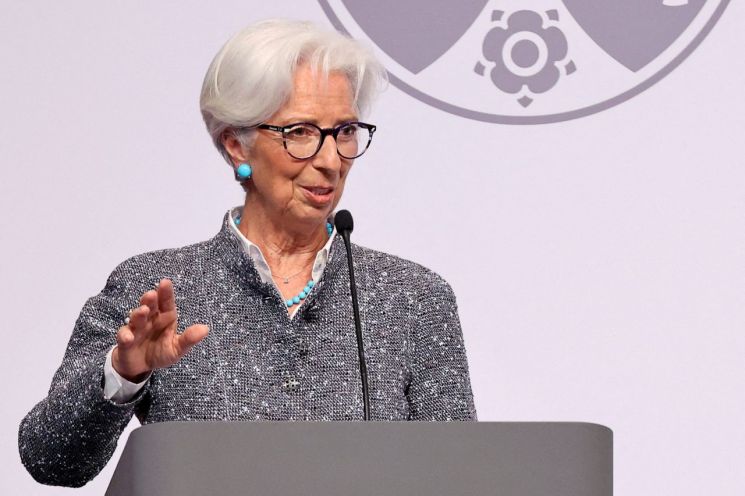
The ECB judges that the easing of inflationary pressures is still far off, so tightening measures are expected to continue even during the recession phase. Isabel Schnabel, an ECB Executive Board member, said, "It is not enough to declare victory over inflation just because it has peaked," adding, "We need to wait for more convincing evidence that inflation is returning to the target range of around 2%."
The WSJ reported, "There is an assessment that this recession is not dramatic enough for the ECB to halt its rate hikes," and noted that factors hindering Eurozone growth are likely to persist over the coming months. The ECB is expected to raise its key interest rate from the current 3.75% to 4.0% at the monetary policy meeting on the 15th.
© The Asia Business Daily(www.asiae.co.kr). All rights reserved.
![Clutching a Stolen Dior Bag, Saying "I Hate Being Poor but Real"... The Grotesque Con of a "Human Knockoff" [Slate]](https://cwcontent.asiae.co.kr/asiaresize/183/2026021902243444107_1771435474.jpg)
















