Increasing Cargo Operation Efficiency by Liquefying Evaporated Gas
Reducing Carbon Dioxide Emissions by Preventing Combustion
"Providing Various Ship Modification Solutions
Contributing to Global Warming Response"
HD Hyundai's ship service subsidiary, HD Hyundai Global Service, has secured the first contract in Korea for the modification of LNG carriers with re-liquefaction facilities that reduce carbon dioxide emissions.
HD Hyundai Global Service announced on the 9th that it recently signed a contract with the Norwegian shipping company 'CoolCo' for the re-liquefaction facility modification project. HD Hyundai Global Service plans to install re-liquefaction facilities that suppress the generation of BOG (Boil Off Gas) on five LNG carriers operated by CoolCo. The contract amount is 10 million USD (approximately 13 billion KRW) per vessel. This modification is expected to reduce about 7,000 tons of carbon dioxide emissions annually per vessel. HD Hyundai Global Service will oversee the entire process, starting from design and engineering for installing the re-liquefaction facilities on LNG carriers, to procuring the necessary re-liquefaction equipment and materials, and carrying out the installation work.
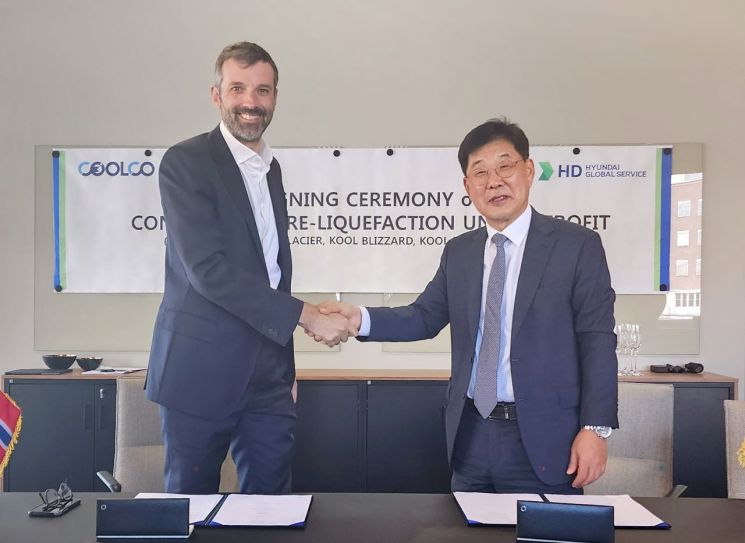 Lee Ki-dong, CEO of HD Hyundai Global Service, and Richard Tyrell, CEO of the Norwegian shipping company Cool Company LTD., are posing for a commemorative photo after recently signing a contract for the retrofit of LNG carrier reliquefaction facilities.
 [Photo by HD Hyundai Global Service]
Dual-fuel electric propulsion LNG carriers without re-liquefaction facilities consume BOG as fuel while underway, but cannot use it when the vessel speed decreases or when berthed. To maintain the pressure inside the cargo tanks, BOG must be vented into the atmosphere or forcibly combusted. This results in cargo loss and greenhouse gas emissions. Re-liquefaction facilities re-liquefy BOG and return it to the cargo tanks or use subcooled LNG to prevent natural vaporization, thereby reducing LNG cargo loss. Since there is no need to combust BOG, carbon emissions can also be reduced. Currently, it is known that there are about 100 LNG carriers worldwide without re-liquefaction facilities installed. Additional modification contracts are expected in the future.
CEO Lee Ki-dong said, “We are receiving inquiries about re-liquefaction facility modification projects from customers around the world,” and added, “We will participate in efforts to address global warming by providing various ship modification solutions.” CoolCo CEO Richard Tyrell stated, “This will enhance the long-term value and competitiveness of LNG carriers while reducing their carbon footprint.”
© The Asia Business Daily(www.asiae.co.kr). All rights reserved.

















