Over 500 Cases of Technology Theft by Large Corporations Annually
Experts Say "Compensation Should Include R&D Costs"
As acts such as stealing the core and technology of products under development by startups to create similar products have recently increased significantly, a series of accusations between startups claiming damages and large corporations are ongoing. Although the political sphere is also stepping up to devise countermeasures, considering that over 500 cases of technology theft occur annually, there are calls for high-intensity measures such as increasing penalties.

Violations of the Unfair Competition Prevention Act increased by 30% in one year... Accusations continue
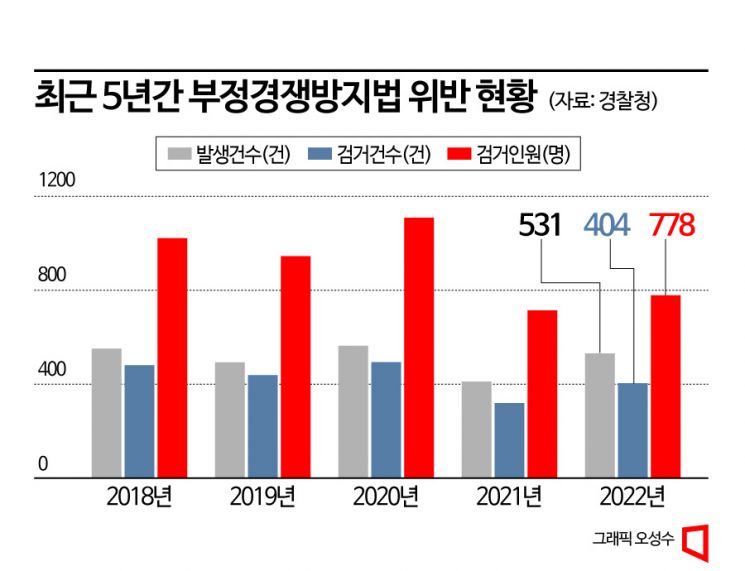
According to the National Police Agency on the 9th, there were a total of 531 cases of violations of the Unfair Competition Prevention Act last year, a 29.1% increase from 411 cases in 2021. During the same period, the number of arrests rose by 64 to 778. Over the past five years, cases of stealing technology from startups or secretly leaking trade secrets while moving to competing companies have reached 400 to 500.
The Unfair Competition Prevention Act was established to prevent acts such as the unauthorized use of widely known trademarks or trade names of others, or infringement of others' trade secrets. Violations are punishable by imprisonment of up to three years or fines of up to 30 million KRW.
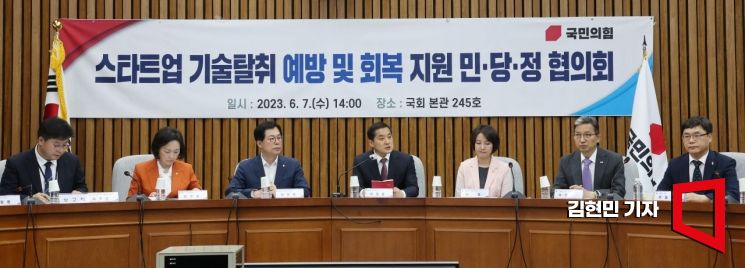 Park Dae-chul, Chairman of the Policy Committee of the People Power Party, is speaking at the Startup Technology Theft Prevention and Recovery Inter-Party Council held at the National Assembly on the 7th. Photo by Hyunmin Kim kimhyun81@
According to a comprehensive report by Asia Economy, the police are investigating a case in which the Citizens' Committee for the Protection of the Livelihood of the Common People filed a complaint against the chairman of LG Group on charges of violating the Unfair Competition Prevention Act and fraud on the 22nd of last month. The Seoul Metropolitan Police Agency recently assigned the case to the Seoul Suseo Police Station.
The Citizens' Committee claims that LG infringed trade secrets by proposing collaboration with Prinker Korea, a startup that manufactures disposable tattoo devices, with the purpose of stealing technology. Previously, Prinker Korea stated that LG Household & Health Care had proposed technological collaboration and supply, and after signing a confidentiality agreement, communication was cut off.
On the other hand, LG denied the allegations and filed a defamation suit against Prinker Korea under the Information and Communications Network Act. LG Household & Health Care told Asia Economy, "We are currently drafting a mutual agreement through mediation by the Win-Win Growth Committee and are seeking a consensus. If an agreement is reached, the complaint will be withdrawn."
Additionally, Lotte Healthcare decided to withdraw its related business on the 7th after allegations of technology theft regarding its pill dispenser (dosage supply device) arose. Bang Seong-bo, CEO of Kiuso, who developed a free application for farm management and was recognized for innovation at the NongHyup contest, also complained of damages, claiming that an app copying his company's functions was created.
Ruling party and government to increase punitive damages to 5 times... 'Research and development costs' included in damage calculation
As technology theft damages to startups continue, the political sphere is busy with prevention and recovery measures. On the 7th, the ruling party and government held a meeting on prevention and recovery support for startup technology theft and announced that punitive damages for startup technology theft will be increased from the current three times to five times.
On March, Yang Geum-hee, a member of the People Power Party, also announced a partial amendment bill to the Unfair Competition Prevention Act. The amendment includes strengthening corporate fines for trade secret infringement to three times that of the perpetrator (extending the statute of limitations for corporate prosecution to 10 years) and establishing confiscation regulations for goods arising from trade secrets.
Experts advise that practical responses such as increasing penalties are necessary.
Kim Kyung-hwan, lead attorney at the law firm Minhoo, said, "It is necessary to reflect input costs such as research and development expenses in the calculation of damages, and penalties should also be increased." He added, "It is very difficult for victims to prove the leakage route, so making the perpetrator prove that they did not commit the theft could be an alternative."
© The Asia Business Daily(www.asiae.co.kr). All rights reserved.
![Clutching a Stolen Dior Bag, Saying "I Hate Being Poor but Real"... The Grotesque Con of a "Human Knockoff" [Slate]](https://cwcontent.asiae.co.kr/asiaresize/183/2026021902243444107_1771435474.jpg)


















